Dicumyl Peroxide (DCP) in EVA Foam: Crosslinking & Curing
- Damao Tech
- EVA Foam , Gloves
- 22 May, 2025
This technical guide to Dicumyl Peroxide (DCP) in EVA foam analyzes the chemical crosslinking process that defines the material’s final physical properties. Precisely managing the DCP concentration and curing protocol is the most direct way to optimize the resilience and thermal stability of your EVA foam products.
In our experience at Damao, achieving peak performance requires more than just correct dosing; it requires a deep understanding of reaction kinetics. By matching the crosslinking speed to your blowing agent’s decomposition, you can ensure a uniform closed-cell structure across entire production batches. For foundational material data, visit our EVA foam pillar page.
The Chemical Mechanism of DCP Crosslinking
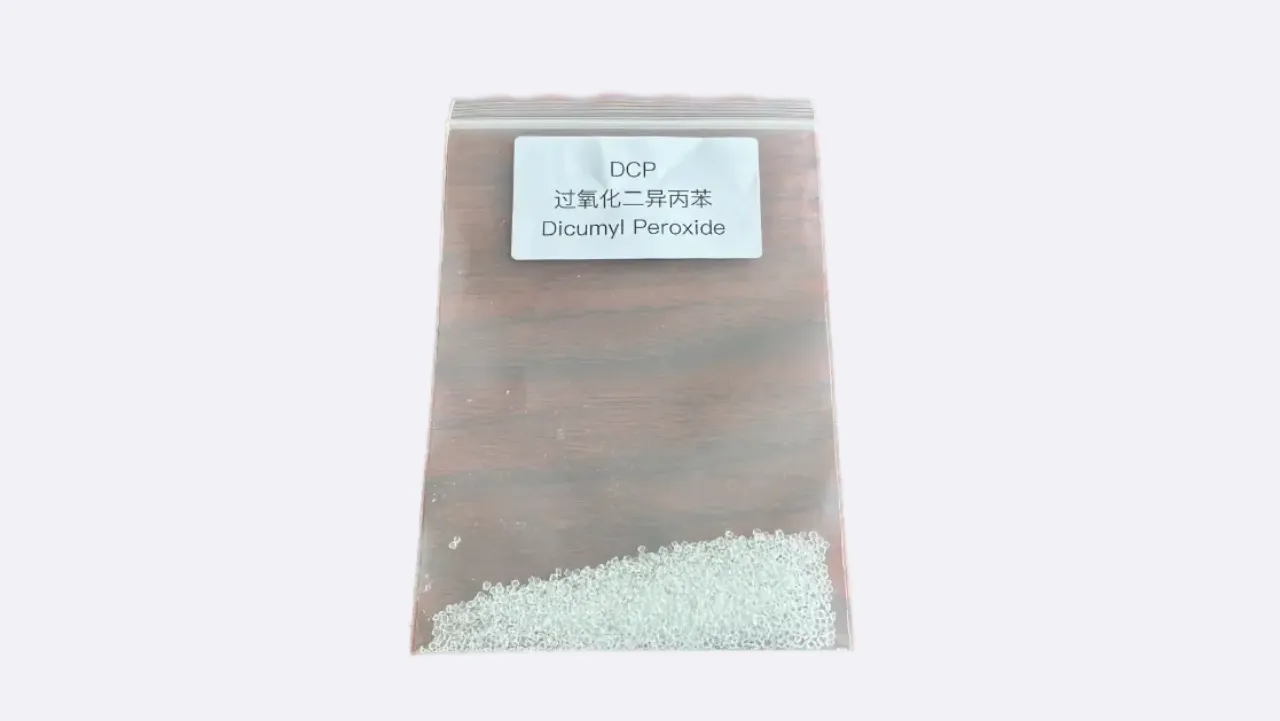
Crosslinking is the chemical process of forming covalent C-C bonds between linear polymer chains of Ethylene-Vinyl Acetate (EVA). Dicumyl Peroxide (C18H22O2) serves as the free-radical initiator that triggers this transformation during the vulcanization stage.
- Decomposition: When heated above 120°C, DCP molecules decompose into reactive cumyl radicals.
- Radical Abstraction: These radicals remove hydrogen atoms from the EVA polymer backbone, creating highly reactive polymer sites.
- Network Formation: The polymer sites bond together, creating a stable three-dimensional thermoset network that cannot be remelted once cured.
This technical network provides the “memory” effect in EVA foam, allowing it to recover its shape after impact. Without DCP, the material would remain a viscous liquid under high heat, failing to maintain the cell wall integrity needed for cushioning.
Synergy Between DCP and Blowing Agents
The synergy between crosslinking and foaming is the simultaneous management of material viscosity and gas release. If crosslinking occurs too early (scorch) or too late, the expanding gas will either be trapped in a rigid matrix or escape the material entirely, leading to collapsed cells.
Engineers at Damao typically use AC (Azodicarbonamide) as the primary foaming agent. The curing temperature of DCP must be calibrated to match the AC decomposition window so the melt strength is high enough to contain the bubbles. Optimized crosslinking supports more uniform cell walls, which improves resilience, compression behavior, and energy return in footwear midsoles.
Managing the Acetophenone Byproduct
Acetophenone is the primary volatile byproduct of DCP decomposition. While DCP is highly effective for curing, its conversion products can introduce a distinct “vinegary” odor and a characteristic yellow tint to lighter-colored foams if not managed correctly.
To minimize these effects, high-quality manufacturers implement two-stage vacuum devolatilization or post-curing heating cycles. These processes help draw the residual acetophenone out of the foam matrix, ensuring the final product meets the stringent TVOC (Total Volatile Organic Compound) standards required for automotive and medical applications.
DCP Troubleshooting Guide for Engineers
Use this troubleshooting guide to identify and correct common defects caused by improper DCP dosing or curing temperatures.
| Defect | Root Cause | Technical Solution |
|---|---|---|
| Radial Cracking | Over-crosslinking (Too much DCP) | Reduce DCP dosage / Shorten cure time |
| Radial Shrinkage | Under-crosslinking (Melt strength too low) | Increase DCP / Verify temperature |
| Vinegar Odor | Residual Acetophenone | Increase post-curing de-volatilization |
| Starry Patterns | Premature curing (Scorch) | Lower internal mixing temperature (<120°C) |
| Yellowing | Peroxide oxidation | Check antioxidant compatibility |
DCP vs. BIPB: Processing Window Comparison
Peroxide selection involves choosing between Dicumyl Peroxide (DCP) and Bis(tert-butylperoxy isopropyl)benzene (BIPB) based on your specific manufacturing constraints. Each offers a different thermal window and odor profile.
- DCP: The industry standard for curing between 150°C and 175°C. It offers the most consistent results for standard density foams (80–150 kg/m³).
- BIPB: Preferred for lower-temperature curing (130°C – 150°C) and applications requiring minimal odor. BIPB is often chosen for high-hardness foams (Shore A >65) where surface appearance is a priority.
Partner with Damao for Technical Excellence
Managing the complex chemistry of peroxides and blowing agents requires state-of-the-art manufacturing controls. At Damao, we provide the technical expertise needed to ensure your custom EVA foam formulations perform flawlessly in their final application.
Ready to improve your foam’s resilience and durability? Contact Damao today to discuss your technical specifications and request a material sample. equirements or request a sample!**