How to Specify Custom EVA Foam: A Technical Guide
- Damao Tech
- EVA Foam
- 28 Jun, 2025
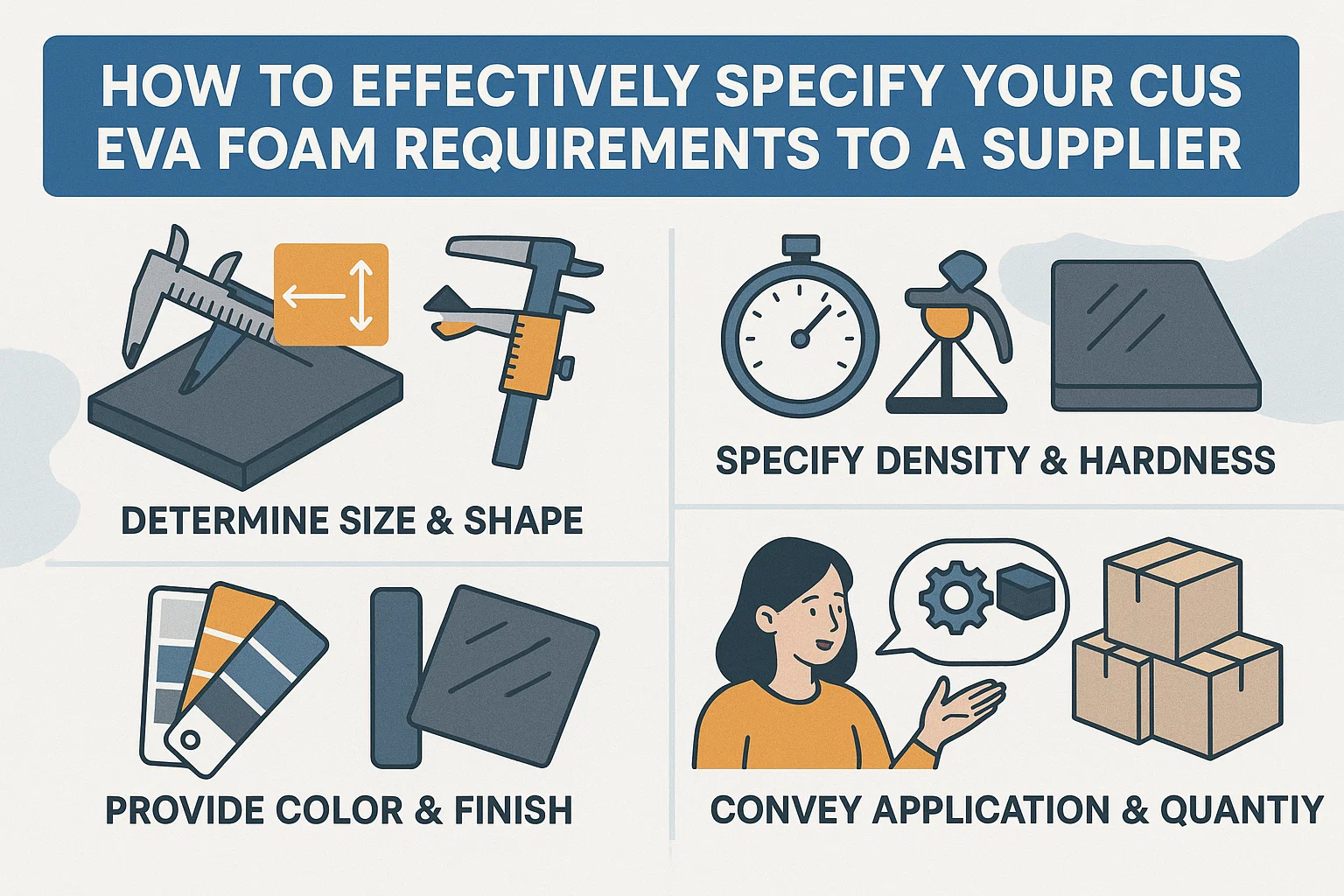
This guide on how to specify custom EVA foam requirements helps procurement managers provide the technical data needed for accurate manufacturing. Effectively communicating your material needs prevents costly production delays and ensures the final product meets your application’s safety standards.
In our experience at Damao, vague specifications often lead to prototypes that fail to meet performance expectations. By bridging the gap between design and manufacturing with precise benchmarks, you can reduce waste and speed up your time-to-market. For a foundational understanding of the material, visit our EVA foam pillar page.
The Role of VA Content in Material Selection
VA content is the percentage of vinyl acetate used in the copolymerization process of the foam. This chemical ratio is the primary driver of the final material’s flexibility, clarity, and rubber-like texture.
| VA Content | Flexibility | Durability | Best Use Case |
|---|---|---|---|
| 10% – 18% | Low | High | Structural parts, industrial flooring |
| 18% – 28% | Medium | Medium | General packaging, athletic footwear |
| 28% – 40% | High | Low | Soft medical pads, luxury unboxing |
When specifying your requirements, consider that higher VA content improves the foam’s ability to resist low temperatures without becoming brittle. However, it also makes the material stickier and potentially harder to fabricate using certain high-speed methods.
Industrial Benchmarks for Tolerances
Tolerances are the acceptable limits of variation in a foam part’s dimensions, typically measured in millimeters. Providing specific tolerance benchmarks ensures your EVA foam fits perfectly into its final assembly or enclosure.
Standard industry tolerances for EVA foam are generally broader than for rigid plastics or metals due to the material’s compressibility. For most CNC or die-cut parts, a tolerance of ±0.5mm to ±1.0mm is considered standard. If your application requires a high-precision fit, such as a localized gasket, specify “critical dimensions” to prioritize these measurements during quality control.
Ready-to-Send Specification Matrix
Use this technical matrix to organize your material needs. You can copy and paste this table directly into your request for quotation (RFQ) when contacting a supplier.
| Technical Parameter | Your Requirement | Benchmark Example |
|---|---|---|
| Core Material | Closed-cell EVA Foam | Technical Grade |
| Target Density | [Insert Value] kg/m³ | 45 kg/m³ |
| Shore Hardness | [Insert Value] A/C | Shore A 40 |
| VA Content | [Insert Value] % | 18% VA |
| Base Color | [Insert Pantone/RAL] | RAL 9005 (Black) |
| Critical Tolerance | ± [Insert Value] mm | ± 0.5 mm |
| Additives | [e.g., UV, ESD, FR] | UV Stabilized |
Avoiding 5 Common Prototype Errors
The prototype validation stage is the process of reviewing first-run samples before committing to a full production order. Catching these common specification errors early prevents large-scale manufacturing failures.
- Compression Mismatch: The foam feels “right” but takes a permanent set after being compressed once.
- Color Drifting: The sample color matches under office lights but looks different in the final product’s operating environment.
- Adhesive Failure: The backing fails to stick to the specific substrate surface (ensure you specify the surface material).
- Odor Release: High-VA foams can sometimes release a strong vinegary smell if not properly aired out.
- Scaling Errors: 3D CAD files might be misinterpreted if the units (inches vs. mm) are not clearly defined.
Verifying these five factors during the sampling stage helps prevent specification drift, reduces rework, and improves the likelihood that the first mass-production run matches the approved prototype.
Maximize ROI through Quantity and Tooling
Order quantity is the number of units ordered, which directly impacts the unit cost through economies of scale. Understanding the relationship between quantity and tooling costs helps you optimize your procurement budget.
Initial setup costs for custom die-cutting or injection molding can be high. However, these expenses are typically one-time charges that are amortized over larger production runs. To achieve the lowest cost-per-unit, discuss your projected annual volume with your supplier to determine if a multi-cavity tool or high-speed CNC process is more efficient for your needs.
Technical Documentation Checklist
A technical document is the combination of drawings and data sheets that defines your part’s requirements. Providing a digital documentation package is the best way to remove ambiguity from the manufacturing process.
- 2D Technical Drawings: PDF format with all critical dimensions and tolerances clearly labeled.
- 3D CAD Files: .STEP or .IGES formats are the industry standards for CNC and molding.
- Safety Data Sheets (SDS): Request these from your supplier to ensure the foam meets your local environmental regulations.
- REACH/RoHS Certificates: Essential for products being sold in European or automotive markets.
Partner with Damao for Material Sourcing
Choosing a supplier partner like Damao ensures you have access to technical experts who understand the nuances of material science. We guide you through the specification process to ensure your custom EVA foam performs exactly as designed.
Ready to start your custom project? Contact Damao today to discuss your technical specifications and request a material sample. For material grades and manufacturing capabilities, visit our custom EVA foam manufacturer page.