EVA Sole Material & Midsole Sourcing: Footwear Foam Engineering Guide
- Damao Tech
- EVA Foam
- 11 Sep, 2026
In global footwear manufacturing, EVA sole material represents over 70% of all midsole and unit-sole production across running shoes, athletic sneakers, casual footwear, and recovery slides.
Footwear engineers and procurement directors rely on Ethylene-Vinyl Acetate foam for its exceptional strength-to-weight ratio, tunable energy return, and versatile processing methods. However, specifying a generic “EVA sole” often results in premature compression set (bottoming out), inadequate grip, or bonding failures during bottom cementing.
At Damao Tech, we manufacture both the raw EVA foam materials and precision-converted EVA foam sheets for global shoe brands and footwear factories. This technical guide examines the chemical compounding, hardness grades, density variations, and quality benchmarks required to specify and source high-performance EVA shoe soles and midsoles.
For a step-by-step breakdown of factory machinery, read our companion guide on how EVA shoe soles are made.
1. What Is EVA Sole Material? (Polymer Chemistry & Compounding)
EVA sole material is a closed-cell elastomeric copolymer composed of ethylene and vinyl acetate, modified with chemical blowing agents and organic peroxides:
- Vinyl Acetate (VA) Content (18% – 28%): The VA percentage determines flexibility, crystal structure, and softness. Lower VA (14%–18%) produces stiffer, high-abrasion outsoles. Higher VA (24%–28%+) yields plush, ultra-elastic running midsoles.
- Crosslinking Agent (Dicumyl Peroxide / DCP): DCP forms permanent covalent crosslinks between polymer chains during heat pressing, providing elastomeric memory and preventing permanent deformation.
- Chemical Blowing Agent (Azodicarbonamide / AC): Thermally decomposes to release nitrogen gas (N₂), creating millions of microscopic, non-communicating closed cells.
- Elastomeric Modifiers (POE / OBC / EPDM): In performance athletic footwear, polyolefin elastomers (POE) or olefin block copolymers (OBC) are blended into the EVA matrix to boost rebound resilience above 65%.
2. The 3 Core Delivery Formats for Footwear Manufacturers
Depending on your shoe assembly method and production scale, Damao Tech supplies EVA sole materials in three distinct industrial formats:
| Supply Format | Typical Thickness / Density | Manufacturing Method | Primary Shoe Category |
|---|---|---|---|
| 1. Injection Molded Phylon Midsoles | 0.16 – 0.22 g/cm³ (45–52 Shore C) | Granule injection + secondary cold-press setting | Performance running shoes, basketball sneakers, trail shoes |
| 2. Compression Molded Unit Soles (CMP) | 0.20 – 0.30 g/cm³ (50–60 Shore C) | Direct hydraulic thermal compression of pre-forms | Sandals, recovery slides, clogs, casual boat shoes |
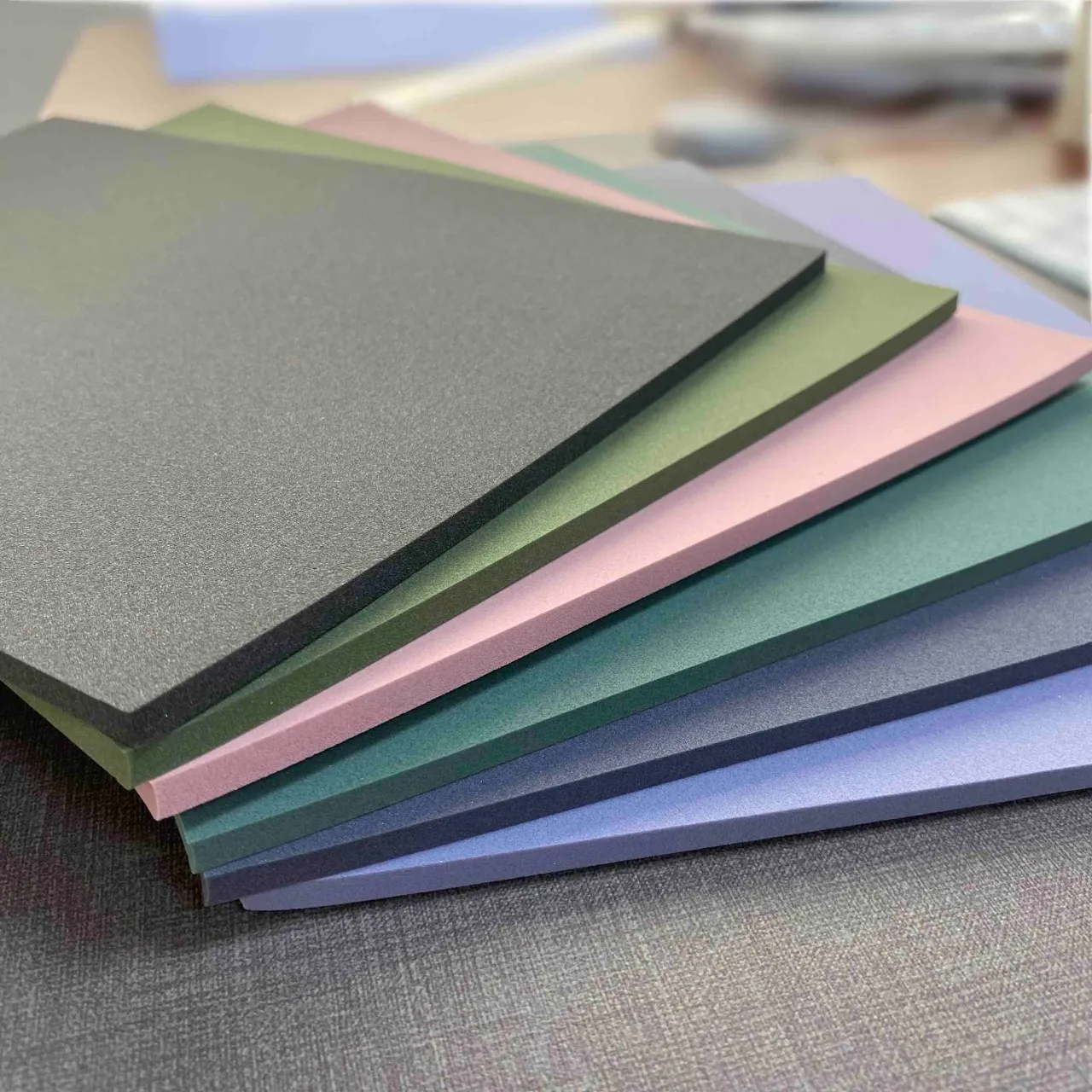
| 3. Die-Cut Skived Sheets | 1.5 – 30 mm (40–70 Shore C) | Continuous block splitting from EVA foam sheets | Orthotic insoles, wedge midsoles, vulcanized sneakers, work boot footbeds |
Phylon vs. Direct Compression EVA (CMP): What Is the Difference?
While traditional compression-molded EVA expands once directly in the mold, Phylon undergoes a proprietary two-step process: primary injection expansion followed by thermal re-pressing inside a secondary mold. Phylon yields a more consistent cell distribution, lighter net weight, and superior fine-line tooling definition for sculpted modern midsoles.
3. Shore C Hardness & Density Matrix for Shoe Applications
Selecting the correct Shore C durometer rating is the single most critical factor in balancing underfoot comfort with biomechanical stability:
| Footwear Component | Target Shore C Hardness | Target Density (g/cm³) | Performance Focus |
|---|---|---|---|
| Plush Cushioning Midsole | 40 – 46 Shore C | 0.15 – 0.18 | Maximum impact dampening, ultra-soft footstrike |
| Balanced Running Midsole | 48 – 53 Shore C | 0.18 – 0.22 | Optimal energy return, stability, and anti-fatigue |
| Dual-Density Medial Post | 58 – 65 Shore C | 0.25 – 0.30 | Pronation control, torsional stiffness |
| Single-Piece Unit Sole (Outsole) | 52 – 58 Shore C | 0.22 – 0.28 | Moderate abrasion resistance with integrated cushioning |
| Heavy-Duty Work Footbed | 60 – 70 Shore C | 0.28 – 0.35 | High structural memory, resistance to heavy load compression |
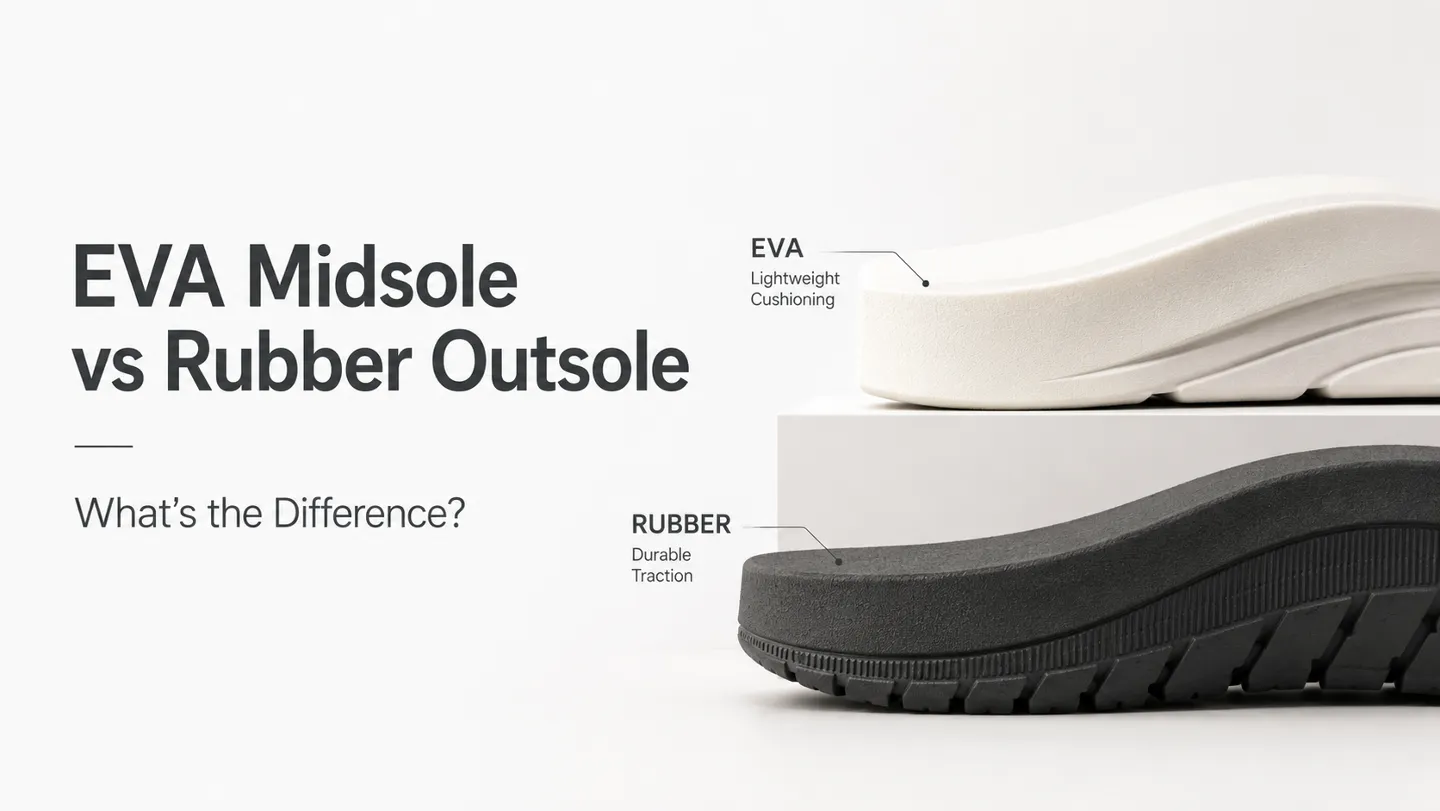
For a comprehensive comparison between EVA midsoles and traditional rubber tread outsoles, read our analysis on EVA Midsole vs Rubber Outsole.
4. Quality Control & B2B Testing Standards
When ordering wholesale EVA sole material from an OEM factory, always require lab verification based on standardized footwear testing protocols:
- Compression Set (ASTM D395, Method B / 22 hrs at 23°C): Must be strictly < 25% for athletic shoes and < 30% for casual footwear. Lower values ensure the shoe sole will not flatten over hundreds of miles.
- Rebound Resilience (ASTM D2632 - Test H): Performance running soles should achieve > 55% to 65% rebound. Standard casual grades achieve 40%–50%.
- DIN Abrasion Loss (DIN 53516): For unit-sole shoes where EVA directly contacts concrete, specify an abrasion loss of < 150 mm³. Standard midsoles bonded to rubber typically measure 200–250 mm³.
- Ross Flexing Resistance (ASTM D1052): Tested at room temperature and -10°C. High-grade EVA sole material must survive 50,000 flex cycles without crack growth exceeding 2 mm.
- Bonding Strength (SATRA TM404): EVA’s closed-cell surface has low surface energy. Before bottom cementing with PU or polychloroprene adhesives, the sole surface must be mechanically buffed and treated with a chemical primer to achieve peel strengths > 3.0 N/mm.
5. How to Source Custom EVA Sole Materials (RFQ Checklist)
To receive an accurate and competitive quotation from Damao Tech, provide the following details in your technical request:
- Component Type: Are you sourcing raw EVA foam sheet rolls, pre-split insole blanks, or custom tooled Phylon midsoles?
- Target Specifications: Target Shore C hardness (e.g., 50 ± 3 Shore C), target density, and color matching (Pantone TPX / TCX code).
- CAD Tooling Files: For custom molded midsoles, submit 3D CAD files (.STEP or .IGES) including shrinkage allowance and grading scales.
- Estimated Order Volume: Initial prototype sampling requirements and annual projected production pairs.
Partner with Damao Tech for Footwear Soling Solutions
With over 20 years of polymer manufacturing expertise, Damao Tech delivers dependable material consistency, customized hardness tuning, and rapid sample turnaround for footwear manufacturers worldwide.
- Looking for raw compounded polymers and blocks? Visit our custom EVA foam material solutions.
- Sourcing sheet materials for shoe die-cutting? Explore our custom EVA foam sheets.
- Have a footwear design ready for prototyping? Contact our footwear engineering team today to request physical swatches and a competitive manufacturing quote.