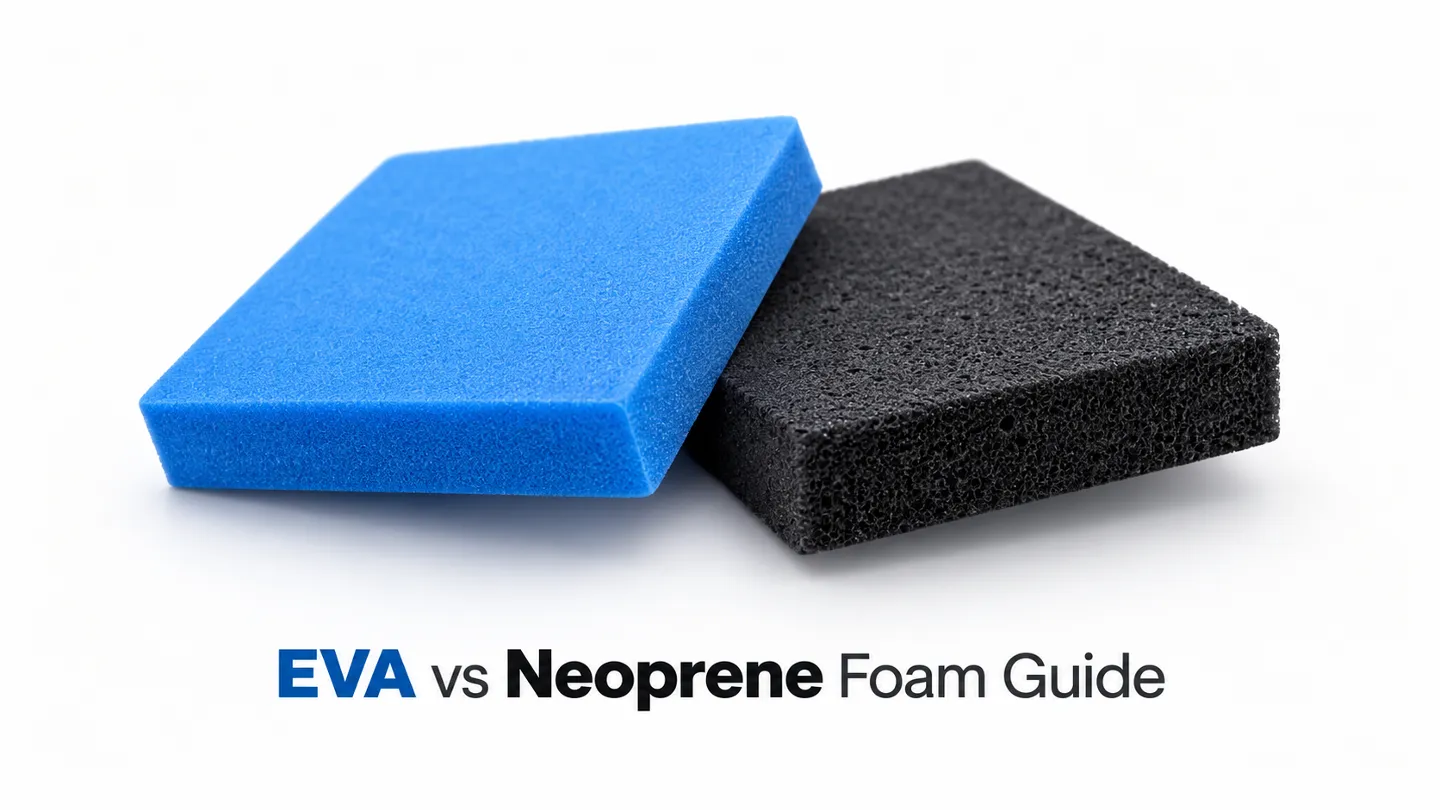
EVA vs Neoprene (CR) Foam: How to Choose for Custom Parts (2026)
- Damao Tech
- EVA Foam
- 05 Oct, 2026
Picking the wrong foam for a custom part is a quiet, expensive mistake. It never shows up on the quote — both EVA and neoprene (CR) die-cut cleanly, both laminate, both take a printed logo. It shows up six months later, when the part yellows in sunlight, swells in contact with oil, or costs twice what it needed to because you specified a premium rubber where a commodity foam would have done the job.
This guide is the same recommendation we give buyers when they ask us “EVA or CR?” — most recently for a laminated foam puck, a golf training aid: 70 mm in diameter, 25 mm thick, two foam discs laminated together with a through-hole and a printed logo. Below you get honest profiles of both materials, a head-to-head comparison table, application rules, fabrication notes for die-cut and laminated parts, and how to specify and vet a manufacturer. If you already know what you need, request a quote and we will confirm the material with physical samples.
Why the EVA vs Neoprene Call Matters
The material decision locks in cost, durability, and feel before a single tool is cut. Take that foam puck: two black closed-cell discs, laminated, a cord hole through the middle, a white logo printed on one face. Built in EVA, it is light, soft to the touch, and cheap to produce at volume. Built in CR (neoprene), it is denser, more oil-resistant, naturally flame-retardant — and roughly twice the material cost.
Neither answer is wrong in the abstract. The right answer depends on where the part lives: a dry driving range versus an oily workshop, indoor retail packaging versus a marine deck. Choose the foam for the part’s real life, not its datasheet.
Key Takeaway: EVA wins on cost, weight, and ease of fabrication. CR wins on chemical resistance, flame retardance, and harsh environments. Match the material to the exposure — not to the budget alone.
EVA Foam: The Profile
EVA (ethylene-vinyl acetate) is the workhorse of custom foam parts — closed-cell, light, and forgiving to fabricate. It is a thermoplastic foam, which means it heat-laminates cleanly and die-cuts with crisp edges.
- Cell structure: closed-cell, fine and uniform. Does not absorb water.
- Hardness: typically Shore C 20–70. Soft-touch grades sit around 25–35C; firm structural grades run up to 60–70C.
- Density: commonly 30–200 kg/m³ for fabricated parts — 38, 50, and 75 kg/m³ are the everyday workhorses.
- Water resistance: excellent. Closed cells shrug off splashes and rain.
- UV / ozone: fair. Prolonged direct sunlight yellows and embrittles EVA over time.
- Oil / chemical: poor. Petroleum oils and solvents swell and degrade it.
- Flame: not inherently flame-retardant; FR grades exist at a premium.
- Fabrication: die-cuts beautifully, heat-laminates to itself with no adhesive, and takes screen printing and heat transfer well.
- Cost: the budget option — typically half the price of CR foam, sometimes less.
Best for: sports goods, packaging inserts, yoga and fitness products, toys, and cost-sensitive consumer parts at volume.
Trade-off: keep it away from oils, solvents, and constant UV exposure.
CR (Neoprene) Foam: The Profile
CR (chloroprene rubber — neoprene is its best-known trade name) is the premium rubber foam, denser and tougher, built for hostile environments. It is a thermoset rubber foam, which changes how it bonds and how it behaves over time.
- Cell structure: closed-cell, slightly larger cells than EVA; grades range from standard to fine-cell smooth-skin.
- Hardness: typically Shore C 10–65, with excellent rebound — it springs back where EVA can take a compression set.
- Density: commonly 120–250 kg/m³. Noticeably heavier in the hand than EVA at the same thickness.
- Water resistance: excellent, and it stays flexible in cold water where EVA stiffens.
- UV / ozone: very good. This is why wetsuits and marine gaskets live outdoors.
- Oil / chemical: good. Resists petroleum oils and many solvents that destroy EVA.
- Flame: inherently flame-retardant and self-extinguishing — a genuine safety advantage.
- Fabrication: die-cuts cleanly; lamination is usually adhesive-based (contact cement) rather than heat; screen-prints well and pad-prints beautifully on small parts.
- Cost: the premium option — roughly 2x EVA material cost, sometimes more.
Best for: marine and watersports, gaskets and seals, oil-exposed environments, orthopedic and protective gear, premium sports products.
Trade-off: heavier and pricier, and some grades carry a rubber odor that needs airing before packing.
Key Takeaway: If the part touches oil, flame, or saltwater — or must survive outdoors for years — CR earns its premium. For everything dry, indoor, and cost-driven, EVA is the rational default.
Head-to-Head: EVA vs Neoprene (CR) Foam
Here is the full comparison in one table — the same table our engineers run through when a buyer asks “which one?”
| EVA Foam | CR (Neoprene) Foam | |
|---|---|---|
| Base polymer | Ethylene-vinyl acetate (thermoplastic) | Chloroprene rubber (thermoset) |
| Cell structure | Closed-cell, fine and uniform | Closed-cell, slightly larger cells |
| Hardness range | Shore C 20–70 | Shore C 10–65, better rebound |
| Typical density | 30–200 kg/m³ | 120–250 kg/m³ (heavier feel) |
| Water resistance | Excellent | Excellent (stays flexible in cold) |
| UV / ozone resistance | Fair — yellows with prolonged sun | Very good — built for outdoors |
| Oil / chemical resistance | Poor — swells in petroleum oils | Good — resists oils and solvents |
| Flame retardance | Not inherent (FR grades cost more) | Inherent — self-extinguishing |
| Lamination | Heat-laminates cleanly, no adhesive | Adhesive lamination (contact cement) |
| Printability | Screen print, heat transfer, pad print | Screen print, pad print (excellent detail) |
| Die-cutting | Crisp edges, minimal dust | Clean cuts, slightly more blade wear |
| Relative material cost | $ | $$–$$$ |
Read the table by elimination. Cross off every row your part does not need, and the winner usually becomes obvious: if oil, flame, or UV survival stays on the list, it is CR. If none of them do, EVA wins on price.
When to Choose EVA
Choose EVA when the part lives a dry, indoor, cost-conscious life. That covers more custom foam parts than most buyers expect:
- Sports and training goods — foam pucks, target pads, practice aids. Light, soft-touch, and cheap at volume.
- Packaging and inserts — protective die-cut inserts, presentation trays, tool organizers.
- Yoga, fitness, and play — blocks, rollers, mats, and children’s products.
- Toys and promotional items — where unit cost decides whether the project happens at all.
- High-volume runs — at 10,000+ units, EVA’s material savings dwarf every other line item.
Key Takeaway: Default to EVA. It handles roughly 80% of custom foam part briefs — you should need a specific reason (oil, flame, UV, or marine exposure) to pay the CR premium.
When to Choose CR (Neoprene)
Choose CR when the environment is hostile or the spec sheet is non-negotiable:
- Marine and watersports — anything that lives on a boat, a dock, or in saltwater.
- Gaskets and seals — where compression-set resistance and chemical exposure matter.
- Oil-exposed environments — workshops, garages, and machinery-adjacent parts.
- Flame-rated applications — where self-extinguishing behavior is specified or legally required.
- Premium sports and medical — orthopedic supports, protective gear, and wetsuit-adjacent products where feel and rebound justify the cost.
Key Takeaway: CR is insurance you can feel. You pay for it in material cost, and it pays you back in environments that kill EVA.
Fabrication Notes: Die-Cutting, Lamination & Printing
Both foams fabricate well, but they do not fabricate identically — the differences show up in lamination and finishing. Our custom EVA foam fabrication guide covers die-cutting, CNC routing, and thermoforming in depth; here is what matters for the EVA-versus-CR decision:
- Die-cutting: both cut cleanly with steel-rule dies. EVA produces less blade wear; CR’s denser rubber dulls tooling slightly faster — negligible at low volumes, worth noting past 50,000 units.
- Laminating two layers: EVA heat-laminates to itself with no adhesive — fast, clean, and cheap. CR needs adhesive lamination (contact cement), which adds a process step and cure time. For a two-disc puck, EVA lamination is the simpler build.
- Through-holes: punch or drill cleanly in both materials. In laminated parts, punch after lamination so the hole aligns through both layers.
- Hidden features: cord anchors and inserts get laminated between the discs before final bonding — works in both materials.
- Logo printing: screen printing works on both. Pad printing excels on small CR parts with curved faces. Heat transfer is an EVA-only option. For a white logo on black foam, single-color screen print is the cost-effective standard on either material.
Key Takeaway: If your part is laminated, EVA’s heat-bonding is the simpler, cheaper build. Specify CR only when the end-use environment demands it — never for fabrication convenience.
How to Specify Your Foam Part
A clean spec sheet gets you an accurate quote on the first round — and filters out traders who cannot read one. Include all six:
- Material and grade — “closed-cell EVA” or “CR (neoprene) foam,” not just “foam.”
- Density — in kg/m³ (e.g., 50 kg/m³ EVA, 160 kg/m³ CR). This drives weight and feel.
- Hardness — Shore C with a tolerance (e.g., “38±5 Shore C”). Always state the scale; Shore A and Shore C numbers are not interchangeable.
- Dimensions and tolerances — diameter and thickness with ± tolerances. Die-cut foam typically holds ±0.5 mm; say so if you need tighter.
- Color — black is standard for both; custom colors need a Pantone reference and usually a minimum quantity.
- Finishing — lamination method, hole sizes, print method, and artwork files.
Key Takeaway: “Black foam disc, 70 mm × 25 mm” gets you three different quotes. A six-line spec gets you one comparable quote — and reveals which suppliers actually understand foam.
How to Vet a Foam Parts Manufacturer
Most “foam factories” on B2B marketplaces are traders marking up someone else’s die-cutting shop. Run this short checklist before you send a deposit:
Green flags:
- Material stock on the shelf — asks your density and Shore C, and can name what they stock.
- In-house die-cutting and lamination — shows you the clicker presses and the lamination line on video.
- Physical samples before production — never approve a laminated part from photos. Flex it, try to delaminate it, scratch the print.
- Tolerances in writing — quotes ± tolerances instead of promising “exact.”
- Clear sample and production lead times — including what a reorder takes.
Red flags (any one is a walk-away):
- Cannot explain the difference between their EVA and CR lines.
- Quotes without asking density or hardness.
- No sample program, or samples “take 6 weeks.”
- Demands 100% upfront. Standard is 30% deposit, balance before shipment or against inspection.
Frequently Asked Questions
EVA vs neoprene — which foam should I choose for a custom part?
Choose EVA for dry, indoor, cost-driven parts: sports goods, packaging inserts, fitness products. Choose neoprene (CR) when the part faces oil, chemicals, UV exposure, or flame-rating requirements — marine gear, gaskets, protective equipment. When in doubt, prototype in EVA first; it is cheaper to iterate.
What is CR foam? Is it the same as neoprene?
Yes. CR stands for chloroprene rubber, and neoprene is its best-known trade name. In foam form it is a closed-cell rubber foam prized for oil resistance, flame retardance, and weather durability — at roughly twice the cost of EVA.
What Shore hardness should I specify for a foam puck or pad?
For a hand-held foam puck or training aid, Shore C 30–45 gives a soft-touch feel with enough body to hold its shape. Firmer structural parts run Shore C 50–65. Always state the scale (Shore C, not A) and a tolerance such as ±5.
Can EVA and neoprene be laminated together?
Yes, with adhesive lamination. EVA-to-CR hybrid parts are common when you want EVA’s low cost on one face and CR’s chemical resistance on the other. Pure EVA stacks heat-laminate with no adhesive; CR-to-CR bonds use contact cement.
How are logos printed on black foam?
Single-color screen printing is the standard for white logos on black foam — crisp, durable, and cheap at volume. Pad printing suits small or curved parts. Heat transfer works on EVA only. Always approve a printed sample before production.
What is the typical MOQ for custom die-cut foam parts?
Simple die-cut parts commonly start at 500–1,000 units. Laminated and printed parts — like the two-disc puck — typically start at 1,000–2,000 units because of setup. At 10,000+ units the per-unit cost drops sharply, so get quotes at two quantities.
Ready to spec your foam part? Request a quote — tell us EVA or CR, or ask us to recommend the closest match, and we will confirm it with physical samples before production.