How EVA Shoe Soles Are Made: Manufacturing Process Explained

How EVA Shoe Soles Are Made: Manufacturing Process Explained

Knowing how EVA shoe soles are made gives buyers, product designers, and footwear engineers a direct advantage when sourcing materials, evaluating supplier quality, and specifying production parameters. This guide covers every stage of the EVA sole manufacturing process — from raw polymer compounding through molding, expanding, and final finishing.

What Is an EVA Shoe Sole?

An EVA shoe sole is a structural or cushioning component made from Ethylene-Vinyl Acetate (EVA) foam, used as a midsole, outsole, or single-piece unit sole in athletic footwear, sandals, and casual shoes. EVA is the material of choice for shoe soles because it is lightweight (density as low as 0.15 g/cm³), provides excellent shock absorption, and can be precisely tuned for hardness and rebound through compounding.

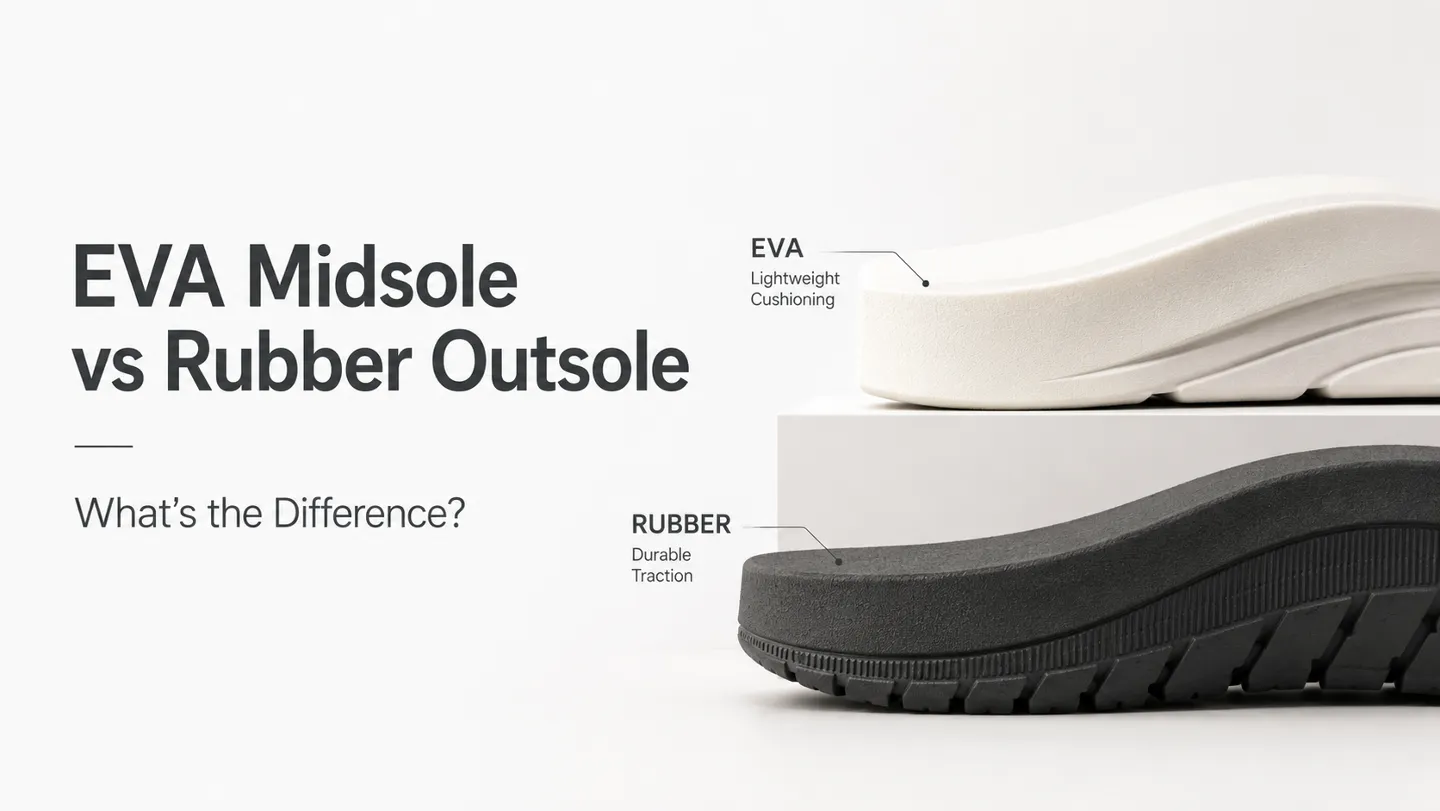
Most consumer running shoes use an EVA midsole paired with a rubber outsole. Budget casual shoes and sandals often use a single-piece EVA sole that serves both cushioning and ground-contact functions.

Step 1: Raw Material Compounding

The manufacturing process begins with compounding — blending the base EVA polymer with performance additives.

A standard EVA shoe sole compound includes:

IngredientRole
EVA resin (14–33% VA content)Base polymer — higher VA = softer, more elastic foam
Dicumyl Peroxide (DCP) or azodicarbonamide (AC foaming agent)Cross-linking agent and blowing agent that creates the cellular structure
Zinc oxideActivator that controls foaming temperature and cross-link density
Stearic acidLubricant and processing aid
Colorants / masterbatchAchieves target color in the finished sole
Fillers (calcium carbonate, silica)Cost-reduction and hardness adjustment
Additives (antioxidants, UV stabilizers)Extends product lifespan

The compounder mixes these ingredients in precise weight ratios using an internal mixer (Banbury mixer) or an open two-roll mill. Mixing temperature is typically kept below 110°C to prevent premature activation of the blowing agent. The output is a uniform, uncured EVA sheet or pellet compound ready for molding.

Step 2: Molding — Injection Molding vs. Compression Molding

Once compounded, the EVA material is shaped into a sole through one of two primary molding methods.

Injection Molding (Phylon / E-TPU Process)

Injection molding is the dominant process for high-volume athletic midsoles. The compounded EVA pellets are fed into a screw-type injection machine, melted under heat (150–175°C), and injected at high pressure into a closed, temperature-controlled steel mold.

During injection, the blowing agent activates and begins expanding the material inside the mold. When the mold opens, the pre-form shoots out and expands rapidly to roughly 150–200% of the mold cavity volume — a stage known as “free expansion.” The resulting part is then placed in a re-pressing mold and compressed back to final dimensions under heat and pressure.

This two-step injection-expansion-repress cycle produces the Phylon midsole, the most common EVA sole format in performance footwear. Phylon soles are extremely lightweight, highly uniform in cell structure, and capable of complex geometries.

Compression Molding (Direct EVA)

Compression molding uses sheet or block EVA compound, which is cut or weighed into pre-forms and placed directly into an open mold cavity. The mold closes under hydraulic pressure (typically 100–180 kg/cm²) and heat (160–175°C) for a dwell time of 8–20 minutes depending on thickness.

During the cure cycle, the cross-linking agent and blowing agent react simultaneously — the material cross-links (curing) while expanding to fill the mold. When the mold opens, the part has expanded to final dimensions without further processing.

Compression molding is preferred for:

  • Thicker one-piece EVA soles (sandal soles, platform shoes).
  • Smaller production runs where tooling costs must stay low.
  • Dual-density soles using two different compounds layered inside the same mold.

Step 3: Post-Molding Expansion and Sizing

Both processes produce a part that is larger than the intended final size — because EVA foam shrinks approximately 3–10% as it cools after expansion. Manufacturers account for this shrinkage by designing molds oversized to compensate.

For Phylon soles, a re-pressing (reprinting) mold brings the expanded pre-form back to exact final dimensions. The expanded foam is placed in a cold mold, pressed under controlled pressure, and heat-set in a steam or oven chamber. This step also improves surface texture uniformity and dimensional consistency.

For compression-molded EVA soles, the mold geometry itself sets the final expanded dimensions — the manufacturer engineers the mold dimensions based on known shrinkage factors for the specific compound.

Step 4: Trimming and Buffing

After demolding, EVA shoe soles have:

  • Flash (thin fins of overflow material around the parting line)
  • Rough or porous surface areas from gas escaping during expansion

Operators trim the flash with a blade or die cutter and then buff the sole surfaces with a rotating abrasive wheel to achieve a uniform, smooth finish. Buffing is critical for the outsole or adhesive surfaces — it creates sufficient mechanical bonding surface for the subsequent cementing step.

For high-volume lines, automated buffing machines handle trimming and surface preparation consistently and with less labor cost than manual operations.

Step 5: Surface Treatment and Painting

Many finished EVA shoe soles receive additional surface treatments before assembly:

  • Painting: Roller coating or spray-applied waterborne paint gives the midsole a finished aesthetic, matching the design brief. Paint is applied in thin coats and cured in a UV tunnel or low-temperature oven.
  • Printing: Logos, size marks, or technical patterns are printed onto the sole surface using screen printing or pad printing.
  • Hot-stamping: Embossed logos or metallic foil branding can be applied via heat die stamps.

Surface coatings also protect the EVA from scuffing and UV yellowing — a known degradation path for low-VA EVA in prolonged outdoor use.

Step 6: Quality Control Testing

Before the sole leaves the factory, it must pass a defined set of performance tests:

TestStandardTypical Acceptable Range
HardnessShore C (ASTM D2240)± 3 Shore C of specification
DensityISO 845± 5% of target density
Compression setASTM D395< 30% at 23°C, 22 hrs
Tensile strengthISO 1798> 1.5 MPa
Elongation at breakISO 1798> 150%
Flex resistanceDIN 53543 or Ross FlexNo cracking after 50,000 cycles
Abrasion lossDIN 53516< 150 mm³ loss

Failures in hardness or density typically trace back to incorrect compound ratios or mold temperature drift. Compression set failures usually indicate insufficient cross-link density — either too little DCP or a short cure time.

Key Process Variables That Control EVA Sole Performance

Every EVA shoe sole performance property — hardness, weight, rebound, durability — is controlled at the compounding and molding stages. Understanding these levers helps buyers write better specifications and evaluate supplier capability.

VariableEffect on Finished Sole
VA content (%)Higher VA → softer, tackier, more elastic foam
DCP loading (%)Higher DCP → more cross-links → firmer, lower compression set
Blowing agent amountMore blowing agent → lower density, lighter sole
Mold temperatureToo low → incomplete cure; too high → surface scorching
Cure timeToo short → under-cross-linked, poor compression set; too long → burned cell walls
Mold cavity designDetermines the expansion ratio and final geometry

EVA Shoe Sole Formats: Which Manufacturing Process Applies?

Sole FormatManufacturing ProcessTypical Application
Phylon midsoleInjection molding + repressRunning shoes, training shoes
Compression EVA midsoleCompression moldingCasual shoes, children’s footwear
One-piece EVA sandal soleCompression moldingEVA sandals, flip-flops, clogs
Dual-density EVA soleTwo-material compression moldStability running shoes
Blown EVA sheetContinuous foaming lineRaw material for cutting into insoles, inserts

Summary

EVA shoe soles are made through a multi-stage process: compounding base polymer with cross-linkers and blowing agents, molding under heat and pressure (via injection or compression), allowing expansion, and finishing through trimming, buffing, and surface coating. Every performance property — from weight and cushioning to durability — is set at the compounding stage and locked in during the cure cycle.

For footwear brands and OEM buyers sourcing EVA sole components, specifying VA content, target Shore C hardness, density, and DCP loading in your technical brief ensures that the supplier manufactures to your exact performance requirement — not just to a generic “EVA foam” standard.

Damao Tech manufactures custom EVA foam materials used in shoe sole applications, including midsole sheets, pre-foamed blocks, and compression-molded parts. Send your specification or sample for a technical review and quotation.

Request EVA Sole Samples and Pricing

Tags :
Share :

Similar Posts

EVA Foam for Marine Applications: Durability and Safety Standards

EVA Foam for Marine Applications: Durability and Safety Standards

The marine environment presents some of the most challenging conditions for industrial materials, requiring resistance to high UV exposure, constant saltwater saturation, and intense mechanical wear.

Read More
Specifying Marine EVA Foam: A Procurement Guide for Boat Owners and Manufacturers

Specifying Marine EVA Foam: A Procurement Guide for Boat Owners and Manufacturers

Selecting the right marine decking material involves more than just choosing a color. For boat manufacturers and commercial vessel operators, the foam must meet rigorous performance standards to ensur

Read More
Comparing TPU with Plastics in Automotive, Footwear, Medical

Comparing TPU with Plastics in Automotive, Footwear, Medical

Thermoplastic polyurethane (TPU) stands out among other commonly used plastics due to its unique combination of properties. In this article, we will compare TPU with other plastics commonly used in th

Read More
Custom Cut EVA Foam: Cutting Methods, Tolerances, and Applications

Custom Cut EVA Foam: Cutting Methods, Tolerances, and Applications

Custom cut EVA foam is used when standard sheet stock needs to become a finished part: a packaging insert, gasket, pad, spacer, protective liner, case interior, or adhesive-backed component. The r

Read More
Custom EVA Foam Fabrication Services: The Complete Guide

Custom EVA Foam Fabrication Services: The Complete Guide

Our custom EVA foam fabrication services transform technical material data into application-specific components for industrial and consumer markets. By utilizing advanced manufacturing technologie

Read More
Custom EVA Foam Inserts Guide: Design and Tool Box Organization

Custom EVA Foam Inserts Guide: Design and Tool Box Organization

Custom EVA foam inserts are precision CNC-routed closed-cell foam layers that lock specific tools, devices, or products into shaped pockets inside a transport case. They prevent impact damage duri

Read More
Dicumyl Peroxide (DCP) in EVA Foam: Crosslinking & Curing

Dicumyl Peroxide (DCP) in EVA Foam: Crosslinking & Curing

This technical guide to Dicumyl Peroxide (DCP) in EVA foam analyzes the chemical crosslinking process that defines the material's final physical properties. Precisely managing the DCP concentratio

Read More
What are the Disadvantages of EVA Foam? An Honest Buyer’s Guide

What are the Disadvantages of EVA Foam? An Honest Buyer’s Guide

Ethylene-Vinyl Acetate (EVA) is widely celebrated for its lightweight cushioning and versatility. However, as an industry-leading manufacturer, Damao Tech believes that informed decisions requ

Read More
Disposable Glove Management Guide: Safety & Cost Savings

Disposable Glove Management Guide: Safety & Cost Savings

This disposable glove management guide provides a framework to balance worker safety with operational efficiency. Managing glove supplies effectively prevents costly stockouts and ensures your tea

Read More
Equine Balance Pads in EVA Foam for Horse Rehab and Stability

Equine Balance Pads in EVA Foam for Horse Rehab and Stability

Equine balance pads are widely used in horse rehabilitation, stability training, and conditioning because they create a controlled unstable surface that encourages small postural adjustments. When the

Read More
EVA foam sheets and fabrication factors for custom foam pricing

EVA Foam Cost Guide: What Affects Custom EVA Foam Pricing?

EVA foam cost depends on more than sheet size. For custom projects, the final price is shaped by material density, thickness, formulation, color, fabrication method, tooling, lamination, packaging

Read More
EVA Foam Density Explained: The Ultimate Guide for Custom Parts

EVA Foam Density Explained: The Ultimate Guide for Custom Parts

EVA foam density is measured in kilograms per cubic meter (kg/m³) and typically ranges from 33 to 280 kg/m³. Low-density EVA (33–60 kg/m³) is soft and compressible for yoga mats and lightweight pa

Read More
EVA Foam for Gaskets and Seals: Selection & Performance

EVA Foam for Gaskets and Seals: Selection & Performance

This guide to EVA foam for gaskets and seals analyzes the physical properties that drive industrial sealing performance. Selecting the correct foam gra

Read More
EVA Foam Engineering: Technical Considerations for Product Designers

EVA Foam Engineering: Technical Considerations for Product Designers

For product designers and industrial engineers, selecting the correct foam material requires an analysis of mechanical properties, environmental resistance, and secondary processing capabilities. Ethy

Read More
EVA Foam Manufacturer Guide: How to Choose a Custom Foam Factory

EVA Foam Manufacturer Guide: How to Choose a Custom Foam Factory

Choosing the right EVA foam manufacturer matters when your project requires more than standard sheet stock. Industrial buyers often need a supplier who can control density, hardness, thickness, co

Read More
EVA Foam Manufacturing Process: From Polymer Resin to Finished Sheets

EVA Foam Manufacturing Process: From Polymer Resin to Finished Sheets

The production of high-performance Ethylene-Vinyl Acetate (EVA) foam is a multi-stage chemical and mechanical process that requires precise control over temperature, pressure, and timing. By adjusting

Read More
EVA Foam Packaging Inserts for Electronics, Tools, and Medical Devices

EVA Foam Packaging Inserts for Electronics, Tools, and Medical Devices

EVA foam packaging inserts protect products by holding each item in a stable, custom-fit cavity. Compared with loose void fill or generic foam blocks, a properly designed EVA insert controls movem

Read More
EVA Foam Pricing Guide: Factors Driving Industrial Manufacturing Costs

EVA Foam Pricing Guide: Factors Driving Industrial Manufacturing Costs

For procurement managers and product designers, understanding the pricing structure of Ethylene-Vinyl Acetate (EVA) foam is essential for accurate project budgeting. While the base material may appear

Read More
EVA Foam for Protective Packaging: Benefits & Custom Solutions

EVA Foam for Protective Packaging: Benefits & Custom Solutions

This guide to EVA foam for protective packaging analyzes why this material is the industry standard for safeguarding high-value items. Using the right

Read More
EVA Foam Rebound Resilience: ASTM D3574 Test H Guide and Data Chart

EVA Foam Rebound Resilience: ASTM D3574 Test H Guide and Data Chart

**EVA foam rebound resilience (or "rebound ratio") is the percentage of impact energy a foam returns after being struck, measured by dropping a 16 mm / 16.3 g steel ball from a 500 mm height onto the

Read More
EVA Foam Sheets: Thickness, Grades & Custom Sizes Guide

EVA Foam Sheets: Thickness, Grades & Custom Sizes Guide

Whether you are an engineer designing shock-absorbing industrial pads, a footwear manufacturer looking for the perfect midsole, or a creative professional building intricate props, the success of your

Read More
EVA Foam Supplier Guide: What Buyers Should Check Before Ordering

EVA Foam Supplier Guide: What Buyers Should Check Before Ordering

Finding an EVA foam supplier is easy. Finding one who can support a custom B2B project with stable material, correct fabrication, and reliable documentation is harder. The right supplier should he

Read More
Industrial and Commercial Applications of EVA Foam: A Technical Overview

Industrial and Commercial Applications of EVA Foam: A Technical Overview

Ethylene-Vinyl Acetate (EVA) foam's versatility is a result of its unique molecular structure, which combines the flexibility of rubber with the processability of thermoplastics. Because it is a close

Read More
EVA Midsole vs Rubber Outsole: What's the Difference?

EVA Midsole vs Rubber Outsole: What's the Difference?

Shoe buyers and footwear engineers often use "midsole" and "outsole" interchangeably — and that single misunderstanding leads to poor material selection and premature sole failure. This guide separate

Read More
EVA vs PE Foam: A Complete Comparison Guide

EVA vs PE Foam: A Complete Comparison Guide

Selecting the wrong closed-cell foam causes immediate performance drop-offs and blown material budgets. This comprehensive guide compares EVA vs PE foam, highlighting their distinct physical stren

Read More
How to Cut EVA Foam Cleanly and Precisely

How to Cut EVA Foam Cleanly and Precisely

To cut EVA foam cleanly, use a sharp snap-off utility knife for sheets under 10 mm, a hot knife for smooth sealed edges on curves, or a bandsaw for foam thicker than 20 mm. The key technique is th

Read More
How to Glue EVA Foam: Complete Adhesive Guide

How to Glue EVA Foam: Complete Adhesive Guide

Attempting to bond closed-cell polymers with standard household glues causes immediate seam failure. This guide explains perfectly how to glue EVA foam by identifying the exact chemical adhesives and

Read More
How to Make Foam Armor: The Ultimate Guide Using Professional EVA Foam

How to Make Foam Armor: The Ultimate Guide Using Professional EVA Foam

Creating movie-quality armor is a blend of artistry and material science. The secret held by professional prop makers isn't just skill—it's the choice of material. High-density EVA Foam has revolu

Read More
How to Specify Custom EVA Foam: A Technical Guide

How to Specify Custom EVA Foam: A Technical Guide

This guide on how to specify custom EVA foam requirements helps procurement managers provide the technical data needed for accurate manufacturing. Effectively communicating your material needs pre

Read More
Product Update: Introducing Our New Foldable Yoga Mats, Smart Jump Ropes & Foam Rollers

Product Update: Introducing Our New Foldable Yoga Mats, Smart Jump Ropes & Foam Rollers

Introduction We are excited to announce a major update to our best-selling fitness lineup. At Damao Tech, we understand that fitness gear is more than just equipment—it is a lifestyle statement.

Read More
Private Label Manufacturing for Equestrian Brands: Build a Custom Stability Pad Line

Private Label Manufacturing for Equestrian Brands: Build a Custom Stability Pad Line

If you want to grow your equestrian brand without building a factory, private label manufacturing gives you a practical way to launch a custom stability pad line with less risk. The right factory

Read More
Reaching Further for Safety & Hygiene: Your Essential Guide to Disposable Veterinary Long Arm Exam Gloves

Reaching Further for Safety & Hygiene: Your Essential Guide to Disposable Veterinary Long Arm Exam Gloves

Hey there, fellow animal care pros! 👋 Whether you're a seasoned veterinarian, a dedicated vet tech, a student learning the ropes, or even a farmer managing livestock health, you understand that veter

Read More
Safe EVA Foam for Children's Toys & Play Mats: Standards, Durability & Design Tips

Safe EVA Foam for Children's Toys & Play Mats: Standards, Durability & Design Tips

Ethylene-Vinyl Acetate (EVA) foam is a highly flexible, shock-absorbing copolymer widely used in nurseries, schools, and playrooms. Parents and manufacturers prioritize this material because it provid

Read More
Specifying EVA Foam Sheets & Rolls

Specifying EVA Foam Sheets & Rolls

Unlock the Potential: Specifying Your Ideal EVA Foam Ethylene-Vinyl Acetate (EVA) foam is a remarkably versatile material, prized for its soft, flexible, yet durable nature.

Read More
Sustainable Custom EVA Foam for Yoga Props: Eco-Friendly Options for High-End Brands

Sustainable Custom EVA Foam for Yoga Props: Eco-Friendly Options for High-End Brands

High-end yoga brands face a persistent challenge: balancing product performance with environmental responsibility. Advanced manufacturing techniques now allow brands to produce sustainable EVA yoga pr

Read More
7 Key Advantages of EVA Foam for Industrial Manufacturing

7 Key Advantages of EVA Foam for Industrial Manufacturing

Ethylene-Vinyl Acetate (EVA) foam has established itself as a critical material in the global manufacturing supply chain. Its unique combination of elastomeric proper

Read More
Veterinary shoulder length Gloves

Veterinary shoulder length Gloves

Introduction Shoulder length plastic gloves, a staple in various industries such as veterinary medicine, food service, and industrial settings, have seen a surge in popularity. These gloves are de

Read More
Water Resistance and Buoyancy of EVA Foam: Properties and Applications

Water Resistance and Buoyancy of EVA Foam: Properties and Applications

EVA foam, or Ethylene-Vinyl Acetate foam, is a versatile, lightweight, and durable material widely used across industries for its exceptional water resistance and buo

Read More
What are the differences between EVA and TPE materials?

What are the differences between EVA and TPE materials?

Choosing the right material can make or break your product's performance, durability, and market appeal. In the world of polymers, EVA (Ethylene Vinyl Acetate) and *TPE (Thermoplastic Elastomer)

Read More
What is a Disposable Plastic Gloves Machine?

What is a Disposable Plastic Gloves Machine?

In sectors where hygiene and safety are paramount, such as healthcare, food service, and cleanroom environments, disposable gloves are an indispensable part of daily operations. But have you ever paus

Read More
What is EVA Foam Padding? Material Definition and Guide

What is EVA Foam Padding? Material Definition and Guide

EVA stands for Ethylene-Vinyl Acetate — a closed-cell copolymer of ethylene gas and vinyl acetate (VA). EVA foam padding is the foamed form of this polymer, prized for its lightweight cushioning,

Read More
Yoga Roller

Yoga Roller

[vc_row][vc_column width="1/1"][vc_column_text]A yoga roller, also known as a foam roller, is a cylindrical tool made from high-density foam used for self-massage, muscle recovery and improv

Read More