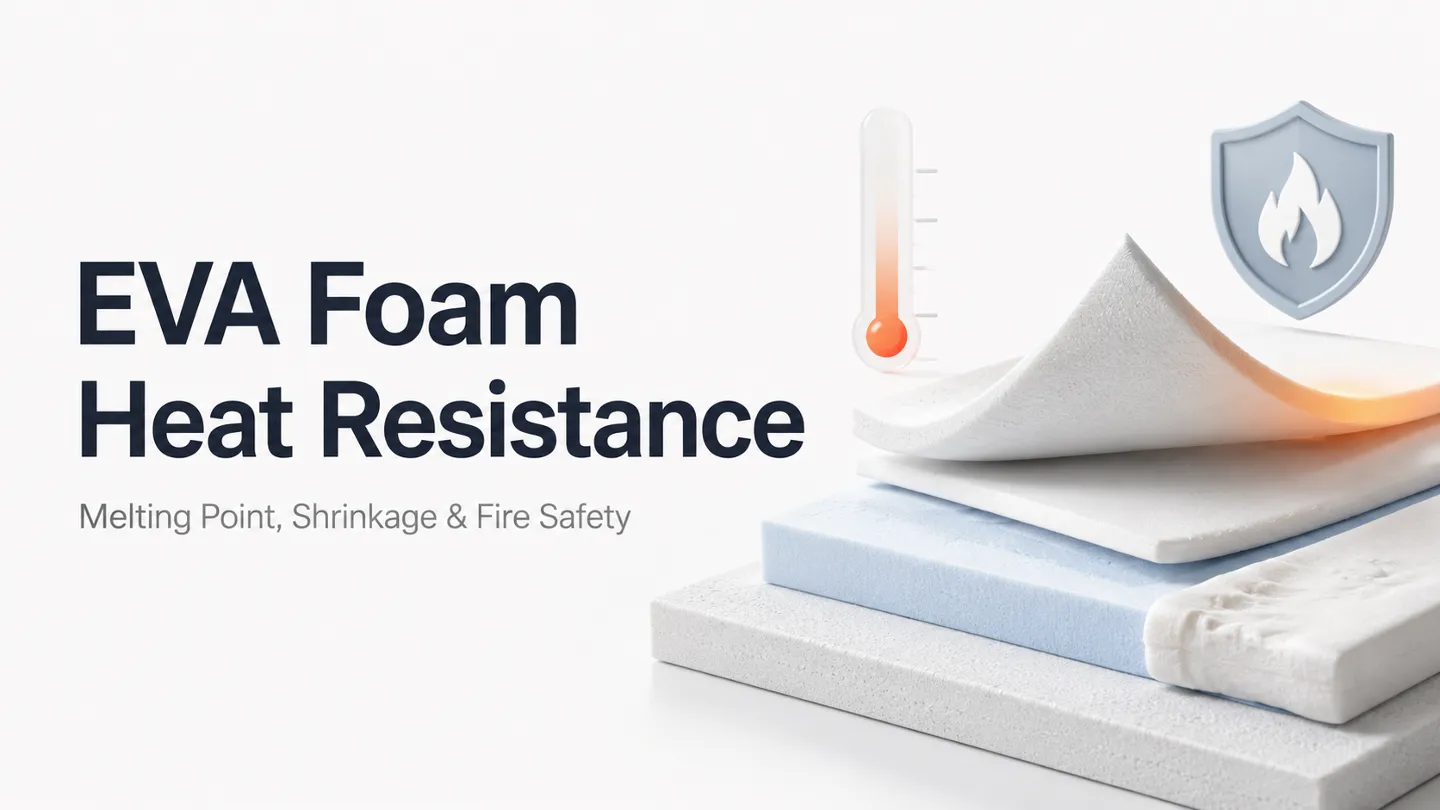
EVA Foam Heat Resistance: Melting Point, Shrinkage & Fire Safety
- Damao Tech
- EVA Foam
- 08 Jul, 2026
EVA foam has no single melting point. It softens between 60–90°C (140–194°F), loses its cell structure between 95–120°C (203–248°F), and thermally decomposes above 230°C (446°F) — and every one of those thresholds shifts with the foam’s VA content, density, and whether it is crosslinked. If you are specifying EVA foam for a product that sees heat — a car interior, a hot warehouse, a dishwasher-adjacent seal — the number that matters is not the melting point but the continuous service limit, which for standard grades is roughly 70°C (158°F).
This guide gives you the full temperature behavior of EVA foam, backed by the production data we use on our own lines: exact thresholds, why the foam shrinks when heated, what fumes it releases and when, and how to specify a grade that survives your operating environment.
EVA Foam Temperature Thresholds at a Glance
Here is the complete thermal behavior of standard closed-cell EVA foam, from room temperature to combustion:
| Temperature | What Happens | Practical Meaning |
|---|---|---|
| Up to ~70°C (158°F) | Dimensionally stable | Safe continuous service range for standard grades |
| 60–90°C (140–194°F) | Softening begins | Low-density foam distorts first; compression set accelerates |
| 90–120°C (194–248°F) | Heat-forming window | Foam becomes pliable enough to shape — this is the cosplay/thermoforming zone |
| 95–120°C (203–248°F) | Polymer melting range | Cell walls collapse; the foam permanently loses thickness and structure |
| 230–350°C (446–662°F) | Thermal decomposition | Acetic acid and other volatiles released; irreversible degradation |
| ~350°C+ (662°F+) | Ignition | EVA burns and can drip when alight, like most polyolefin foams |
Two variables move these numbers significantly:
- VA (vinyl acetate) content. Higher VA content (28–40%) lowers the melting range and makes the foam softer; low-VA grades (10–18%) hold their shape 10–15°C further. According to the polymer literature on vinyl acetate copolymers (ScienceDirect), EVA crystallinity — and with it the softening temperature — drops as VA content rises.
- Crosslinking. Foam cured with a peroxide crosslinker no longer melts like a thermoplastic; it chars instead of flowing and gains roughly 15–20°C of usable service temperature. That is one of the main reasons production EVA foam is crosslinked at all — see our guide to DCP crosslinking in EVA foam for how the cure works.
Does EVA Foam Shrink When Heated?
Yes — unrestrained heating shrinks EVA foam, typically by 2–5% of linear dimension. The mechanism is simple: EVA foam is expanded with gas during manufacturing, which leaves residual stress frozen into the cell walls. Heat past the softening point relaxes that stress, the cell walls pull back, and the sheet gets smaller and slightly thicker at the edges.
From our production experience, three factors decide how much a given sheet shrinks:
- Density. Low-density foam (under 60 kg/m³) shrinks the most because its thin cell walls carry more residual stress. High-density grades (150 kg/m³ and up) may move less than 1%.
- Temperature and time. Ten seconds under a heat gun shapes the surface; two minutes soaks the core and shrinks the whole part. Shrinkage is cumulative across repeated heat cycles.
- Post-cure history. Sheets that were heat-stabilized (annealed) after foaming have already released most of their stress and stay far more stable. This is worth asking your supplier about directly — it is a standard option on our lines for parts with tight tolerances.
For prop makers, this same behavior is a feature: the 90–120°C forming window is exactly how curved armor pieces get their shape. Our EVA foam armor guide covers heat-forming technique in detail.
Key takeaway: if your part has dimensional tolerances and will see heat, specify a high-density, heat-stabilized, crosslinked grade — not standard sheet stock.
Is EVA Foam Toxic When Heated?
At crafting and forming temperatures (under 150°C), fully cured EVA foam releases no meaningful toxic fumes. The material itself is non-toxic at room temperature — it is BPA-free, latex-free, and widely certified for children’s products, as we cover in our EVA foam safety guide.
Heating changes the picture in two stages:
- 90–150°C (heat-gun range): you may smell a faint waxy odor. This is mostly trapped process gas, not decomposition. Work in a ventilated space as a precaution, but this range is considered safe for hobby use.
- Above ~230°C (scorching/burning): the acetate groups begin splitting off as acetic acid vapor, followed by hydrocarbon fragments and, with open flame, carbon monoxide. These fumes are irritating and genuinely harmful. Never let EVA foam smoke or char in an enclosed space.
The practical rule: shaping is fine, scorching is not. If the foam browns or smokes, the temperature is far past the forming window and the part is ruined anyway.
Is EVA Foam Flammable?
Standard EVA foam is combustible. It ignites at roughly 350°C, burns with a steady flame, and can drip molten polymer — behavior typical of polyolefin foams. It is not classed as highly flammable (it does not flash-ignite like some open-cell PU foams), but untreated foam will not pass a vertical burn test either.
For applications with fire requirements, flame-retardant EVA grades exist and are a routine production option:
| Requirement | Typical Standard | How EVA Meets It |
|---|---|---|
| Consumer electronics cases | UL 94 HB | FR additive package in the foam compound |
| Automotive interior parts | FMVSS 302 | FR grade + density selection; horizontal burn under 102 mm/min |
| Building/flooring uses | Regional codes (e.g., EN 13501) | FR grade, usually combined with lamination |
Flame-retardant packages add cost and slightly increase density, so specify them only where the application demands it. If your part needs both high heat and fire resistance, EVA may be the wrong material entirely — silicone or melamine foam holds up past 200°C where EVA cannot. Our comparison of EVA foam’s limitations covers when to switch materials.
How to Specify Heat-Resistant EVA Foam
When heat is part of your operating environment, put these four items in your RFQ:
- Real operating temperature at the foam’s location — not ambient. A dashboard in summer sun reaches 80–100°C while the cabin sits at 40°C. Measure or estimate the local peak.
- Density grade. Move up the density range for heat exposure; higher density means thicker cell walls and slower distortion. Our EVA foam density guide maps grades to applications.
- Crosslinked, heat-stabilized stock. Ask for both by name. Crosslinking raises the ceiling; annealing removes the shrinkage.
- FR package if standards apply. Name the exact standard (UL 94 HB, FMVSS 302) so the compound is built to pass it, not retrofitted.
We run these specifications daily across densities from 30 to 250 kg/m³ — send your drawing and temperature profile through our custom EVA foam page and our engineers will confirm the right grade before sampling.
Frequently Asked Questions
What temperature does EVA foam melt at?
EVA foam has a melting range, not a single point: the polymer melts between 95–120°C (203–248°F), with low-VA, high-density grades at the top of that range. Softening and permanent distortion start earlier, at 60–90°C.
Can EVA foam go in direct sunlight?
Short-term, yes. Long-term outdoor exposure combines UV degradation with heat cycling: dark-colored foam surfaces in direct summer sun can exceed 70°C, entering the softening range. For outdoor products, use UV-stabilized, higher-density grades.
Is EVA foam heat resistant enough for car interiors?
Standard grades are marginal — enclosed cars reach 70–90°C interior surface temperatures in hot climates. For automotive parts, specify crosslinked EVA rated for continuous 90°C service and FMVSS 302 flammability compliance.
At what temperature can I heat-form EVA foam?
The working window is 90–120°C at the foam surface — reachable with a standard heat gun in 10–30 seconds. Shape the foam while pliable and hold it until cool. Going hotter risks scorching, shrinkage, and acetic acid fumes.
Does EVA foam release toxic fumes in normal use?
No. At room temperature and normal service temperatures, cured EVA foam is inert and non-toxic. Harmful fumes (acetic acid, carbon monoxide) only appear with decomposition above roughly 230°C or open burning.