EVA Foam Rolls: Sizes, Density Options & When to Choose Rolls Over Sheets
- Damao Tech
- EVA Foam
- 03 Jul, 2026
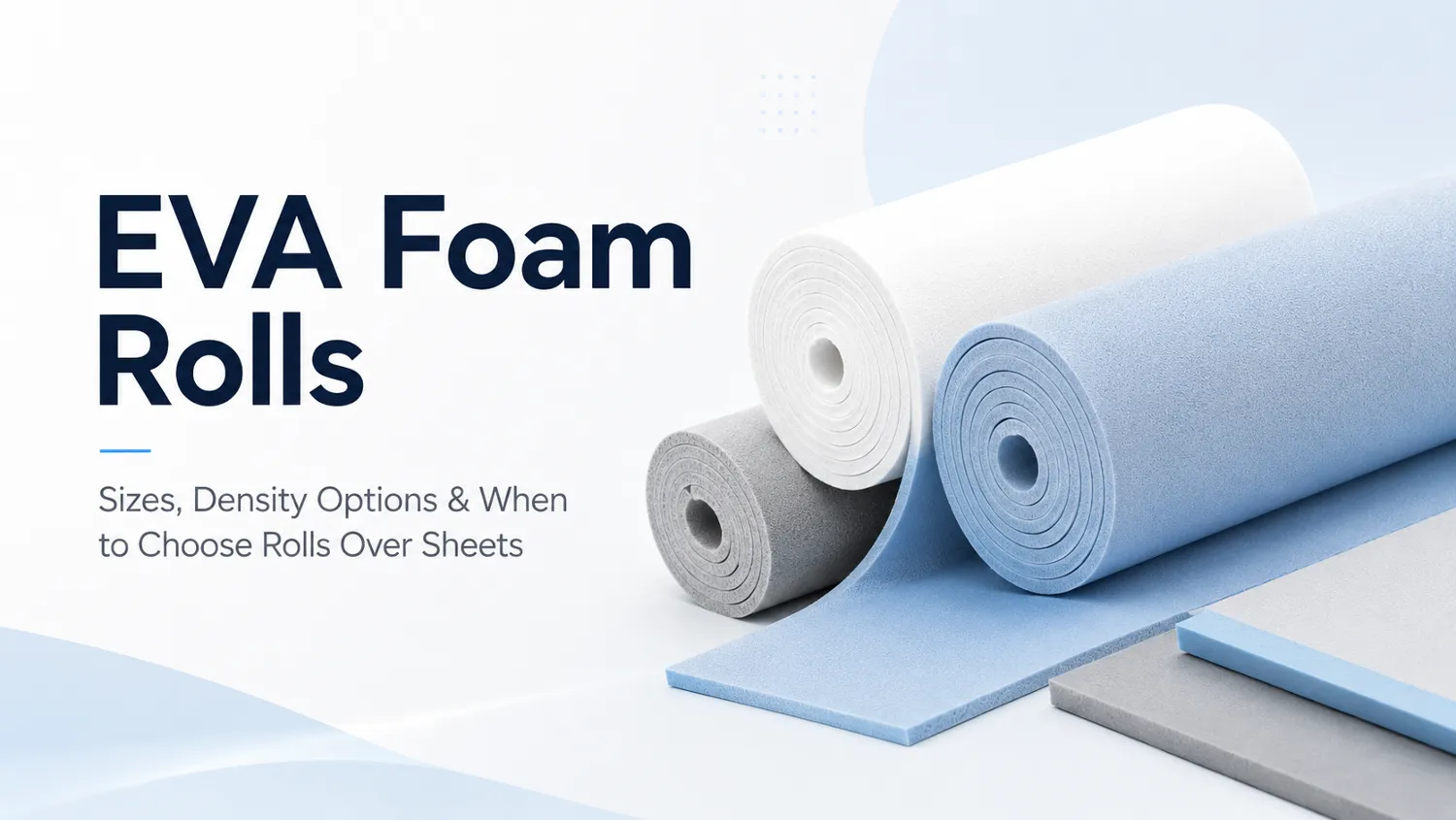
EVA foam rolls are continuous lengths of closed-cell EVA foam supplied on a roll instead of as cut sheets. They are the preferred format for high-volume die-cutting, sports and event flooring, lamination lines, and any application where long, seam-free coverage or automated feeding matters.
This guide explains standard roll dimensions, available density and thickness ranges, when rolls are the better choice over sheets, and what to specify when ordering. For the base material options, see our custom EVA foam page.
What Are EVA Foam Rolls?
EVA foam rolls are produced by skiving (splitting) foam blocks or buns into a continuous thin layer, which is then wound onto a core. Because the material is closed-cell, the roll keeps EVA’s core properties — water resistance, cushioning, and chemical stability — in a format that suits continuous processing.
Typical configurations:
- Thickness: commonly 0.5 mm to 10 mm for roll stock (thicker material is usually supplied as sheets).
- Width: standard widths around 1 m to 1.5 m, with custom slitting available.
- Length: tens to hundreds of meters per roll depending on thickness.
- Density: the same 33–280 kg/m³ range as sheet stock — see our EVA foam density guide for how to choose.
- Options: color, embossed or smooth surface, film or fabric lamination, and PSA (adhesive) backing.
Rolls vs. Sheets: Which Format Fits Your Project?
Both formats use the same material — the choice is about processing and waste:
| Factor | Rolls | Sheets |
|---|---|---|
| Best for | Continuous die-cutting, laminating, flooring | CNC routing, thick parts, small runs |
| Thickness range | Thin (0.5–10 mm) | Thin to very thick (1–100 mm+) |
| Material waste | Lower on nested repeat parts | Higher between separate sheets |
| Automation | Feeds directly into rotary die-cut and lamination lines | Manual or flat-bed handling |
| Seams in large areas | Fewer or none | Joints between sheets |
Rule of thumb: for thin, repeated parts at volume — gaskets, seals, packaging liners, tape backing — rolls reduce cost and handling. For thick inserts, machined pockets, or prototypes, use sheets. For sheet specifications, see our EVA foam sheets guide.
Common Applications for EVA Foam Rolls
- Rotary die-cutting: continuous feeding for gaskets, seals, spacers, and small pads at high volume.
- Flooring and underlayment: sports floors, event flooring, and acoustic or moisture underlayment with minimal seams.
- Lamination lines: bonding EVA to fabrics, films, or adhesives in a continuous process for footwear, bags, and automotive interior parts.
- Protective packaging: roll-fed liners and interleaving layers for shipping lines.
- Tape and PSA products: adhesive-backed EVA supplied in rolls for peel-and-stick assembly.
How to Specify EVA Foam Rolls in an RFQ
To get an accurate quote, include:
- Thickness and tolerance.
- Roll width and preferred roll length (or maximum roll weight your line can handle).
- Density or a reference sample — see the density guide if unsure.
- Color and surface finish (smooth, embossed, textured).
- Lamination or PSA backing requirements.
- Application and processing method (rotary die-cut, lamination, manual install).
- Order quantity and repeat demand.
If you are still comparing suppliers, our EVA foam manufacturer and supplier guide covers capabilities, MOQ, lead time, and quality documentation to check before ordering.
Frequently Asked Questions
What is the maximum thickness for EVA foam rolls? Roll stock is practical up to roughly 10 mm. Beyond that, the material resists winding and is normally supplied as sheets.
Can EVA foam rolls be laminated or adhesive-backed? Yes. Rolls are the standard input format for lamination — film, fabric, and PSA adhesive backing are all applied in continuous roll-to-roll processes.
Are EVA foam rolls waterproof? Yes. EVA is closed-cell, so roll stock does not absorb water and resists mold, making it suitable for underlayment and marine use.
What roll width should I order? Match the width to your die-cutting layout or coverage area to minimize edge waste — custom slitting to your line width usually pays for itself at volume.
Order Custom EVA Foam Rolls from Damao Tech
Damao Tech supplies custom EVA foam rolls in the thickness, width, density, color, and lamination your process requires, alongside sheets and die-cut parts. Send your specification or a reference sample to request a quote.