EVA Foam Manufacturer & Supplier Guide: How to Choose a Factory
- Damao Tech
- EVA Foam
- 03 May, 2026
Choosing the right EVA foam manufacturer matters when your project requires more than standard sheet stock. Industrial buyers often need a supplier who can control density, hardness, thickness, color, lamination, adhesive backing, and final fabrication in one workflow. This guide explains how to evaluate a custom EVA foam factory before you move from RFQ to sampling and mass production.
If you are still defining the base material, start with Damao Tech’s custom EVA foam manufacturer page for available density ranges, thickness options, and fabrication capabilities.
What a Custom EVA Foam Manufacturer Should Provide
A capable manufacturer should help you convert application requirements into a manufacturable foam specification. For B2B projects, the discussion should go beyond price per sheet and include the final part function.
Key capabilities to check:
- Material formulation: density, Shore hardness, VA content, color, additives, and closed-cell structure.
- Sheet and roll conversion: skiving, splitting, roll stock, sheets, and pre-cut blanks.
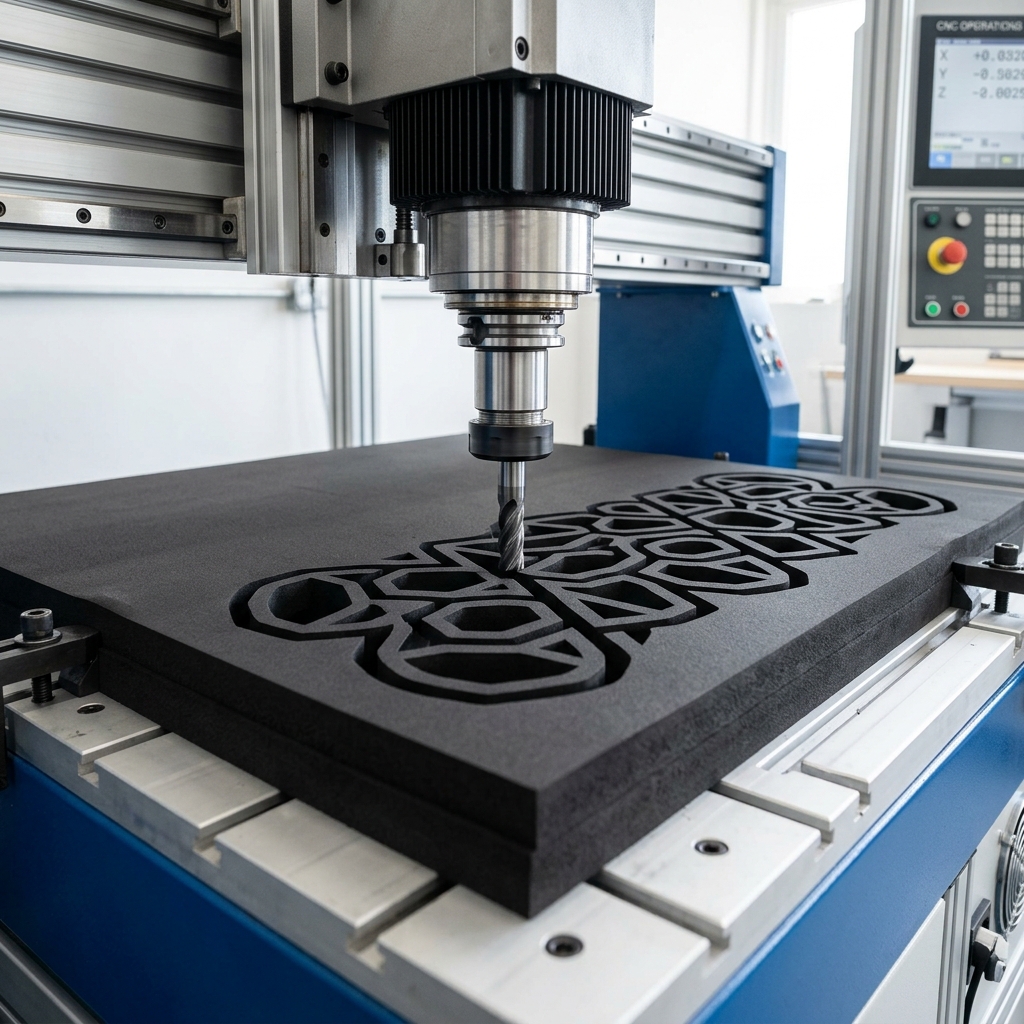
- Secondary fabrication: die cutting, CNC routing, waterjet cutting, thermoforming, lamination, and PSA backing.
- Application support: packaging inserts, gaskets, pads, protective components, sport goods, and consumer product parts.
- Quality documentation: inspection records, tolerance checks, batch traceability, and third-party testing when required.
A factory that controls both material production and secondary processing can usually reduce handoff errors because the same team understands how foam formulation affects cutting, bonding, compression, and surface finish.
Manufacturer vs. Trading Company: What Buyers Should Check
A trading company may be useful for simple commodity orders, but custom EVA foam projects usually require direct technical communication with the production team. Before placing an order, confirm whether the supplier can answer engineering-level questions about the foam and the finished part.
Ask these questions:
- Can you recommend density and hardness based on product weight, impact risk, and fit requirements?
- Can you provide samples from the same process intended for mass production?
- Do you control skiving, die cutting, CNC routing, lamination, and packing in-house?
- Can you hold the required tolerance after foam compression and recovery?
- Can you document material batch, color standard, adhesive grade, and inspection criteria?
If the supplier cannot connect your drawing to a controlled manufacturing process, the lowest quote may create hidden cost during sampling, rework, or final assembly.
Technical Capabilities That Affect Final Part Quality
Custom EVA foam quality depends on the match between material grade and fabrication method. A good manufacturer should explain which process fits your geometry and volume.
| Requirement | Recommended Capability | Why It Matters |
|---|---|---|
| Flat gaskets or pads | Die cutting | Efficient for repeatable high-volume shapes |
| Tool or case inserts | CNC routing | Allows pockets, finger pulls, and multi-depth cavities |
| Branded packaging inserts | Lamination and color matching | Supports premium appearance and better unboxing experience |
| Adhesive-backed components | PSA lamination | Improves assembly speed and bonding consistency |
| 3D contoured parts | Thermoforming | Produces shaped components that match product geometry |
For a deeper process comparison, read our guide to custom EVA foam fabrication services.
Quality Control Points for EVA Foam Manufacturing
Because EVA foam is compressible, quality control should include both material and dimensional checks. Do not evaluate only visual appearance. For industrial projects, define the inspection method before mass production begins.
Important checkpoints include:
- Density and hardness confirmation from approved samples.
- Thickness checks after skiving or lamination.
- Color comparison against Pantone, RAL, or approved physical sample.
- Pocket depth and fit checks for CNC-routed inserts.
- Adhesive peel performance for PSA-backed foam.
- Packaging method to prevent deformation during shipping.
A clear inspection standard helps both buyer and manufacturer avoid subjective acceptance disputes after production.
MOQ, Lead Time, and Sample Expectations
Buyers often compare factories on unit price alone, but MOQ and lead time can change the real project cost. Small custom runs may require setup time for color, lamination, tooling, or CNC programming; high-volume projects may need die tooling to lower the long-term unit cost. Ask the manufacturer to break the quote into:
- Material cost.
- Tooling or programming cost.
- Sampling cost.
- Secondary processing cost.
- Packaging and logistics cost.
- Estimated lead time for sample and production.
This structure makes quotes easier to compare and reduces surprises after the sample is approved.
Quality Documents and Compliance
Not every project needs the same compliance package, but a capable manufacturer should be able to discuss what is available. Depending on the application, you may need:
- RoHS or REACH statements.
- Third-party test reports.
- Material safety documentation.
- Lot traceability.
- Color approval records.
- Dimensional inspection reports.
- Adhesive or lamination specification.
For automotive, electronics, medical packaging, or export markets, confirm these requirements before placing the order rather than after production has started.
Red Flags When Choosing an EVA Foam Manufacturer
Be cautious if a supplier:
- Quotes without asking about application or density.
- Cannot explain the difference between sheet supply and custom fabricated parts.
- Avoids discussing tolerances or foam compression behavior.
- Cannot provide a physical sample before production.
- Uses vague material descriptions such as “high quality EVA” without measurable specs.
- Cannot confirm whether fabrication is in-house or outsourced.
These issues can lead to inconsistent samples, poor fit, unexpected odor, color mismatch, adhesive failure, or deformation during shipping.
RFQ Information to Send Your Manufacturer
The faster you provide technical details, the faster a manufacturer can quote accurately. A strong RFQ package should include:
- 2D drawing or 3D CAD file.
- Target density or reference sample.
- Thickness and tolerance requirements.
- Color, surface finish, and lamination needs.
- Adhesive backing requirement, if any.
- Estimated order quantity and annual demand.
- Intended application and operating environment.
- Packaging and shipping requirements.
If you do not have a full specification yet, use our custom EVA foam requirements guide to organize the information before requesting a quote.
Summary: Choose the Manufacturer That Reduces Project Risk
The best EVA foam manufacturer is not simply the cheapest supplier. For custom projects, choose a factory that can recommend the right material, validate the fabrication method, produce repeatable samples, and document quality before mass production. This reduces specification drift and helps ensure the final foam part performs as expected in the real application.
Damao Tech supplies custom EVA foam for packaging, inserts, gaskets, pads, and industrial components. Contact our team with your drawing, sample, or application details to start a manufacturability review.