EVA Foam Pricing Guide: Factors Driving Industrial Manufacturing Costs
- Damao Tech
- EVA Foam
- 07 Jul, 2025
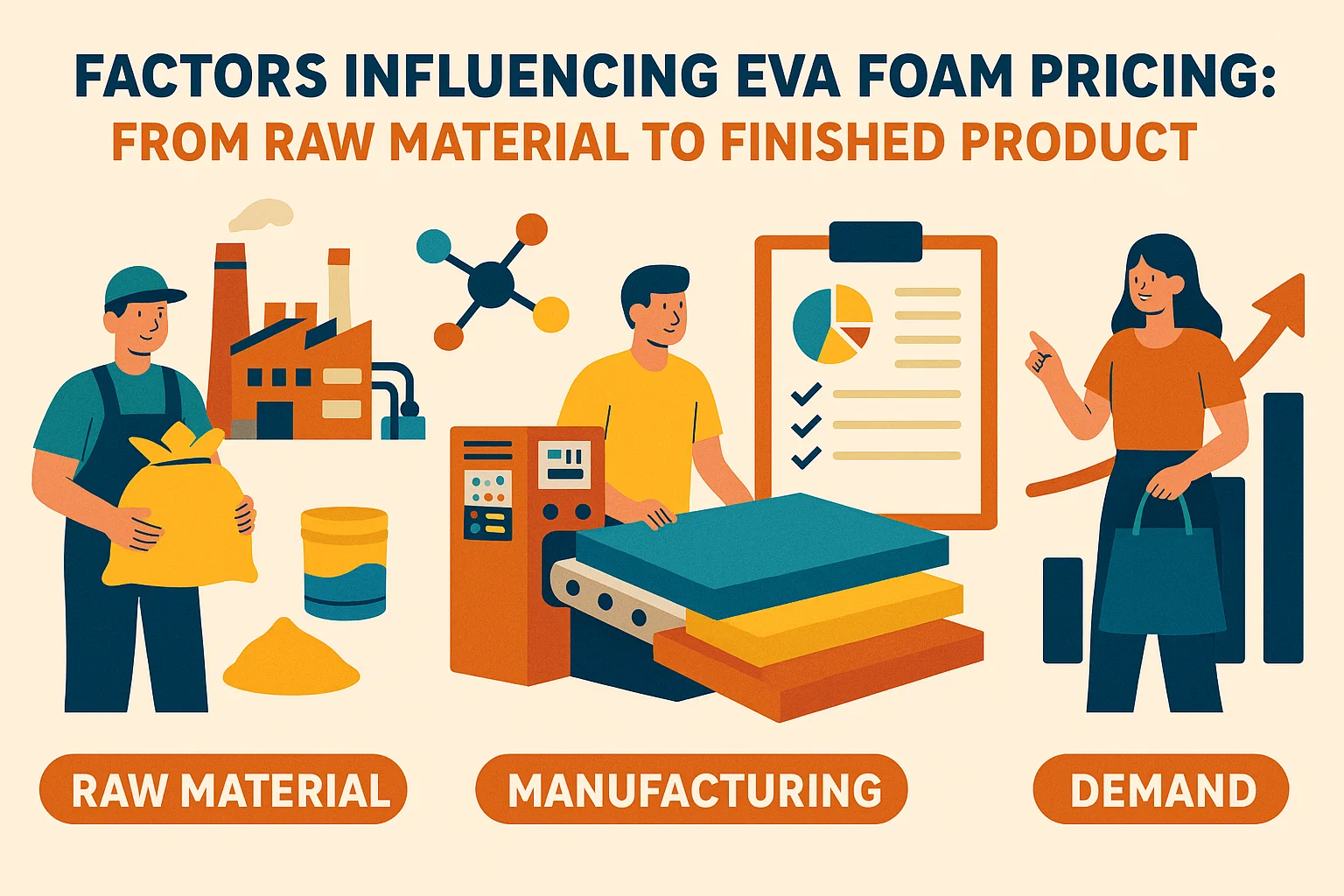
For procurement managers and product designers, understanding the pricing structure of Ethylene-Vinyl Acetate (EVA) foam is essential for accurate project budgeting. While the base material may appear consistent, several technical variables—from chemical composition to secondary fabrication—significantly impact the final unit cost. This guide details the primary cost drivers in the EVA foam manufacturing process.
1. Raw Material Costs: VA Content and Purity
The foundation of EVA foam pricing is the global cost of ethylene and vinyl acetate (VA) resins, which fluctuate based on petrochemical market indices.
- VA Content: High-VA resin (above 20-30%) is more expensive than standard low-VA resin. If your application requires superior flexibility, transparency, or low-temperature toughness, the material cost will be higher.
- Purity: Virgin EVA resin provides the most consistent cell structure and mechanical properties. While recycled or lower-grade resins are more affordable, they may introduce variances in density and durability that are unacceptable for high-precision industrial parts.
2. Manufacturing Complexity: Density and Additives
The foaming process itself adds significant value and cost depending on the required material specifications.
- Density (kg/m³): High-density foam requires more raw resin per cubic meter, directly increasing the material cost. For example, a 200 kg/m³ foam will naturally be more expensive than a 50 kg/m³ foam.
- Technical Additives: Specialized properties require expensive chemical inclusions:
- UV Inhibitors: Essential for marine and outdoor use.
- Fire Retardants: Required for automotive and aerospace (UL 94 compliance).
- Anti-Static (ESD) Agents: Critical for electronics packaging.
- Color Pigments: Custom color matching (RAL or Pantone) involves setup fees and pigment costs compared to standard charcoal or white.
3. Secondary Processing and Custom Fabrication
The format in which the foam is delivered also impacts the price:
- Skiving (Slicing): Slicing a large foam bun into precise sheets (measured in millimeters) involves labor and machinery time. Thinner sheets (under 2mm) often have a higher per-square-meter cost due to the increased risk of material variance and slower processing speeds.
- Custom Fabrication:
- Die-Cutting: Cost-effective for high-volume, simple geometries.
- CNC Routing: Higher precision for complex, multi-level designs (e.g., custom tool inserts), priced based on machine run-time.
- Thermoforming: Requires custom molds and heat-processing cycles.
- Adhesive Lamination: Applying high-bond PSA (Pressure Sensitive Adhesive) like 3M 9448A adds significant material value and labor.
4. Economies of Scale: MOQ and Lead Times
Like most industrial manufacturing, volume is the most powerful lever in reducing per-unit costs.
- Minimum Order Quantity (MOQ): Large-scale production runs allow for more efficient resin usage and lower machinery setup costs. Small custom runs often incur a “setup premium.”
- Packaging and Logistics: EVA foam is lightweight but high-volume. Freight costs are often calculated by volumetric weight, making efficient palletization and bulk shipping critical for maintaining a competitive final price.
Summary
The final price of an EVA foam component is a reflection of its chemical performance, manufacturing density, and the precision of its final fabrication. By identifying your “must-have” technical requirements versus “nice-to-have” features, you can optimize your material specification for maximum cost-effectiveness. Request a transparent quote from Damao Tech today to see how our vertically integrated manufacturing can reduce your procurement costs.