EVA vs PE Foam: What's the Difference for Packaging and Inserts?
- Damao Tech
- EVA Foam
- 15 Jul, 2025
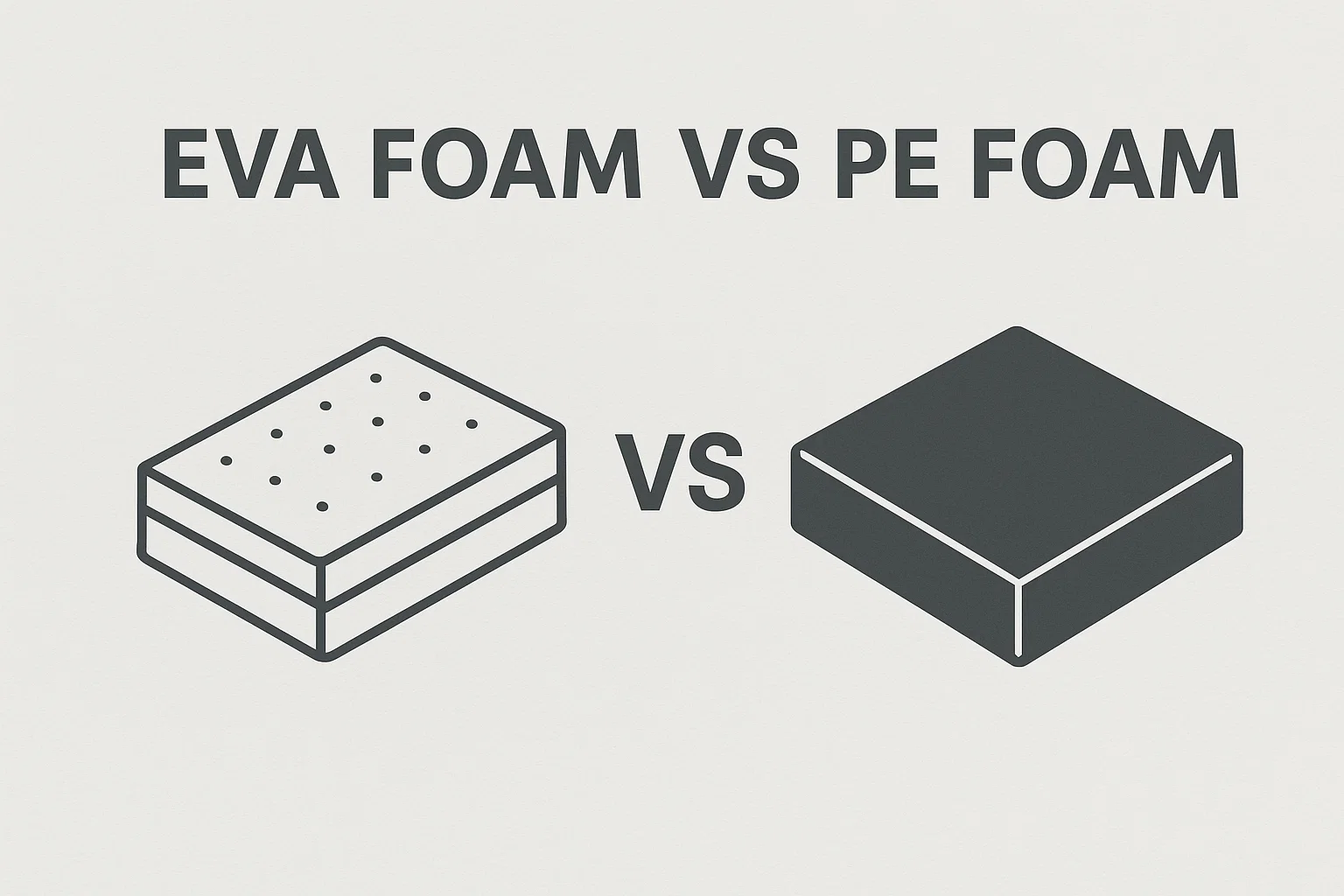
Selecting the wrong closed-cell foam can lead to immediate product damage during shipping or a blown materials budget. In the industrial packaging and custom insert market, the two heavyweights are EVA foam (Ethylene-Vinyl Acetate) and PE foam (Polyethylene).
While they look similar to the naked eye, their chemical structures dictate vastly different mechanical capabilities. This guide compares EVA vs PE foam side-by-side, analyzing flexibility, Shore hardness, rebound elasticity, long-term durability, and wholesale cost so you can specify the right material for your next project.
1. What is PE Foam (Polyethylene)?
PE Foam (Polyethylene) is a lightweight, closed-cell foam manufactured by extruding polyethylene polymer injected with a blowing agent. Because standard PE lacks elastomeric copolymers, it produces a stiffer, more structural cellular lattice.
In commercial converting, PE foam typically comes in two distinct categories:
- EPE (Expanded Polyethylene): Non-cross-linked foam with a visible, larger cell structure. It is extremely lightweight, low-cost, and commonly used for disposable cushioning wrap and single-trip protective packaging.
- XLPE (Cross-Linked Polyethylene): Chemically or irradiation cross-linked PE foam. It features a microcellular structure, higher density (30–120+ kg/m³), and superior chemical resistance, making it suitable for medical packaging and industrial seals.
Key Strengths of PE Foam:
- Maximum Rigidity & Bracing: Excellent compressive stiffness. It firmly blocks heavy equipment (such as server chassis or automotive castings) from shifting inside shipping crates.
- Superior Thermal Insulation: Low thermal conductivity makes PE foam a global standard for HVAC pipe insulation and building expansion joints.
- Budget-Friendly: Standard PE foam is significantly cheaper per cubic meter than EVA, making it the preferred choice for disposable, high-volume shipping.
Common PE Foam Applications: Industrial corner protectors, HVAC insulation, appliance shipping blocks, and disposable packaging pads.
2. What is EVA Foam (Ethylene-Vinyl Acetate)?
EVA Foam is a copolymer of ethylene and vinyl acetate (VA). The addition of vinyl acetate molecules disrupts the rigid polyethylene crystalline chain, creating an elastomer with rubber-like flexibility, high elasticity, and an ultra-fine closed-cell surface.
By adjusting the vinyl acetate percentage (typically 14% to 28%) and the cross-linking density, manufacturers can fine-tune EVA foam across a wide spectrum of densities (30 to 250+ kg/m³) and hardness ratings (15 to 80 Shore C).
Key Strengths of EVA Foam:
- Dynamic Shock Absorption & High Rebound: Instead of simply bracing a load, EVA dissipates kinetic shock and rebounds back to its original thickness without permanent flattening.
- Tear & Friction Resistance: Tools and delicate instruments can slide into precision-routed pockets thousands of times without flaking, dusting, or tearing.
- Velvet-Like Surface Presentation: EVA features an ultra-smooth, uniform cell finish that holds deep colors, laser engraving, and custom silkscreening for retail packaging.
Common EVA Foam Applications: CNC-routed tool drawer inserts, Pelican case inserts, protective drone cases, athletic footwear midsoles, and orthopedic pads.
3. Video & Lab Test: Shore Hardness & Rebound Comparison
To see the physical difference between these two materials, watch our laboratory test comparing a green high-density PE foam block against a black high-rebound EVA foam specimen using a Shore durometer:
Key Takeaways from the Shore Hardness Test:
- Surface Indentation Resistance:
High-density PE foam shows a firmer surface resistance under static pin contact due to its crystalline polymer backbone. However, when pushed past its yield threshold, PE cells undergo plastic deformation and crush permanently. - Elastic Recovery & Energy Return:
High-rebound EVA foam exhibits rubber elasticity. As the durometer indenter presses in, the copolymer cell walls absorb the load and immediately spring back to zero deflection upon release. - Specifying Hardness vs. Density:
Hardness and density are independent parameters. A high-density EVA foam can be formulated with a soft touch (e.g., 25–35 Shore C) or rigid structure (e.g., 60–75 Shore C). Learn more in our dedicated EVA foam density and Shore hardness guide.
4. Comprehensive Engineering Specification Matrix
When sourcing foam for custom inserts or industrial components, compare these performance metrics:
| Property / Feature | PE Foam (Polyethylene / XLPE) | EVA Foam (Ethylene-Vinyl Acetate) | Specification Winner |
|---|---|---|---|
| Polymer Chemistry | Pure polyethylene homopolymer | Ethylene & Vinyl Acetate copolymer | — |
| Typical Density Range | 18 – 100 kg/m³ (EPE to XLPE) | 30 – 250+ kg/m³ | EVA Foam for higher structural mass |
| Shore Hardness Range | 20 – 60 Shore 00 / Low Shore C | 15 – 80 Shore C (also 30–60 Shore A) | EVA Foam for wide tuning range |
| Impact Absorption Mechanism | Rigid deceleration; crush-absorption | Viscoelastic damping; elastic rebound | EVA Foam for fragile electronics |
| Compression Set Resistance | Moderate to poor (permanent denting) | Excellent (recovers after cyclic loads) | EVA Foam for reusable case liners |
| Surface Finish & Cell Texture | Visible, coarse cell boundaries | Ultra-fine, smooth, velvet-like touch | EVA Foam for luxury presentation |
| CNC Routing & Milling | Prone to fuzzing and rough edges | Ultra-clean pocket walls and sharp bevels | EVA Foam for tight CAD tolerances |
| Laser Cutting Quality | Can melt or produce heat shrink | Crisp, clean cut lines with low scorching | EVA Foam for laser-engraved tool trays |
| Moisture Absorption | Impermeable closed cell (< 1%) | Impermeable closed cell (< 1%) | Tie (Both waterproof) |
| Material Cost Factor | Budget / Economy | Moderate to Premium | PE Foam for disposable packaging |
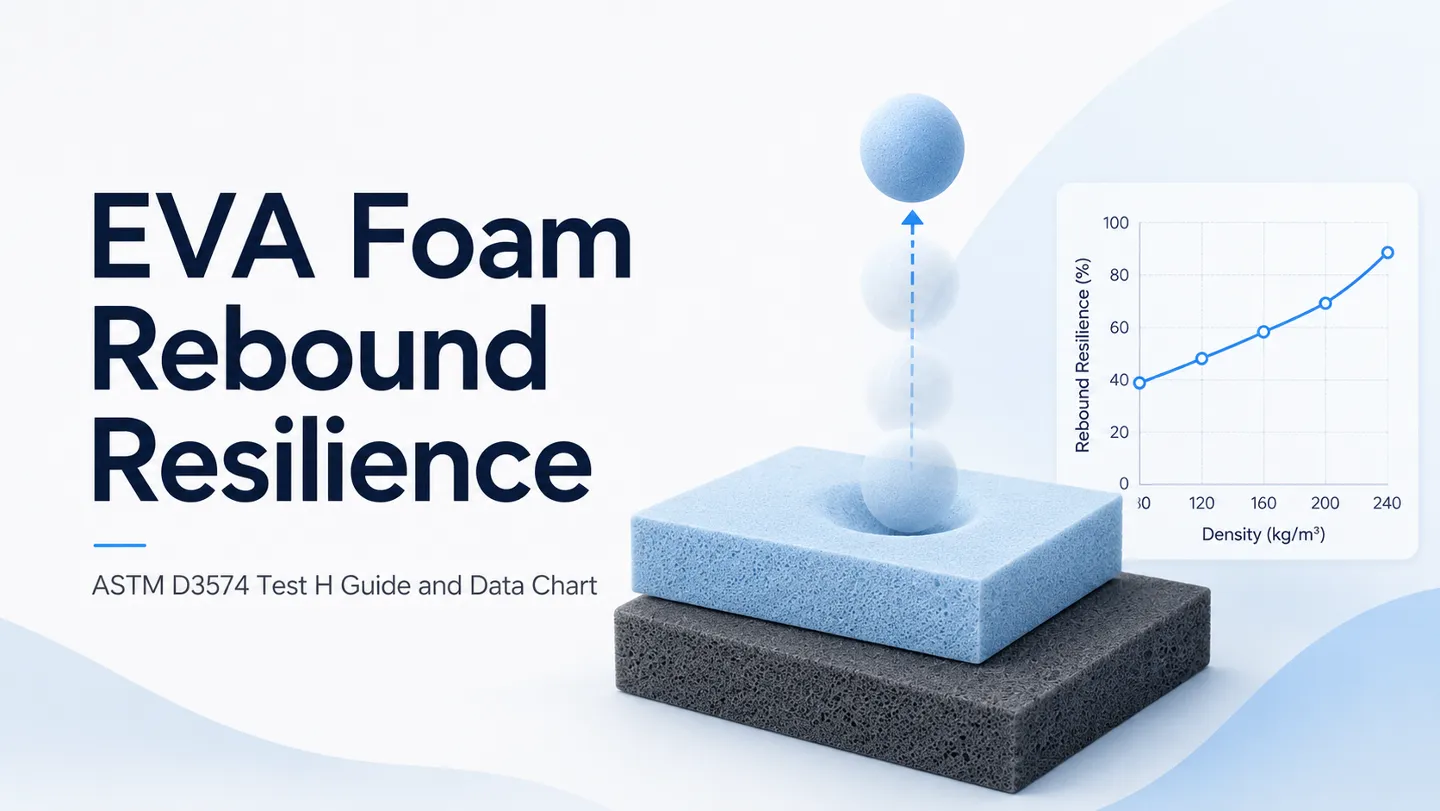
To understand dynamic energy-return mechanics, read our EVA foam rebound resilience guide.
5. Fabrication Comparison: CNC Routing, Die-Cutting & Laser Processing
Converting raw foam sheets into finished inserts requires compatible machinery and proper tooling speeds:
- CNC Routing: EVA foam holds crisp sidewalls, tight radius corners, and multi-depth step pockets without tearing. Standard PE foam can shred or create burrs along routed edges unless high-density cross-linked (XLPE) grades are used with razor-sharp end mills. Learn best practices in our custom cut EVA foam guide.
- Die-Cutting: Both materials die-cut cleanly under clicker presses up to 25 mm thickness. For thicknesses exceeding 50 mm, EVA recovers its cross-sectional square edge better than standard PE foam, which tends to dish (hourglass taper) under rule pressure.
- Adhesive Backing (PSA): Both foams accept rubber-based and acrylic pressure-sensitive adhesives, though EVA’s denser, smoother skin delivers superior peel strength for heavy-duty peel-and-stick gaskets.
6. The Hybrid Solution: EVA/PE Blends
If your project demands the smooth finish and tear resistance of EVA, but strict container-budget limits prevent 100% virgin EVA, consider EVA/PE blend foams.
By compounding 20%–40% EVA with 60%–80% PE, manufacturers produce a cost-optimized foam:
- Significantly higher tear strength and smoother cell texture than pure PE.
- Noticeably lower raw material cost than pure EVA.
- 15% to 25% lighter weight than equal-hardness virgin EVA.
EVA/PE blends are widely used in high-volume consumer electronics packaging, power tool carry cases, and mid-tier promotional unboxing kits.
7. Decision Framework: Which Foam Should You Specify?
Specify PE Foam (or XLPE) if:
- Single-Trip Shipping: The foam insert will be discarded by the end user immediately upon unboxing.
- Blocking & Bracing Heavy Equipment: You need stiff, structural spacers to lock heavy pumps, server racks, or automotive engines inside crates.
- Strict Budget Constraints: Every cent per cubic meter impacts the packaging margin.
- Thermal Insulation: The application requires HVAC or building envelope insulation properties.
Specify EVA Foam if:
- Long-Term Reusable Inserts: The case or drawer will be opened and used thousands of times (e.g., flight cases, medical instruments, mechanic tool chests).
- Drop-Protection for Fragile Cargo: High-rebound energy absorption protects delicate optics, cameras, lenses, or circuit boards from repeated drops.
- Luxury Presentation: The aesthetic touch, velvet finish, and custom color matching represent your premium brand image.
- Precision Milling: Your design contains complex 3D contoured cavities, finger grooves, and tight tolerances.
Frequently Asked Questions
Is EVA foam harder or softer than PE foam?
EVA foam can be formulated to be both softer and harder than PE foam. Standard EPE foam is relatively soft and compressible, while high-density PE is stiff and rigid. EVA foam spans a broader spectrum—from ultra-soft 15 Shore C cushions to rock-hard 80 Shore C structural blocks. Unlike PE, EVA maintains rubbery flexibility across all hardness grades.
Does PE foam permanently dent after heavy impacts?
Yes. Under severe or repeated impact, the cell walls of standard polyethylene foam collapse and crush, resulting in permanent deformation (high compression set). EVA foam contains rubbery vinyl acetate copolymer chains that absorb kinetic energy and rebound back to their original profile.
Which foam is better for CNC router tool trays?
EVA foam is universally preferred for CNC routing. It cuts cleanly with razor-sharp pocket edges, produces minimal dust, and holds heavy steel wrenches or micrometers without wall fatigue. Standard PE foam tends to fray, tear, or leave fuzzy edges during high-speed CNC milling.
Are EVA and PE foams waterproof?
Both EVA and PE foams are closed-cell materials, meaning individual cells are sealed and cannot absorb water, oils, or ambient humidity. Both are completely waterproof, mold-resistant, and buoyant.
Source Custom EVA & PE Foam from Damao Tech
Not sure whether standard PE, high-density XLPE, or custom EVA foam best fits your CAD drawing and budget?
At Damao Tech, we manufacture raw foam blocks, continuous rolls, and precision-converted parts. Explore our custom EVA foam manufacturing capabilities, review custom EVA foam sheet specifications, or contact our technical team to request sample materials and prototype testing for your project.