EVA Foam Rebound Resilience: ASTM D3574 Test H Guide and Data Chart

EVA Foam Rebound Resilience: ASTM D3574 Test H Guide and Data Chart

EVA Foam Rebound Resilience: ASTM D3574 Test H Guide and Data Chart

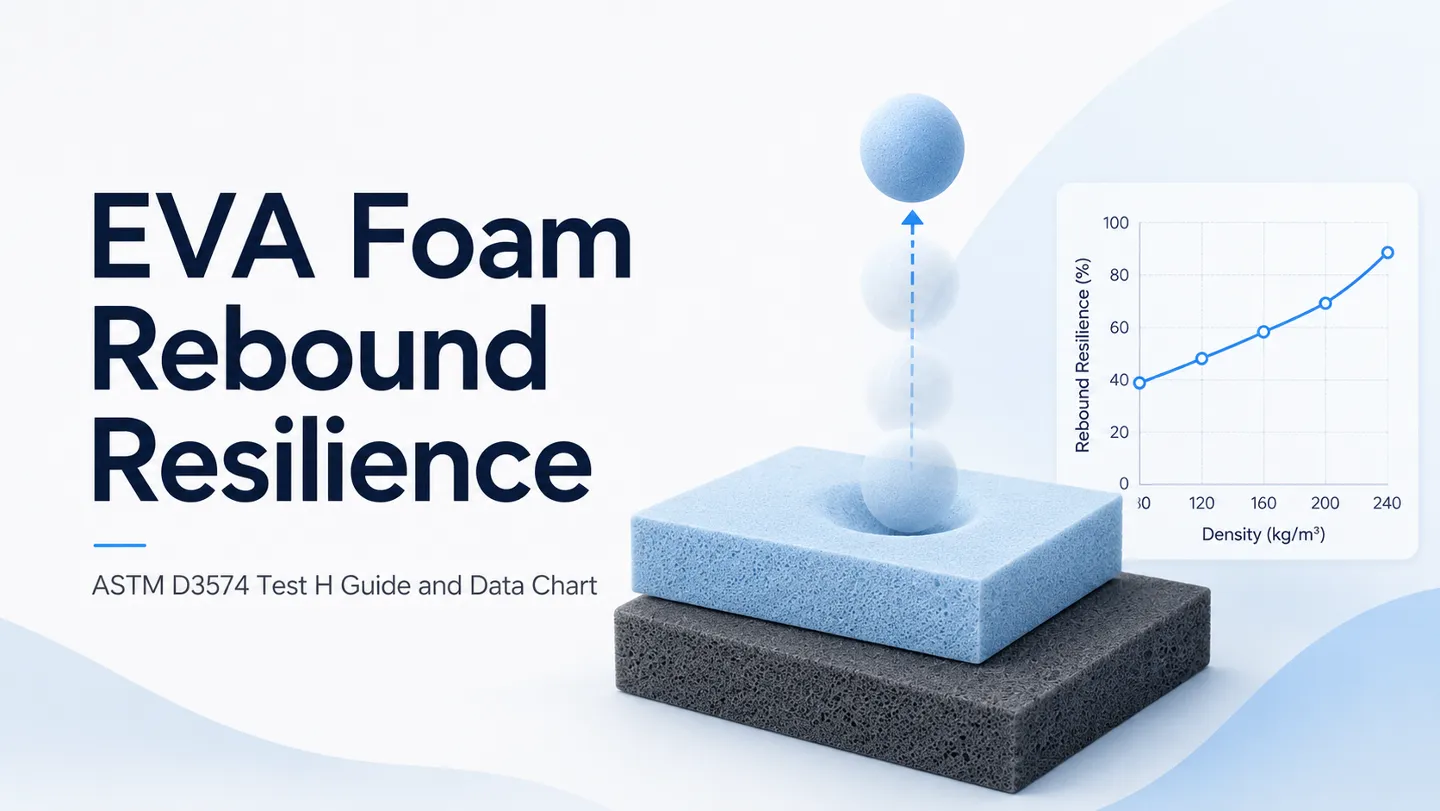
EVA foam rebound resilience (or “rebound ratio”) is the percentage of impact energy a foam returns after being struck, measured by dropping a 16 mm / 16.3 g steel ball from a 500 mm height onto the foam and recording how high it bounces back. The governing standard for flexible EVA foam is ASTM D3574 Test H (identical to ISO 8307); typical EVA values range from 30 % to 65 %, controlled by foam density and vinyl-acetate (VA) content.

If you spec EVA foam for shoe midsoles, sports padding, protective packaging, or vibration mounts, the rebound value tells you how much of an impact comes back as bounce versus how much is absorbed. This guide explains the correct test standard (a common point of confusion), the exact Test H procedure, the relationship between density / VA% and rebound, and how to write a rebound specification on a purchase order so a supplier like Damao Tech delivers material that actually performs.

What Is Rebound Resilience?

Rebound resilience is a direct measurement of a foam’s elasticity — how efficiently it stores and returns the kinetic energy of an impact. It is expressed as a percentage:

$$ \text{Rebound Ratio (%)} = \frac{\text{Rebound Height}}{\text{Drop Height}} \times 100% $$

  • High rebound (50–65 %+) → energy-return foam. The foam “throws back” the impactor. Used in running-shoe midsoles, sports flooring, trampoline pads.
  • Medium rebound (35–50 %) → balanced cushioning. Used in case inserts, knee pads, general protective padding.
  • Low rebound (20–35 %) → energy-absorbing foam. The impact is dissipated as heat instead of returning. Used in shock-absorbing packaging, fragile-product transport inserts, vibration damping.

This single number distinguishes “bouncy” EVA from “dead” EVA — two samples with identical density and Shore C hardness can still rebound very differently depending on VA content and crosslinking.

ASTM D3574 Test H: The Correct Standard for EVA Foam

For flexible cellular polymers (which includes EVA foam, polyurethane foam, and most closed-cell padding foams), the authoritative rebound test is:

  • ASTM D3574 – Test H: Ball Rebound Resilience
  • ISO 8307 — internationally equivalent, same procedure
  • GB/T 6670 — Chinese national equivalent

Test H Procedure

StepSpecification
SpecimenEVA foam pad, minimum 50 mm thick, 100 Ă— 100 mm or larger surface
Conditioning23 °C ± 2 °C, 50 % ± 5 % RH for ≥ 16 hours before test
Drop tubeClear vertical tube, internal diameter matched to ball
Steel ballDiameter 16 mm, mass 16.3 g (±0.5 g)
Drop height500 mm (measured from underside of ball to specimen surface)
MeasurementMaximum rebound height of the ball, read by light curtain or high-speed camera
ResultAverage of 5 drops at 5 different specimen locations

The reported rebound resilience is the ratio of rebound height to drop height, expressed as a percentage and rounded to the nearest 1 %.

Why Test H Matters for Buyers

Most low-cost EVA foam data sheets either omit rebound or quote a number from an unspecified test method. Insisting on “rebound ≥ X % per ASTM D3574 Test H” in your PO does three things:

  1. Locks the supplier to a single, repeatable method.
  2. Makes batch-to-batch comparison meaningful (different labs converge on the same number).
  3. Gives you a defensible specification if a shipment rebounds dramatically lower than ordered.

ASTM D3574 vs D2632 vs F1976: Don’t Mix These Up

The most common spec mistake on EVA orders is calling out the wrong standard. Each method was designed for a different material class:

StandardMaterialMethodWhen to Use
ASTM D3574 Test HFlexible cellular foam (EVA, PU)Ball drop, 500 mm, 16 mm / 16.3 g steel ballâś… Default for EVA foam rebound
ISO 8307Flexible cellular foamIdentical to D3574 Test HInternational contracts; same number
ASTM D2632Solid rubber (rubber sheet, gaskets)Vertical rebound of a falling plunger❌ Not appropriate for foam — gives misleadingly low values on EVA
ASTM F1976Athletic footwear midsolesImpact attenuation + energy return at higher impact energiesSports-shoe certification only
ASTM D2240Any polymerShore A / C / 00 durometerHardness, not rebound — often confused

If your supplier sends a rebound value tested per D2632, ask for retest per D3574 Test H. The numbers are not interchangeable.

How Density and VA Content Affect EVA Rebound

EVA foam rebound is driven by two production variables that you can spec on the order:

1. Density (kg/mÂł)

For a given EVA formulation, rebound generally increases with density up to a point, then plateaus. Very low-density EVA collapses under the ball and absorbs more energy; high-density EVA has stiffer cell walls that snap back.

2. VA (Vinyl Acetate) Content

VA percentage controls how rubbery the polymer matrix is. Higher VA = more elastomeric = higher rebound, but also softer and more expensive.

EVA GradeDensity (kg/mÂł)VA ContentTypical Rebound (D3574 Test H)Common Application
Low-density packaging foam33–6014–18 %25–35 %Shock-absorbing inserts, fragile-product packaging
Standard padding60–10018–22 %35–45 %Case interiors, general protective padding
Midsole / orthotic100–15022–28 %45–55 %Footwear midsoles, athletic insoles
High-rebound EVA130–18028–35 %55–65 %Running-shoe energy-return inserts, sports flooring
High-density structural180–28014–22 %40–50 %Tool-tray inserts, gaskets, load-bearing pads (rebound deliberately mid-range)

These ranges are typical for Damao Tech production lots; exact numbers depend on the crosslinking agent (usually DCP — dicumyl peroxide), foaming agent, and post-cure conditions.

Specifying Rebound on a B2B Purchase Order

When you order EVA foam for a performance-critical application, include all four lines below. Omitting any one of them lets the supplier ship a technically conforming but practically wrong product.

EVA foam, closed-cell
- Density:     XX  kg/m³  ± 5 %        (per ASTM D3575 Suffix W)
- Hardness:    XX  Shore C ± 3         (per ASTM D2240)
- Rebound:     ≥ XX %                   (per ASTM D3574 Test H / ISO 8307)
- Compression set: ≤ XX % at 50 % strain, 22 h @ 70 °C (per ASTM D3574 Test D)

For high-rebound shoe-midsole work, additionally cite ASTM F1976 for impact energy return — but keep D3574 Test H as the primary rebound number.

Quick Reference: Target Rebound by Application

ApplicationTarget Rebound (Test H)Why
Fragile-product packaging25–35 %Maximum energy absorption protects contents
Tool-case inserts35–45 %Cushioning without pushing tools back out
Knee / elbow pads40–50 %Balance protection and tactile feedback
Yoga / floor mats45–55 %Comfortable spring without instability
Running-shoe midsole55–65 %Returns energy to the runner per stride
Vibration-damping mount20–30 %Dissipates oscillation as heat

Frequently Asked Questions

Is “rebound” the same as “resilience”? In foam standards yes — ASTM D3574 Test H is officially titled “Ball Rebound Resilience.” “Rebound ratio” and “ball rebound” describe the same measurement.

Can I use ASTM D2632 results for EVA foam? No. D2632 is for solid rubber and uses a much heavier plunger; applying it to EVA foam under-reports rebound by 10–20 percentage points. Always specify D3574 Test H.

Does higher Shore C hardness mean higher rebound? Not necessarily. Hardness and rebound are independent properties — you can have a hard but “dead” foam (low rebound, high damping) or a softer high-rebound foam. Always specify both.

What is a “good” rebound value for EVA foam? There is no single “good” value — it depends on application. A 60 % rebound EVA is excellent for shoe midsoles but a terrible choice for shock-absorbing packaging.

Does Damao Tech provide test reports? Yes — for custom EVA orders Damao Tech can supply per-batch ASTM D3574 Test H rebound reports along with density, hardness, and compression-set data on request. Contact our engineers to discuss your spec sheet.

Next Steps

  • Determine your application’s target rebound from the reference table above.
  • Add the ASTM D3574 Test H line to your purchase order.
  • Request a sample lot with full test report before committing to a production order.

For density selection, see our EVA Foam Density Guide. For hardness, see EVA Foam Density & Hardness: Shore A, C, and 00 Guide.

Ready to spec a custom EVA foam grade with verified rebound performance? Explore our EVA foam capabilities or request a quote.
Tags :
Share :

Similar Posts

EVA Foam for Marine Applications: Durability and Safety Standards

EVA Foam for Marine Applications: Durability and Safety Standards

EVA Foam for Marine Applications: Durability and Safety Standards The marine environment presents some of the most challenging conditions for industrial materials, requiring resistance to high UV e

Read More
Specifying Marine EVA Foam: A Procurement Guide for Boat Owners and Manufacturers

Specifying Marine EVA Foam: A Procurement Guide for Boat Owners and Manufacturers

Specifying Marine EVA Foam: A Procurement Guide for Manufacturers Selecting the right marine decking material involves more than just choosing a color. For boat manufacturers and commercial vessel

Read More
Comparing TPU with Plastics in Automotive, Footwear, Medical

Comparing TPU with Plastics in Automotive, Footwear, Medical

Thermoplastic polyurethane (TPU) stands out among other commonly used plastics due to its unique combination of properties. In this article, we will compare TPU with other plastics commonly used in th

Read More
Custom Cut EVA Foam: Cutting Methods, Tolerances, and Applications

Custom Cut EVA Foam: Cutting Methods, Tolerances, and Applications

Custom cut EVA foam is used when standard sheet stock needs to become a finished part: a packaging insert, gasket, pad, spacer, protective liner, case interior, or adhesive-backed component. The r

Read More
Custom EVA Foam Fabrication Services: The Complete Guide

Custom EVA Foam Fabrication Services: The Complete Guide

Custom EVA Foam Fabrication Services Guide Our custom EVA foam fabrication services transform technical material data into application-specific components for industrial and consumer markets. B

Read More
Custom EVA Foam Inserts Guide: Design and Tool Box Organization

Custom EVA Foam Inserts Guide: Design and Tool Box Organization

Custom EVA Foam Inserts Guide: Design for Tool Boxes and Cases **Custom EVA foam inserts are precision CNC-routed closed-cell foam layers that lock specific tools, devices, or products into shaped

Read More
Dicumyl Peroxide (DCP) in EVA Foam: Crosslinking & Curing

Dicumyl Peroxide (DCP) in EVA Foam: Crosslinking & Curing

Dicumyl Peroxide (DCP) in EVA Foam This technical guide to Dicumyl Peroxide (DCP) in EVA foam analyzes the chemical crosslinking process that defines the material's final physical properties. P

Read More
What are the Disadvantages of EVA Foam? An Honest Buyer’s Guide

What are the Disadvantages of EVA Foam? An Honest Buyer’s Guide

What are the Disadvantages of EVA Foam? An Objective Analysis Ethylene-Vinyl Acetate (EVA) is widely celebrated for its lightweight cushioning and versatility. However, as an industry-leading m

Read More
Disposable Glove Management Guide: Safety & Cost Savings

Disposable Glove Management Guide: Safety & Cost Savings

Disposable Glove Management Guide This disposable glove management guide provides a framework to balance worker safety with operational efficiency. Managing glove supplies effectively prevents

Read More
Equine Balance Pads in EVA Foam for Horse Rehab and Stability

Equine Balance Pads in EVA Foam for Horse Rehab and Stability

Equine balance pads are widely used in horse rehabilitation, stability training, and conditioning because they create a controlled unstable surface that encourages small postural adjustments. When the

Read More
EVA foam sheets and fabrication factors for custom foam pricing

EVA Foam Cost Guide: What Affects Custom EVA Foam Pricing?

EVA Foam Cost Guide: What Affects Custom EVA Foam Pricing? EVA foam cost depends on more than sheet size. For custom projects, the final price is shaped by material density, thickness, formulat

Read More
EVA Foam Density Explained: The Ultimate Guide for Custom Parts

EVA Foam Density Explained: The Ultimate Guide for Custom Parts

EVA Foam Density Explained: The Ultimate Guide for Custom Parts EVA foam density is measured in kilograms per cubic meter (kg/m³) and typically ranges from 33 to 280 kg/m³. Low-density EVA (33–

Read More
EVA Foam Density & Hardness: Shore A, C, and 00 Guide

EVA Foam Density & Hardness: Shore A, C, and 00 Guide

EVA Foam Density & Hardness Guide This technical guide to EVA foam density and hardness provides the framework needed for precise material selection. Understanding the mechanical differences be

Read More
EVA Foam for Gaskets and Seals: Selection & Performance

EVA Foam for Gaskets and Seals: Selection & Performance

EVA Foam for Gaskets and Seals This guide to EVA foam for gaskets and seals analyzes the physical properties that drive industrial sealing performan

Read More
EVA Foam Engineering: Technical Considerations for Product Designers

EVA Foam Engineering: Technical Considerations for Product Designers

EVA Foam Engineering: Technical Considerations for Product Designers For product designers and industrial engineers, selecting the correct foam material requires an analysis of mechanical propertie

Read More
EVA Foam Manufacturer Guide: How to Choose a Custom Foam Factory

EVA Foam Manufacturer Guide: How to Choose a Custom Foam Factory

EVA Foam Manufacturer Guide: How to Choose a Custom Foam Factory Choosing the right EVA foam manufacturer matters when your project requires more than standard sheet stock. Industrial buyers of

Read More
EVA Foam Manufacturing Process: From Polymer Resin to Finished Sheets

EVA Foam Manufacturing Process: From Polymer Resin to Finished Sheets

EVA Foam Manufacturing Process: From Polymer Resin to Finished Sheets The production of high-performance Ethylene-Vinyl Acetate (EVA) foam is a multi-stage chemical and mechanical process that requ

Read More
EVA Foam Packaging Inserts for Electronics, Tools, and Medical Devices

EVA Foam Packaging Inserts for Electronics, Tools, and Medical Devices

EVA Foam Packaging Inserts for Electronics, Tools, and Medical Devices EVA foam packaging inserts protect products by holding each item in a stable, custom-fit cavity. Compared with loose void

Read More
EVA Foam Pricing Guide: Factors Driving Industrial Manufacturing Costs

EVA Foam Pricing Guide: Factors Driving Industrial Manufacturing Costs

EVA Foam Pricing Guide: Factors Driving Industrial Manufacturing Costs For procurement managers and product designers, understanding the pricing structure of Ethylene-Vinyl Acetate (EVA) foam is es

Read More
EVA Foam for Protective Packaging: Benefits & Custom Solutions

EVA Foam for Protective Packaging: Benefits & Custom Solutions

EVA Foam for Protective Packaging This guide to EVA foam for protective packaging analyzes why this material is the industry standard for safeguardi

Read More
EVA Foam Sheets Technical Guide: Understanding Density, Hardness, and Quality

EVA Foam Sheets Technical Guide: Understanding Density, Hardness, and Quality

Whether you are an engineer designing shock-absorbing industrial pads, a footwear manufacturer looking for the perfect midsole, or a creative professional building intricate props, the success of your

Read More
EVA Foam Supplier Guide: What Buyers Should Check Before Ordering

EVA Foam Supplier Guide: What Buyers Should Check Before Ordering

EVA Foam Supplier Guide: What Buyers Should Check Before Ordering Finding an EVA foam supplier is easy. Finding one who can support a custom B2B project with stable material, correct fabricatio

Read More
Industrial and Commercial Applications of EVA Foam: A Technical Overview

Industrial and Commercial Applications of EVA Foam: A Technical Overview

Industrial and Commercial Applications of EVA Foam: A Technical Overview Ethylene-Vinyl Acetate (EVA) foam's versatility is a result of its unique molecular structure, which combines the flexibilit

Read More
EVA vs PE Foam: A Complete Comparison Guide

EVA vs PE Foam: A Complete Comparison Guide

EVA vs PE Foam: A Complete Comparison Guide Selecting the wrong closed-cell foam causes immediate performance drop-offs and blown material budgets. This comprehensive guide compares **EVA vs PE foa

Read More
How to Cut EVA Foam Cleanly and Precisely

How to Cut EVA Foam Cleanly and Precisely

How to Cut EVA Foam Cleanly and Precisely **To cut EVA foam cleanly, use a sharp snap-off utility knife for sheets under 10 mm, a hot knife for smooth sealed edges on curves, or a bandsaw for foam

Read More
How to Glue EVA Foam: Complete Adhesive Guide

How to Glue EVA Foam: Complete Adhesive Guide

How to Glue EVA Foam: Complete Adhesive Guide Attempting to bond closed-cell polymers with standard household glues causes immediate seam failure. This guide explains perfectly how to glue EVA foam

Read More
How to Make Foam Armor: The Ultimate Guide Using Professional EVA Foam

How to Make Foam Armor: The Ultimate Guide Using Professional EVA Foam

How to Make Foam Armor: A Professional Guide to Fabrication Creating movie-quality armor is a blend of artistry and material science. The secret held by professional prop makers isn't just skill—it

Read More
How to Specify Custom EVA Foam: A Technical Guide

How to Specify Custom EVA Foam: A Technical Guide

How to Specify Custom EVA Foam Requirements This guide on how to specify custom EVA foam requirements helps procurement managers provide the technical data needed for accurate manufacturing. Ef

Read More
Product Update: Introducing Our New Foldable Yoga Mats, Smart Jump Ropes & Foam Rollers

Product Update: Introducing Our New Foldable Yoga Mats, Smart Jump Ropes & Foam Rollers

Introduction We are excited to announce a major update to our best-selling fitness lineup. At Damao Tech, we understand that fitness gear is more than just equipment—it is a lifestyle statement.

Read More
Private Label Manufacturing for Equestrian Brands: Build a Custom Stability Pad Line

Private Label Manufacturing for Equestrian Brands: Build a Custom Stability Pad Line

If you want to grow your equestrian brand without building a factory, private label manufacturing gives you a practical way to launch a custom stability pad line with less risk. The right factory

Read More
Reaching Further for Safety & Hygiene: Your Essential Guide to Disposable Veterinary Long Arm Exam Gloves

Reaching Further for Safety & Hygiene: Your Essential Guide to Disposable Veterinary Long Arm Exam Gloves

Hey there, fellow animal care pros! đź‘‹ Whether you're a seasoned veterinarian, a dedicated vet tech, a student learning the ropes, or even a farmer managing livestock health, you understand that veter

Read More
Safe EVA Foam for Children's Toys & Play Mats: Standards, Durability & Design Tips

Safe EVA Foam for Children's Toys & Play Mats: Standards, Durability & Design Tips

Ethylene-Vinyl Acetate (EVA) foam is a highly flexible, shock-absorbing copolymer widely used in nurseries, schools, and playrooms. Parents and manufacturers prioritize this material because it provid

Read More
Shoulder Length Plactic Gloves with Elastic Band Cuff

Shoulder Length Plactic Gloves with Elastic Band Cuff

Introduction: Shoulder length plastic gloves have become increasingly popular in a variety of industries and professions, such as veterinary medicine, food service, and industrial settings. These

Read More
Specifying EVA Foam Sheets & Rolls

Specifying EVA Foam Sheets & Rolls

Unlock the Potential: Specifying Your Ideal EVA Foam Ethylene-Vinyl Acetate (EVA) foam is a remarkably versatile material, prized for its soft, flexible, yet durable nature.

Read More
Sustainable Custom EVA Foam for Yoga Props: Eco-Friendly Options for High-End Brands

Sustainable Custom EVA Foam for Yoga Props: Eco-Friendly Options for High-End Brands

High-end yoga brands face a persistent challenge: balancing product performance with environmental responsibility. Advanced manufacturing techniques now allow brands to produce sustainable EVA yoga pr

Read More
7 Key Advantages of EVA Foam for Industrial Manufacturing

7 Key Advantages of EVA Foam for Industrial Manufacturing

7 Key Advantages of EVA Foam for Industrial Manufacturing Ethylene-Vinyl Acetate (EVA) foam has established itself as a critical material in the global manufacturing supply chain. Its unique combin

Read More
Veterinary shoulder length Gloves

Veterinary shoulder length Gloves

Introduction Shoulder length plastic gloves, a staple in various industries such as veterinary medicine, food service, and industrial settings, have seen a surge in popularity. These gloves are de

Read More
Water Resistance and Buoyancy of EVA Foam: Properties and Applications

Water Resistance and Buoyancy of EVA Foam: Properties and Applications

EVA foam, or Ethylene-Vinyl Acetate foam, is a versatile, lightweight, and durable material widely used across industries for its exceptional water resistance and buoyancy. Whether you're a manufactur

Read More
What are the differences between EVA and TPE materials?

What are the differences between EVA and TPE materials?

EVA vs. TPE: Which Material is Best for Your Next Project? Choosing the right material can make or break your product's performance, durability, and market appeal. In the world of polymers, **EVA (

Read More
What is EVA Foam? Properties, Manufacturing, and Industrial Applications

What is EVA Foam? Properties, Manufacturing, and Industrial Applications

What is EVA Foam? Technical Properties and Manufacturing Guide Ethylene-Vinyl Acetate (EVA) foam is a closed-cell elastomeric polymer known for its exceptional stress-crack resistance, low-temperat

Read More
What is a Disposable Plastic Gloves Machine?

What is a Disposable Plastic Gloves Machine?

In sectors where hygiene and safety are paramount, such as healthcare, food service, and cleanroom environments, disposable gloves are an indispensable part of daily operations. But have you ever paus

Read More
What is EVA Foam? Complete Technical Materials Guide

What is EVA Foam? Complete Technical Materials Guide

What is EVA Foam? Complete Technical Materials Guide Industrial manufacturers frequently struggle to source structural materials that combine heavy shock absorption with absolute waterproofing. Thi

Read More
What is EVA Foam Padding? Material Definition and Guide

What is EVA Foam Padding? Material Definition and Guide

What is EVA Foam Padding? Material Definition and Guide EVA stands for Ethylene-Vinyl Acetate — a closed-cell copolymer of ethylene gas and vinyl acetate (VA). EVA foam padding is the foamed fo

Read More
Yoga Roller

Yoga Roller

[vc_row][vc_column width="1/1"][vc_column_text]A yoga roller, also known as a foam roller, is a cylindrical tool made from high-density foam used for self-massage, muscle recovery and improv

Read More