EVA Foam Cost Guide: What Affects Custom EVA Foam Pricing?
- Damao Tech
- EVA Foam
- 03 May, 2026
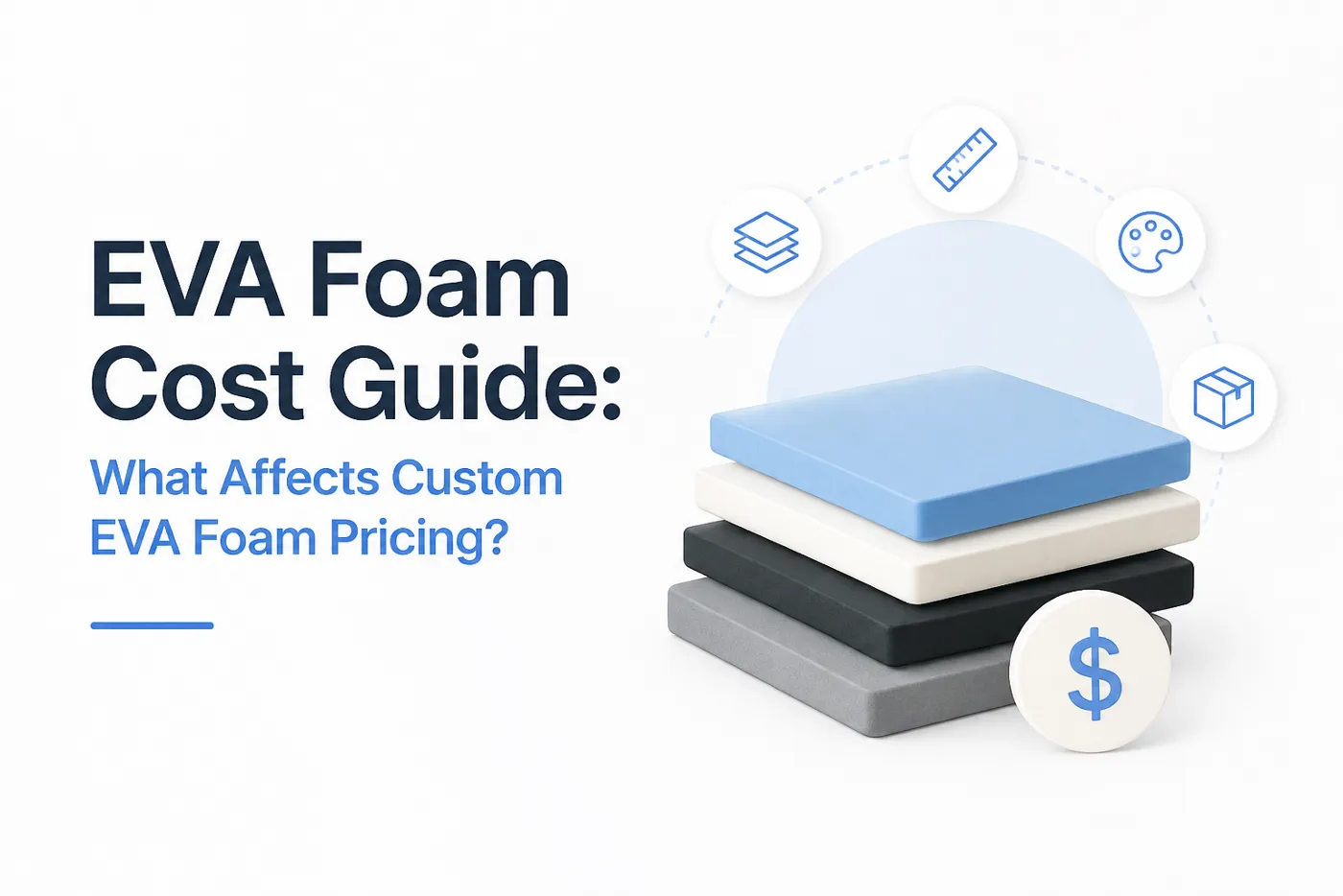
EVA foam cost depends on more than sheet size. For custom projects, the final price is shaped by material density, thickness, formulation, color, fabrication method, tooling, lamination, packaging, and order volume. Understanding these factors helps buyers compare quotes correctly and avoid choosing a low price that does not match the final application.
If you need a material and fabrication quote, start from Damao Tech’s custom EVA foam manufacturer page.
Main Factors That Affect EVA Foam Cost
A custom EVA foam quote usually combines material cost, processing cost, setup cost, and logistics cost. Each part of the quote should be reviewed separately.
| Cost Factor | Why It Matters | Typical Buyer Question |
|---|---|---|
| Density | Higher density uses more material and changes cutting behavior | What density is required for the load? |
| Thickness | Thick foam requires more material and may need different cutting methods | What thickness tolerance is acceptable? |
| Color | Custom colors may require pigment matching and setup | Is standard black acceptable or is Pantone matching required? |
| Fabrication | CNC, die cutting, routing, and lamination have different costs | Which process fits the design and quantity? |
| Tooling | Dies, molds, and fixtures may be one-time costs | Can the design justify tooling investment? |
| MOQ | Small runs carry higher setup cost per unit | What annual volume should be considered? |
| Packaging | Foam is lightweight but bulky | How can packing reduce volumetric freight cost? |
For a broader cost breakdown, see our existing EVA foam pricing guide.
Density and Thickness: The Base Material Cost
Density is one of the largest cost drivers because it determines how much raw material is used in a given volume. A high-density EVA foam sheet is usually more expensive than a low-density sheet of the same size and thickness. However, using foam that is too soft may cause poor support, compression set, or damaged packaging.
Thickness also affects cost. Thin sheets may require careful skiving control, while very thick foam may require slower cutting, routing, or multi-layer construction. Buyers should avoid over-specifying thickness if the application can perform with a more efficient design.
Fabrication Method and Unit Price
The same foam material can have very different final costs depending on how it is converted into a part.
- Die cutting: efficient for high-volume flat shapes after tooling is made.
- CNC routing: better for prototypes, pockets, multi-depth inserts, and complex layouts.
- Waterjet cutting: useful for detailed flat profiles where thermal effects should be avoided.
- Thermoforming: requires mold and heat-processing setup for shaped components.
- Lamination: adds cost but can improve appearance, bonding, or assembly efficiency.
For method selection, read custom EVA foam fabrication services and custom cut EVA foam.
Tooling, Sampling, and MOQ
A low unit price may not be meaningful if tooling is high and order volume is small. Conversely, a higher setup cost can be economical when spread across a large production run.
When comparing suppliers, ask them to separate:
- Sample cost.
- Tooling or programming cost.
- Material cost.
- Fabrication cost.
- Packaging cost.
- Freight estimate.
This makes it easier to compare quotes from different suppliers and understand the break-even point between CNC prototyping and die-cut mass production.
Custom Features That Increase Cost
Some custom features are worthwhile because they improve product protection, appearance, or assembly efficiency. Others may be unnecessary depending on the application.
Features that can increase cost include:
- Pantone or RAL color matching.
- Two-tone laminated foam.
- Flocking, fabric, film, or velvet lamination.
- Pressure-sensitive adhesive backing.
- Anti-static or ESD grades.
- Flame-retardant or UV-resistant additives.
- Tight tolerance CNC pockets.
- Individual packing or export cartons.
Use these features where they support the final product requirement, not simply because they are available.
How to Reduce Custom EVA Foam Cost Without Reducing Performance
Cost optimization should focus on design efficiency, not just cheaper material. Practical options include:
- Confirm the lowest density that still passes fit and protection testing.
- Use standard colors when branding does not require custom matching.
- Simplify pocket geometry where it does not affect product protection.
- Increase order quantity to reduce setup cost per unit.
- Switch from CNC to die cutting after the design is validated and volume increases.
- Improve nesting to reduce material waste.
- Review packaging dimensions to reduce volumetric freight.
A manufacturer can often suggest design changes that reduce waste while preserving the functional requirement.
Information Needed for an Accurate Price
To quote custom EVA foam accurately, send:
- Drawing, CAD file, or sample photo with dimensions.
- Required density, thickness, and hardness if known.
- Application and product weight.
- Quantity and forecast volume.
- Color, lamination, and adhesive requirements.
- Tolerance and critical dimensions.
- Packaging and destination country.
- Compliance or testing requirements.
If you are unsure about the specification, use our custom EVA foam requirements guide before requesting a quote.
Summary
EVA foam price is driven by material selection, fabrication complexity, tooling, order quantity, and logistics. The best quote is not always the lowest initial price; it is the one that matches the part function, production volume, and quality requirements.
Damao Tech provides custom EVA foam for packaging inserts, gaskets, pads, sheets, rolls, and precision-cut industrial parts. Send your drawing or sample requirement to receive a practical cost review.