Wholesale Yoga Towels: Custom & Bulk Buying Guide for Brands (2026)
- Damao Tech
- Yoga
- 04 Oct, 2026
Nobody searching for “wholesale yoga towels” wants a three-pack off a retail shelf. They are studio owners outfitting hot yoga rooms, DTC brands building a private-label line, hotel buyers stocking wellness amenities, or corporate wellness managers kitting out retreats — and they need to know what a bulk towel actually costs, which print method survives a hundred wash cycles, and how to tell a real textile manufacturer from a middleman.
This guide covers the full picture: microfiber vs. cotton-blend vs. suede fabrics, silicone grip-dot technology, sublimation vs. screen printing for custom logos, MOQ tiers from 100 units, pricing drivers, and a vetting checklist for manufacturers. Whether you need a personalized yoga towel run of 100 units or 10,000 towels for a hotel rollout, the sections below will keep you from ordering the wrong fabric. When you are ready to talk numbers, request a quote — or keep reading and come back with better questions.
Why Brands Buy Yoga Towels in Bulk: The Business Case
A branded yoga towel is the cheapest retention tool a studio owns. It appears in every class photo, goes home in gym bags, and nobody hesitates to buy a second one. For hotels, it is an amenity that reads premium at a unit cost below the shampoo bottles in the bathroom.
Four buyer profiles dominate wholesale yoga towels:
- Yoga studios and chains — grip towels for hot rooms and retail corners. Typical orders: 100–500 units per design, reordered quarterly.
- DTC and private-label brands — accessories lines on Shopify or Amazon, usually paired with mats. Typical orders: 500–3,000 units with custom packaging.
- Hotels, resorts, and spas — wellness amenities and spa retail. Typical orders: 1,000–10,000 units, deadline-driven.
- Corporate wellness buyers — retreat and onboarding-kit swag. Typical orders: 200–2,000 units, where logo accuracy beats price.
Key Takeaway: Know which buyer you are before requesting quotes. Studios care about grip and fast reorders; DTC brands care about unit cost and packaging; hotels care about surviving hundreds of laundry cycles.
Towel Fabrics Compared
Fabric decides two things: performance on a sweaty mat, and how your logo looks after fifty washes. Three options dominate:
Microfiber (The Workhorse)
- Build: 80/20 or 85/15 polyester-polyamide split microfiber, 200–300 GSM.
- Performance: most absorbent — holds several times its weight in water, dries fast between back-to-back hot classes.
- Customization: takes dye sublimation beautifully; full-color edge-to-edge designs with zero hand feel.
- Best for: branded studio towels and DTC lines. Trade-off: the classic “grabby” texture is not for everyone.
Cotton Blend (The Natural Feel)
- Build: 60/40 or 70/30 cotton-polyester, 300–400 GSM.
- Performance: softer hand, familiar terry texture; dries slower than microfiber.
- Customization: screen print or embroidery only — sublimation cannot bond to cotton.
- Best for: hotel and spa amenities where natural fibers are the brand story. Trade-off: surface prints fade faster.
Suede Microfiber (The Premium Tier)
- Build: flat-weave microfiber with a suede finish, 180–250 GSM.
- Performance: smooth, lint-free, packs small; slightly less absorbent than terry.
- Customization: excellent for sublimation — razor-sharp detail and fine text.
- Best for: premium DTC and corporate gifts. Trade-off: thinner feel can read as less substantial.
Key Takeaway: Full-color design? Choose microfiber or suede with sublimation — no ink layer means nothing to crack or peel. Natural-fiber brand story? Accept screen print or embroidery on cotton blend and budget for faster wear.
Grip Dots: The Silicone Detail That Defines a Yoga Towel
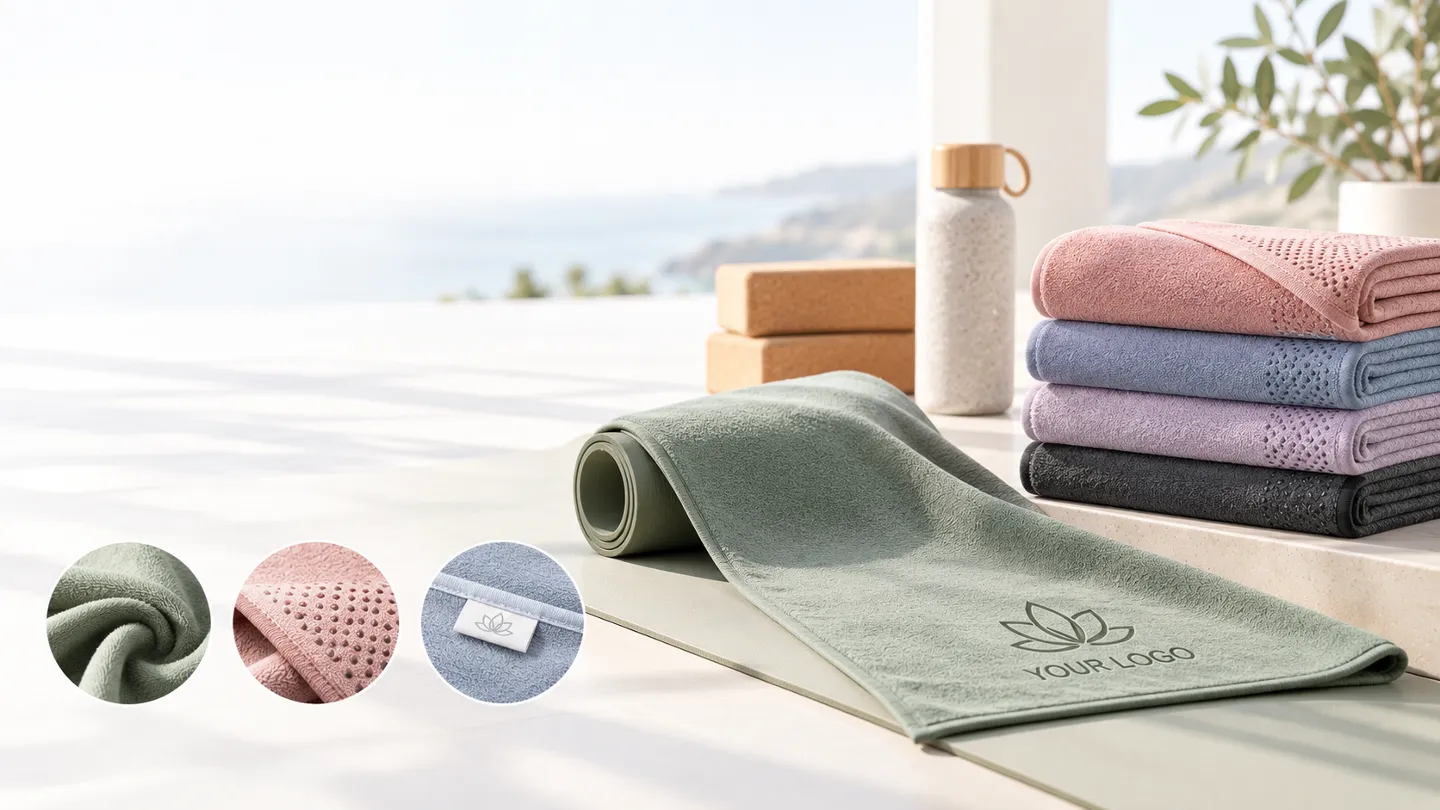
Grip dots separate a yoga towel from a gym towel — and they are the top quality differentiator in bulk orders. Silicone nubs on the underside bite into the mat and stop the towel bunching mid-flow. Specify:
- Pattern: full-coverage grids grip best; corner-only patterns are cheaper but shift in practice. Ask for a photo of the actual layout, not a rendering.
- Compound: textile-grade silicone, heat-cured. Cheap PVC-based dots harden and crack with washing — the classic bargain-towel failure.
- Density: roughly 2–3 mm dots on a 3–4 cm grid is the industry standard. Denser grips better but adds cost.
- Proof: ask for a towel after 50+ industrial wash cycles. Dots peeling at the edges? Walk away.
One thing buyers miss: dots go on the underside, so double-sided designs need print and dots registered correctly. Confirm dots are applied after printing — and judge alignment from a physical sample, never photos.
Key Takeaway: Spec the silicone, not just the dots. Compound, cure method, wash evidence. Dots fail first on cheap towels and drive most returns.
Custom Printing: Sublimation vs. Screen Print vs. Embroidery
Print method decides whether your logo looks sharp in year two or washed out by month three.
| Dye Sublimation | Screen Print | Embroidery | |
|---|---|---|---|
| How it works | Heat transfers dye into polyester fibers | Ink through a mesh screen onto fabric | Thread stitched into the towel |
| Durability | Permanent — cannot crack, peel, or fade | Good (1–2 years of regular washing) | Excellent — outlasts the towel |
| Detail | Full color, photographic, edge-to-edge | Bold graphics, limited colors | Simple logos and text |
| Works on | Microfiber, suede (polyester-based) | Any fabric, best on cotton blend | Any fabric, best on heavier weaves |
| Best for | All-over designs, gradients | 1–3 color logos on cotton towels | Hotel/spa logos, premium minimal branding |
| Relative cost | $ | $ | $$$ |
Sublimation is the default for custom yoga towels for a reason: dye bonds at the molecular level, so there is no hand feel and nothing to crack — ever. Constraint: it needs light-colored polyester, and deep navy or black can shift in hue. Dark brand color? Approve a strike-off (printed swatch) before bulk.
Key Takeaway: Default to sublimation on microfiber or suede for full color. Screen print for simple cotton-towel logos. Embroidery only when budget allows — beautiful, but 3–5x sublimation cost per unit.
Sizes: What to Order
Wrong size is the number one complaint in bulk towel orders — a towel that does not cover the mat is useless. The lineup:
- Mat towel (the standard): 68” × 24” (173 × 61 cm). What 90% of studios order — quote against this first.
- Oversized: 72” × 26” for taller practitioners; roughly 10% more fabric cost.
- Hand towel: 16” × 26” for face, hands, amenity kits, event swag. The natural second SKU.
- Corner-pocket: sewn pockets hook over mat ends — stays put without relying on dots. Premium differentiator, adds a sewing step.
- GSM guide: 200–250 suede, 250–300 microfiber terry, 300–400 cotton blend. Above 350 GSM, dry time hurts studios.
Bundle opportunity: towels pair naturally with mats. A custom towel + mat set (see our custom yoga mat guide) lifts average order value and gives retailers a ready-made set.
Key Takeaway: Start with the 68” × 24” mat towel. Add hand towels second. Corner pockets differentiate if the budget allows.
MOQs and Pricing in 2026
MOQs for custom yoga towels are lower than most buyers expect — textile print lines change over fast. When buying yoga towels bulk, current reality:
- Studio tier: 100–200 units per design. Small-batch sublimation; highest unit cost, but you can test three designs with minimal risk.
- Brand tier: 500–1,000 units. The DTC sweet spot — meaningful per-unit savings, custom packaging economical, Pantone matching available.
- Scale tier: 3,000+ units. Container pricing; negotiate dedicated runs, custom GSM, exclusive colorways.
Unit price drivers, in order:
- Fabric and GSM — the biggest lever; heavier weaves and cotton blends cost more.
- Size — a hand towel can cost half a mat towel; mostly fabric area.
- Print complexity — sublimation setup is cheap regardless of color count; screen print climbs past 3 colors; embroidery is priced by stitch count.
- Grip dots — an extra process step; full coverage costs more, and some factories price dots as an add-on.
- Packaging — belly band over polybag is cheap; a rigid gift box can add 20–30% to landed cost.
- Volume — 200 to 1,000 units typically cuts unit cost 25–35%.
Key Takeaway: Quote two quantities (200 and 1,000). The gap tells you how fast to scale.
Private-Label Packaging
For DTC and retail, packaging is what the customer photographs. Cheapest to priciest: polybag with branded sticker (studio minimum) → printed belly band (cheap, sharp, easy per design) → hang tag with story card (Amazon/DTC standard) → custom box or tube (gift sets; budget for dielines and longer first-order lead time).
Amazon note: belly bands tear in warehouse bins. A polybag inside the band is the cheap insurance most brands use.
Vetting a Manufacturer: Checklist & Red Flags
Most “manufacturers” on B2B marketplaces are trading companies marking up someone else’s mill. Checklist before any deposit:
Green flags:
- Live factory video — see sublimation printers, cutting tables, sewing lines.
- Certifications — OEKO-TEX or equivalent for fabric; textile-grade silicone confirmation.
- Wash-tested samples — wash ten times yourself; check print, dots, edges. Never approve from photos.
- MOQ and lead time in writing — including rush-reorder terms.
- Reference customers — two brands in your segment, ideally one that reorders.
Red flags (any one = walk away):
- No factory address or refuses video.
- 50% below every other quote (wrong GSM, no-name silicone, no QC).
- 100% upfront — standard is 30% deposit, 70% against B/L or inspection.
- Cannot explain sublimation vs. screen print or which fabrics each suits.
- No samples, or samples “take 6 weeks” (no stock = likely trader).
Lead Times and Freight
Realistic calendar for a custom order:
- Samples: 7–10 days for a strike-off; 10–15 for a sewn sample with dots.
- Bulk: 20–30 days after approval under 5,000 units; 30–40 above.
- Ocean freight: 25–40 days. Towels cube out before they weigh out — get carton dimensions early and price on volume.
- Air: viable for sub-500-unit emergency reorders at roughly 4–6x ocean cost.
Plan backwards: January studio launch → approve samples by early September. Holiday retail → sail by early September. Reorders run 6–8 weeks door to door.
Frequently Asked Questions
What is the minimum order for wholesale yoga towels?
100–200 units per design for sublimated microfiber — enough to test three designs affordably. Mid-tier is 500–1,000 units. Anyone demanding container quantities for a first order is not set up for brands.
Sublimation or screen print for custom yoga towels?
Sublimation for full-color designs on microfiber or suede: permanent, zero hand feel, and color count does not affect cost. Screen print for simple 1–3 color logos on cotton blend, where sublimation cannot bond. Embroidery is the premium option for hotel and spa branding.
Do yoga towels need silicone grip dots?
Yes — buyers expect them as standard. Dots stop the towel bunching on the mat mid-flow. Specify textile-grade, heat-cured silicone in full coverage; cheap PVC-based dots harden and crack with washing.
How long do production and shipping take?
Samples 7–15 days; bulk production 20–40 days after approval; ocean freight 25–40 days. Plan 3–4 months from first contact to warehouse; reorders run 6–8 weeks.
Can I get my logo in exact brand colors?
Mostly. Sublimation hits Pantone closely on light fabrics, but dark backgrounds can shift — always approve a physical strike-off first. Screen print uses spot colors and nails brand colors exactly.
What packaging works for private-label yoga towels?
Polybag with sticker, then belly band, then hang tag with story card, then custom box or tube for gift sets. For Amazon, put a polybag inside the belly band — bands alone tear in warehouse bins.
Ready to put your brand on a towel? Request a quote with your target quantity, fabric, and design — we will come back with MOQs from 100 units, sublimation strike-offs, and wash-tested samples so you can feel the grip dots yourself.