Wholesale Yoga Blocks: Bulk Buying Guide for Studios, Retailers & Brands (2026)
- Damao Tech
- Yoga
- 04 Oct, 2026
Nobody searching for “wholesale yoga blocks” wants a six-pack from a retail listing. They are studio chains outfitting twenty locations, DTC brands building a prop line, distributors filling a container, or corporate buyers kitting out a wellness program — and they need to know what a block costs at 500 units, which material survives daily studio abuse, and how to tell a real yoga block manufacturer from a trading company.
This guide covers the full picture: EVA vs. cork vs. foam materials, the sizes and densities that sell, custom logo printing, MOQs and bulk pricing for 2026, and a manufacturer vetting checklist. Whether you need 100 blocks or 10,000, the sections below will keep you from overpaying. Ready to talk numbers? Request a quote. Also see our custom yoga mat guide.
The Bulk Business Case: Why Blocks Are a Margin Product
A yoga block is one of the highest-margin props in the studio retail corner. Cheap to make, efficient to ship, and sold at 3–4x wholesale cost. Unlike mats, blocks wear out — studios reorder every year or two, making them a repeat-purchase product rather than a one-time sale.
Three buyer profiles dominate the bulk yoga blocks market:
- Yoga studio chains — outfitting and refreshing locations. Typical: 100–1,000 units in brand colors.
- DTC wellness brands — private-label prop lines. Typical: 500–5,000 units with custom packaging.
- Distributors and corporate buyers — containers for resale; retreat and office kits. Typical: 2,000–10,000+ units.
Key Takeaway: Blocks are a reorder product, not a one-off. Pick a supplier you can grow with — switching manufacturers mid-line means mismatched colors and densities your customers will notice.
EVA vs. Cork vs. Foam: Block Materials Compared
The material decides how the block feels, how long it lasts, what it costs to ship, and which logo methods work. The three materials you will encounter are high-density EVA, natural cork, and soft foam — and they serve very different buyers.
High-Density EVA (The Workhorse)
- Construction: closed-cell EVA foam, compression-molded. Lightweight, water-resistant, wipes clean.
- Feel: firm with slight give; supports full body weight.
- Durability: excellent. Resists dents, cracking, and moisture through years of daily classes.
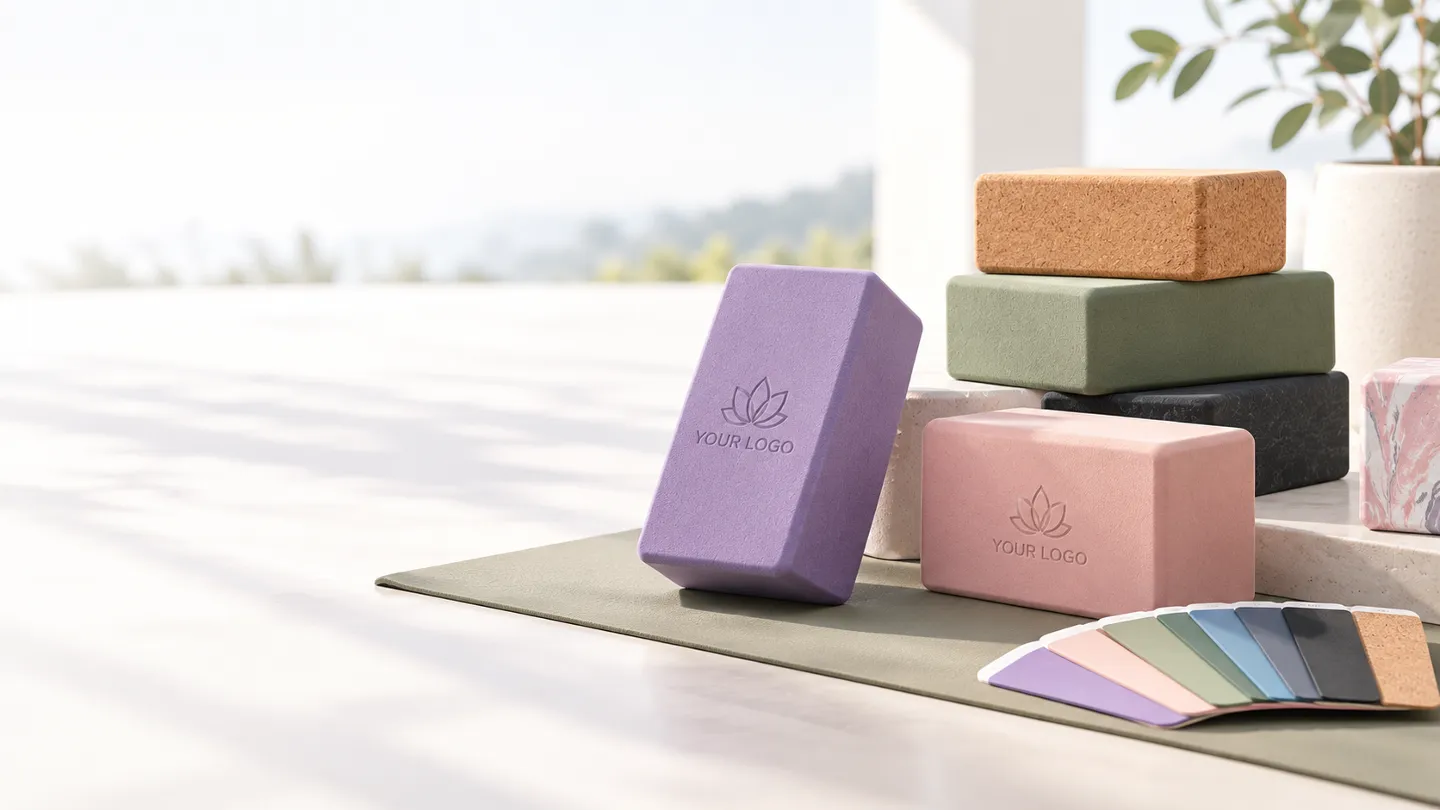
- Customization: screen printing and heat debossing; debossed logos are permanent.
- Best for: studio chains, DTC brands, and volume orders of wholesale yoga blocks — the default for roughly 80% of B2B buyers.
- Trade-off: petroleum-based; eco-positioned brands usually offset this with a cork premium SKU.
Natural Cork (Premium Tier)
- Construction: granulated cork bark heat-pressed into a solid block. No glues, no plastics — the most natural option on the market.
- Feel: firmer than EVA; warm textured grip improves with sweat.
- Durability: outstanding. Resists odor and moisture, naturally antimicrobial, does not shed.
- Customization: laser engraving and debossing; engraving is the premium finish.
- Best for: premium studio brands, eco-positioned DTC labels, and corporate programs. Buying cork yoga blocks wholesale means selling a story as much as a product.
- Trade-off: heavier (roughly 2x EVA), raising freight cost per unit; unit cost runs 2–3x EVA.
Soft / Recycled Foam (Budget Tier)
- Construction: lower-density foam, sometimes pressed from recycled EVA offcuts.
- Feel: softer — compresses under body weight. Fine for restorative, inadequate for power yoga.
- Durability: fair. Dents and compresses with heavy studio use; expect a shorter replacement cycle.
- Customization: screen printing only — the surface is too soft for a clean deboss.
- Best for: giveaways, beginner kits, and ultra-price-sensitive bulk orders.
- Trade-off: a false economy for studios.
Key Takeaway: Default to high-density EVA for volume orders and add cork as your premium SKU. That two-SKU lineup covers every buyer from budget studios to eco-luxury brands.
Sizes, Densities & Shapes: Specifying Your Block
Get the spec wrong and nothing else matters — an under-dense block is the number one complaint in bulk orders. The industry standard is 9” × 6” × 4” (23 × 15 × 10 cm), which suits the vast majority of practitioners. A slimmer 9” × 6” × 3” variant serves travel kits and smaller-framed users.
On density, insist on high-density EVA — 50 kg/m³ and up. Below that threshold, blocks dent under body weight and develop permanent compression marks within months. Ask for the density figure in writing; a manufacturer that cannot quote it is not one you want.
Also look for beveled edges, single-piece molding (no delamination risk), and color through the core — cheap blocks are surface-dyed, and a scratch reveals white foam.
Key Takeaway: Spec one standard SKU (9×6×4”, high-density EVA, beveled edges) and one premium SKU (same size, natural cork). Two SKUs cover 90% of B2B demand and keep inventory simple.
Custom Logo Printing: Screen Print vs. Deboss vs. Laser
Your logo turns a commodity prop into your brand’s billboard in a hundred studios. Here is how the three printing methods compare.
| Screen Printing | Heat Deboss | Laser Engraving | |
|---|---|---|---|
| How it works | Ink pressed through a mesh screen onto the block surface | Heated die presses the design into the foam | Laser etches the design into cork |
| Durability | Good — but can scuff with heavy handling | Permanent — part of the block itself | Permanent — cannot fade or peel |
| Detail level | Full color, fine detail | Tonal; bold shapes and text work best | Extremely fine, tonal |
| Best material | EVA and soft foam | High-density EVA | Natural cork |
| Best for | Colorful logos, small batches | Studio workhorse blocks at volume | Premium cork lines |
| Relative cost | $ | $$ | $$$ |
Deboss deserves special attention for B2B buyers. The industry standard for wholesale yoga blocks: die setup amortizes to nearly nothing past 500 units, the mark is permanent, and it reads premium without laser’s per-unit cost. For cork, laser engraving is the expected finish.
Key Takeaway: Deboss your EVA blocks, laser-engrave your cork blocks. Screen print only when you need full-color artwork or are testing a design at low volume.
MOQs and Unit Pricing: What to Expect in 2026
MOQs for yoga blocks are lower than most buyers assume — no container needed to launch a private-label line. Current market reality:
- Starter tier: 100–300 units per design/color. Small-batch print lines; highest unit cost, but minimal risk to test colors.
- Mid tier: 500–1,000 units. The sweet spot — real per-unit savings; custom colors and packaging become economical.
- Scale tier: 5,000+ units. Container pricing; negotiate custom molds and exclusive colorways.
What drives the unit price (in order of impact):
- Material — cork costs 2–3x high-density EVA. This is the single biggest lever.
- Density — higher-density EVA uses more material per block.
- Customization — deboss die setup is a one-time cost; screen print adds per-unit ink and labor.
- Packaging — a printed box or sleeve can add 10–20% to landed cost. Worth it for retail.
- Order volume — the usual curve; the jump from 300 to 1,000 units typically cuts unit cost 20–30%.
Key Takeaway: Always get quotes at two quantities (e.g., 300 and 1,000 units). The price break between them tells you how aggressively to plan your first reorder.
Private-Label Packaging: What “Retail-Ready” Means
Packaging is what separates a wholesale commodity from a retail product. Decide among these tiers before you request quotes — packaging lead time can exceed production lead time if you leave it late.
- Bulk polybag — cheapest, fine for studio-direct orders where blocks go straight onto shelves.
- Printed belly band or sleeve — logo, barcode, care instructions. Minimum viable retail branding.
- Full-color box — the DTC standard; justifies premium pricing, protects in transit.
- Eco packaging for cork lines — recycled kraft, soy inks, no plastic.
Confirm whether quotes include packaging — the most common source of confusion in this category.
How to Vet a Yoga Block Manufacturer: Checklist & Red Flags
Most “manufacturers” on B2B marketplaces are traders marking up someone else’s molding line. Use this checklist before sending a deposit.
Green flags (ask for all five):
- Factory video or live call — see the molds, deboss stations, and cork presses.
- Density and material specs in writing — EVA density (kg/m³), cork grade, and confirmation of single-piece molding.
- Physical samples — never approve from photos. Stand on it, scratch the logo, check edges and color-through.
- MOQ, lead time, and payment terms in writing — including rush-reorder terms.
- Reference customers — at least two brands or distributors in your market you can contact.
Red flags (any one is a walk-away):
- No factory address or refuses video verification.
- Cannot quote EVA density — means they are reselling, not molding.
- Quotes 50% below everyone else (under-dense foam or no QC — there is no magic).
- Demands 100% payment upfront. Standard is 30% deposit, 70% against bill of lading or pre-shipment inspection.
- Ships samples that differ from the quoted spec (“the bulk goods will be the same” — they will not be).
Lead Times & Freight: Planning Your First Order
Blocks are bulky — freight planning matters more here than for most yoga props. A standard block occupies real cubic meters, so ocean freight is priced on volume, not weight.
- Samples: 5–7 days plus courier time.
- Bulk production: 20–30 days after sample approval.
- Ocean freight: 25–40 days. Under a full container, LCL keeps cash sane; above ~15 CBM, price FCL.
- Total: plan 3 months from first contact to warehouse for an initial order; reorders run 6–8 weeks once tooling and colors are locked.
Involve your freight forwarder before confirming the order — a surprise on CBM math can erase your negotiated margin.
Frequently Asked Questions
How much do wholesale yoga blocks cost per unit?
A high-density EVA block with debossed logo is the baseline; cork runs ~2–3x. At 100–300 units expect starter pricing; at 1,000+ units cost typically drops 20–30%. Compare quotes at two quantities; confirm packaging is included.
What is the minimum order quantity for bulk yoga blocks?
Flexible manufacturers accept 100–300 units per design/color. Mid-tier MOQs are 500–1,000 units. Be wary of anyone demanding container quantities for a first order.
EVA or cork — which should I choose for my brand?
High-density EVA for volume and studio orders — lighter, cheaper to ship, debosses beautifully. Cork for premium and eco lines. Most brands carry both.
Can I put my logo on yoga blocks?
Yes — screen printing (full color, small batches), heat debossing (permanent, the B2B standard for EVA), laser engraving (premium finish for cork). Provide vector artwork.
How long does production and shipping take?
Samples: 5–7 days. Production: 20–30 days after approval, plus 25–40 days ocean freight. Plan 3 months for a first order; reorders run 6–8 weeks.
Are cork yoga blocks eco-friendly?
Yes — harvested without felling the tree, pressed without glues or plastics, naturally antimicrobial and biodegradable. Confirm no synthetic binders are used.
Ready to put your brand on the block? Request a quote — send material, quantity, and logo for samples, specs, and honest lead times. Blocks are a reorder business; choose a supplier built for the second order.