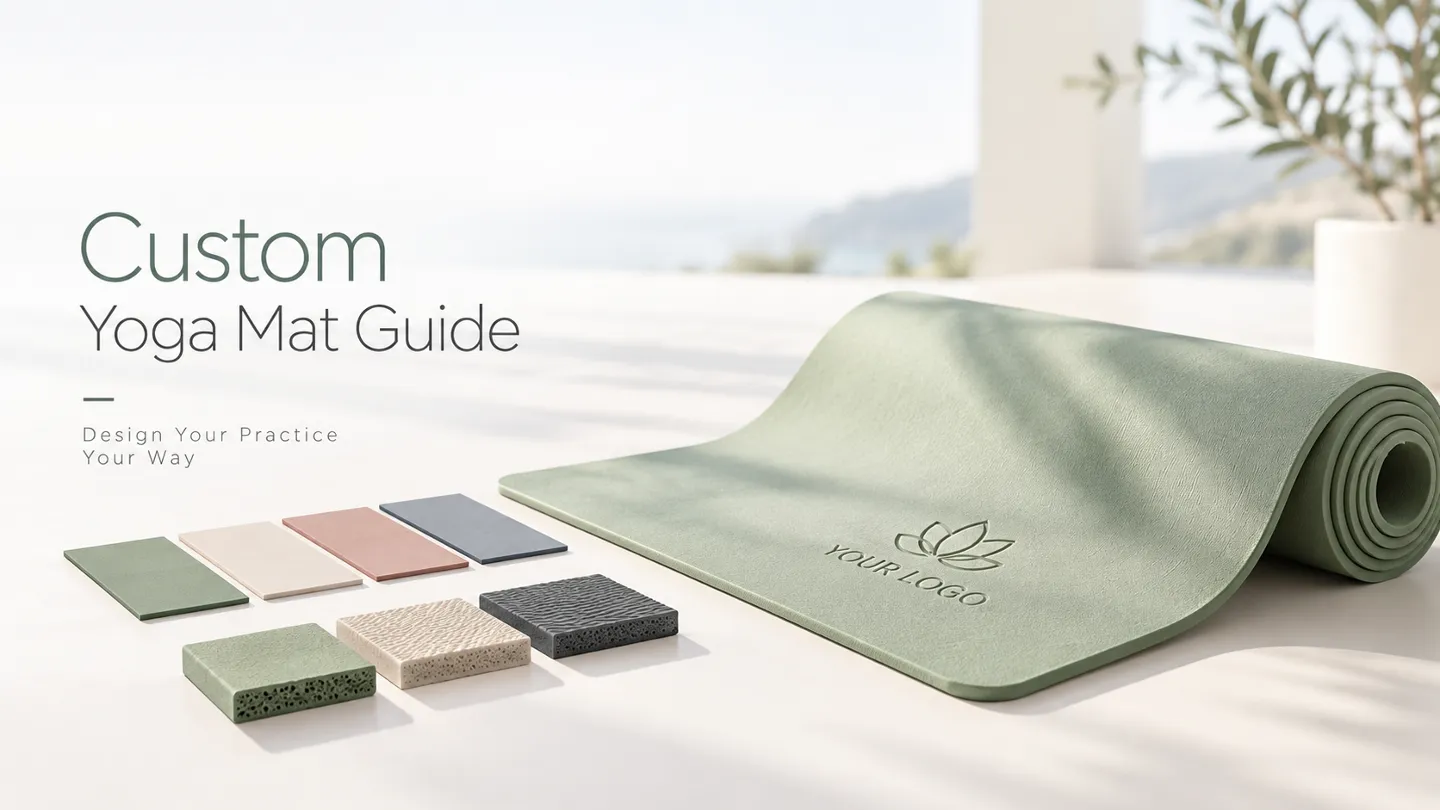
Custom Yoga Mat Guide: OEM, Logo Printing & Wholesale Buying for 2026
- Damao Tech
- Yoga
- 04 Oct, 2026
Nobody searching for “custom yoga mat” wants a generic mat with a sticker on it. They are studio owners building a brand, wellness startups launching a product line, or corporate buyers ordering branded mats for retreats — and they need to know what customization actually costs, which printing method survives daily practice, and how to tell a real manufacturer from a trading company.
This guide covers the full picture: which mat materials take customization best, how laser engraving compares to UV printing, what MOQs and pricing to expect in 2026, and a vetting checklist for yoga mat manufacturers. Whether you need 50 mats for a boutique studio or 10,000 for a retail launch, the sections below will keep you from paying for the wrong thing. If you are ready to see what a finished custom mat looks like, browse our custom premium yoga mat.
Why Brands Go Custom: The Business Case
A custom yoga mat turns a commodity into a brand asset. Studios sell them at 2–3x wholesale cost, instructors use them as walking billboards, and corporate wellness programs order them as premium gifts that people actually keep. The math is simple: a generic mat competes on price, while a branded mat competes on identity — and identity commands margin.
Three buyer profiles dominate the custom yoga mat market:
- Yoga studios and chains — branded mats for retail corners and teacher training programs. Typical orders: 50–500 units per design.
- Wellness and DTC brands — launching a private-label mat line on Shopify or Amazon. Typical orders: 500–5,000 units, often with custom packaging.
- Corporate and event buyers — branded mats for retreats, conferences, and employee wellness kits. Typical orders: 100–2,000 units, deadline-driven.
Key Takeaway: Know which buyer you are before requesting quotes. Studios care about low MOQs and fast turnaround; DTC brands care about unit cost at scale and packaging; corporate buyers care about deadline certainty above all.
Yoga Mat Materials Compared: What Takes Customization Best
Not every mat material accepts customization equally — the base material decides which printing methods work and how long the branding lasts. The three materials you will encounter are PU rubber, PVC, and TPE, and they behave very differently under a laser or ink.
PU + Natural Rubber (Premium Tier)
- Construction: eco-polyurethane top layer heat-bonded to a natural rubber base. No glue, no PVC.
- Grip: the best wet grip in the industry — the PU surface actually gets grippier with sweat.
- Customization: takes laser engraving beautifully. The laser etches alignment markers and logos permanently into the surface with zero inks or chemicals.
- Best for: premium studio brands, DTC labels, anyone whose logo must survive years of daily practice.
- Trade-off: heavier (around 2.5 kg for a standard mat) and higher unit cost than PVC.
PVC (Budget Tier)
- Construction: single-layer polyvinyl chloride, usually 4–6 mm thick.
- Grip: decent when dry, slippery when wet.
- Customization: limited to screen printing or heat transfer, both of which crack and peel with heavy use.
- Best for: promotional giveaways and ultra-price-sensitive bulk orders.
- Trade-off: not eco-friendly, and printed logos degrade visibly within months.
TPE (Mid Tier)
- Construction: thermoplastic elastomer, lighter than rubber, often dual-color.
- Grip: moderate; better than PVC, worse than PU.
- Customization: accepts UV printing reasonably well, but engraving is shallow.
- Best for: mid-range retail mats where price matters more than longevity.
Key Takeaway: If your brand name is on the mat, choose PU rubber with laser engraving. It is the only combination where the customization is genuinely permanent — printed PVC logos are a false economy for anything beyond giveaways.
Customization Techniques: Laser Engraving vs. UV Printing vs. Stamping
The printing method matters more than most buyers realize — it determines whether your logo looks premium in year two or embarrassing by month six. Here is how the three main techniques compare.
| Laser Engraving | UV Printing | Gold/Silver Stamping | |
|---|---|---|---|
| How it works | Laser etches the design into the mat surface | UV-cured ink printed onto the surface | Metallic foil heat-pressed onto the mat |
| Durability | Permanent — cannot peel or fade | Good (2–3 years of regular use) | Decorative — best for accents, not full logos |
| Detail level | Extremely fine lines and alignment markers | Full color, photographic detail | Simple shapes and text |
| Eco impact | Zero inks or chemicals | Low-VOC UV inks | Foil waste, minimal |
| Best for | Logos + alignment systems on PU mats | Colorful all-over designs | Premium accent details |
| Relative cost | $$ | $ | $$$ |
Alignment markers deserve special attention. Laser-etched alignment lines are the signature feature of premium custom mats — they help practitioners hold correct posture and they photograph beautifully for social media. Because the etching is permanent, the feature never wears off, which is exactly why studios pay a premium for it.
Sizing, Thickness & Weight: Specifying Your Mat
Get the dimensions wrong and nothing else matters — an undersized mat is the number one complaint in custom orders. Standard and options:
- Standard size: 180 cm × 66 cm. Fits most practitioners. This is the default you should quote against.
- Extra long/wide: 200 cm × 70 cm for taller users or studio differentiation. Adds roughly 10–15% to material cost.
- Travel (2 mm): ultralight around 1.6 kg, folds into a suitcase. Lower grip and cushioning — position it as a travel product, not a daily driver.
- Standard (4–4.5 mm): the sweet spot. Around 2.5 kg, the right balance of cushioning, stability, and portability for studio and home use.
- Thick (5–6 mm): maximum joint protection. Heavier and bulkier; popular with beginners and gentle/restorative yoga lines.
Key Takeaway: Offer two SKUs — a 4.2 mm standard and a 2 mm travel. That covers 90% of buyers and keeps your inventory simple.
MOQs and Pricing: What to Expect in 2026
Minimum order quantities for custom yoga mats have fallen dramatically — you no longer need a container to launch a brand. Current market reality:
- Startup/boutique tier: 50–100 units per design. Available from flexible manufacturers running small-batch laser lines. Unit cost is highest here, but inventory risk is near zero.
- Mid tier: 500–1,000 units. The sweet spot for DTC brands — meaningful per-unit savings kick in, and custom packaging becomes economical.
- Scale tier: 5,000+ units. Container-level pricing. At this volume, negotiate tooling amortization, custom colorways, and dedicated production slots.
What drives the unit price (in order of impact):
- Material — PU rubber costs 2–3x PVC. This is the single biggest cost lever.
- Thickness — more material, more cost, roughly linear.
- Customization complexity — single logo engraving is cheap; full-surface UV art costs more in setup.
- Packaging — a branded carry bag and box can add 15–25% to landed cost. Worth it for retail.
- Order volume — the usual curve; the jump from 100 to 1,000 units typically cuts unit cost 20–30%.
Key Takeaway: Get quotes at two quantities (e.g., 200 and 1,000 units). The price break between them tells you how fast you should plan to scale.
How to Vet a Yoga Mat Manufacturer: Checklist & Red Flags
Most “manufacturers” you find on B2B marketplaces are trading companies marking up someone else’s factory. Use this checklist before sending a deposit.
Green flags (ask for all five):
- Factory video or live video call — see the laser engravers and cutting tables yourself.
- Material certifications — SGS or equivalent test reports for the PU and rubber (phthalate-free, heavy-metal-free).
- Physical samples — never approve a bulk run from photos. Test grip when wet, check edge finishing, try to scratch the logo off.
- Clear MOQ and lead-time in writing — including what happens if you need a rush reorder.
- Reference customers — at least two brands in your market segment you can contact.
Red flags (any one is a walk-away):
- No factory address or refuses video verification.
- Quotes 50% below everyone else (wrong material or no QC — there is no magic).
- Demands 100% payment upfront. Standard is 30% deposit, 70% against bill of lading or pre-shipment inspection.
- Cannot explain the difference between their PU and PVC lines.
- No sample program, or samples “take 6 weeks” (means no stock, likely a trader).
Frequently Asked Questions
How much does a custom yoga mat cost per unit?
It depends on material and volume. A custom PU rubber mat with laser-engraved logo runs roughly 2–3x the cost of a printed PVC mat. At 50–100 units expect boutique pricing; at 1,000+ units the per-unit cost typically drops 20–30%. Always compare quotes at two quantities and confirm whether packaging is included.
What is the minimum order for custom yoga mats?
Flexible manufacturers now accept 50–100 units per design for laser-engraved PU mats, which makes small-batch brand launches viable. Standard mid-tier MOQs are 500–1,000 units. Be wary of anyone demanding container quantities for a first order.
Laser engraving vs. UV printing — which should I choose?
Choose laser engraving for logos and alignment markers on PU rubber mats — it is permanent and uses no inks. Choose UV printing when you need full-color artwork or photographic designs. For a premium brand mat, the standard is laser-engraved logo plus optional UV-printed accent art.
How long does production take?
Samples: 7–10 days. Bulk production: 25–35 days after sample approval, plus 25–40 days ocean freight depending on your port. Plan 3–4 months from first contact to warehouse for an initial order; reorders run 6–8 weeks.
Can I get my logo in my exact brand colors?
Yes. Manufacturers can color-match the mat body to Pantone references and laser-engrave or UV-print your logo. Note that laser engraving is tonal (it reveals the layer beneath) rather than full-color — for exact color logos, use UV printing.
Are custom yoga mats eco-friendly?
They can be. PU + natural rubber mats are PVC-free, use heat-bonding instead of chemical glues, and the rubber base is biodegradable. Ask for SGS test reports confirming phthalate-free and heavy-metal-free materials, and consider plastic-free packaging to complete the story.
Ready to put your brand on a mat? Start with our custom premium yoga mat — PU rubber, laser-engraved alignment system, and MOQs from 50 units. Request samples and see the engraving quality for yourself.