Bulk Yoga Bolsters: Wholesale Buying Guide for Studios & Retailers (2026)
- Damao Tech
- Yoga
- 04 Oct, 2026
Nobody searching for “bulk yoga bolsters” is outfitting a single studio room. They are multi-location chains standardizing props across every site, retreat centers replacing a hundred bolsters a year, DTC brands launching a private-label props line, or distributors filling a container — and they need to know which shapes actually sell, which fillings survive commercial use, what customization costs at volume, and how to tell a real yoga bolster manufacturer from a trading company.
This guide covers the full picture: bolster shapes and their buyer profiles, filling materials compared, custom branding methods, MOQ and pricing tiers for 2026, private-label packaging, and a vetting checklist for manufacturers. Whether you need 100 embroidered bolsters for a studio chain or 2,000 units for a retail launch, the sections below will keep you from ordering the wrong thing. Ready to talk numbers? Request a quote and tell us your shape, filling, and quantity.
Why Studios and Retailers Buy Bolsters in Bulk
A bolster is the one prop students notice. Cheap bolsters go flat in six months, leak filling through weak seams, and make your studio look tired. Good ones last years, hold their shape through daily restorative classes, and quietly justify a higher drop-in price. For retailers, they are a high-margin add-on that rides along with mat sales.
Four buyer profiles dominate the bulk yoga bolster market:
- Yoga studio chains — standardizing props across locations for brand consistency. Typical orders: 100–500 units per shape, often with embroidered logos.
- Retreat and wellness centers — high replacement volume from daily use. Typical orders: 200–1,000 units, durability matters more than branding.
- DTC props brands — launching private-label bolster lines on Shopify or Amazon. Typical orders: 300–2,000 units, with custom packaging.
- Distributors and wholesalers — stocking regional yoga supply catalogs. Typical orders: 1,000–5,000+ units, price-driven.
Key Takeaway: Know which buyer you are before requesting quotes. Chains care about consistency and branding; retreat centers care about durability and replacement cost; DTC brands care about packaging and unboxing; distributors care about landed cost per unit.
Bolster Shapes Compared: Rectangular, Round, and Pranayama
Shape is the first spec to lock in — it decides which classes the bolster serves and who buys it. The three shapes you will encounter cover nearly all commercial demand.
Rectangular Bolster (Standard)
- Construction: flat-sided box shape, typically 60 cm × 23 cm × 12 cm, with handles on the ends.
- Use: the workhorse. Restorative yoga, prenatal classes, backbends over the long edge. Stacks neatly for storage — chains love this.
- Customization: largest printable/embroiderable surface of the three shapes.
- Best for: studio chains and retailers. If you stock one shape, make it this one.
Round Bolster (Cylindrical)
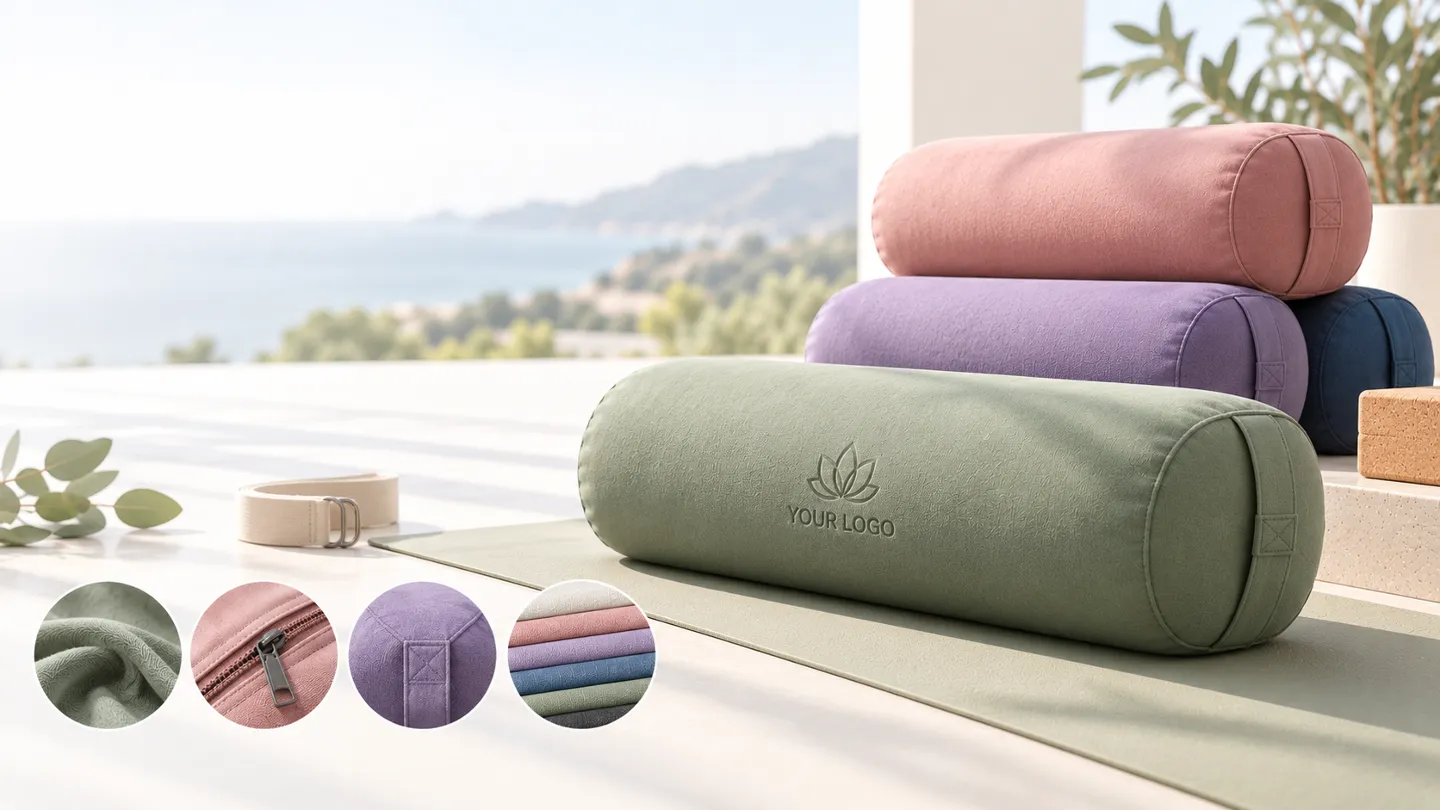
- Construction: cylinder, typically 60 cm long × 23 cm diameter, often with a carry handle.
- Use: deeper backbends, spinal extension, side-lying support. Popular in Iyengar and therapeutic settings.
- Customization: embroidery works well along the length; printed designs wrap awkwardly.
- Best for: therapeutic studios and teacher training programs.
- Trade-off: rolls in storage — needs a rack or bin.
Pranayama Bolster (Slim Pillow)
- Construction: low, wide pillow shape, roughly 60 cm × 25 cm × 10 cm.
- Use: breathwork, meditation, gentle chest opening. A niche but growing segment as breathwork classes expand.
- Customization: embroidery on the top face; small branding area.
- Best for: meditation centers and premium DTC lines positioning around breathwork.
- Trade-off: smallest market of the three — order conservatively on a first run.
Key Takeaway: Rectangular covers 70–80% of commercial demand. Add round for therapeutic lines; treat pranayama as a second-SKU expansion, not a launch product. Many buyers pair bolsters with mats when outfitting studios — our custom yoga mat guide covers that side of the order.
Fillings: The Real Quality Differentiator
Filling decides firmness, weight, lifespan, and cost — it is where cheap bolsters fail and good ones earn their margin. Here is how the three main fillings compare.
| Cotton Batting | Buckwheat Hull | Recycled Fiber | |
|---|---|---|---|
| Feel | Firm, supportive, classic | Very firm, molds to the body, heavier | Medium-soft, lighter |
| Weight (rectangular) | ~2.5 kg | ~3.5–4 kg | ~1.8 kg |
| Lifespan (commercial use) | 3–5 years | 5+ years (hulls can be topped up) | 1–2 years before flattening |
| Eco story | Natural, biodegradable | Natural, renewable, refillable | Diverts plastic waste |
| Best for | Studios and retail (the standard) | Premium/therapeutic lines | Budget and travel-oriented lines |
| Relative cost | $$ | $$$ | $ |
Cotton batting deserves the default position. It is what most practitioners expect, it holds shape through years of commercial use, and it sits in the middle on cost. Specify a minimum batting density in writing — vague “cotton filled” specs are how you end up with lumpy bolsters.
Buckwheat hull is the premium play. Heavier and firmer, with a devoted following in therapeutic and prenatal segments — and the refillable angle (sell top-up hull bags as an accessory) is a genuine DTC differentiator. Factor the extra weight into freight pricing.
Key Takeaway: Cotton batting for your core SKU, buckwheat hull for a premium tier. Avoid recycled fiber for anything positioned above budget — the flattening timeline will cost you in replacements and reputation.
Cover Fabrics That Survive Studio Use
The cover takes the abuse — sweat, washing, dragging across studio floors. Spec it like commercial upholstery, not home decor.
- Cotton canvas (10–12 oz) — the industry standard. Durable, breathable, takes embroidery cleanly. Specify a tight weave; loose canvas pills fast.
- Upcycled/recycled canvas — same performance as virgin canvas with a sustainability story. Costs 10–15% more; worth it for eco-positioned brands.
- Removable covers with hidden zippers — non-negotiable for studio buyers. The zipper should tuck away so it never touches skin.
- Colorfastness — demand a wash test report. Deep colors (navy, burgundy, forest) bleed in the first washes if the dye process is cheap, and stained bolsters get retired early.
Key Takeaway: 12 oz cotton canvas, removable, hidden zipper, documented colorfastness. That spec sheet separates commercial-grade from decorative in one paragraph.
Custom Branding: Embroidery vs. Woven Labels vs. Print
The branding method sets your MOQ and your perceived quality. Here is the honest breakdown.
| Embroidery | Woven Label | Screen Print | |
|---|---|---|---|
| How it works | Thread stitched directly into the cover | Small fabric label sewn into the seam | Ink printed on the cover panel |
| Look and feel | Premium, tactile, permanent | Clean, professional, subtle | Flat, can crack over time |
| Detail level | Bold logos and text; fine detail limited | Small logos and text only | Full detail and color |
| Durability | Outlasts the bolster | Outlasts the bolster | 2–3 years of commercial washing |
| Typical branding MOQ | 100 units per design | 300 units per design | 200 units per design |
| Relative cost | $$ | $ | $ |
Embroidery is the studio-chain standard. Premium look, survives commercial laundering, and the 100-unit MOQ fits chain rollouts. Keep designs bold — thread cannot render fine lines.
Woven labels are the quiet professional choice. Sewn into the seam or handle, they brand without dominating the product — and distributors can run different labels for different accounts.
Key Takeaway: Embroidery for brand-forward buyers, woven labels for distributors and white-label programs. Reserve screen print for promotional runs where cost beats longevity.
MOQs and Pricing: What to Expect in 2026
Bolster MOQs are friendlier than most buyers expect — the tooling is simple and sewing lines are flexible.
- Test tier (100 units): available from flexible manufacturers for embroidered cotton-batting bolsters. Highest unit cost, but lets a chain pilot one location before committing.
- Core tier (300–500 units): the sweet spot for studios, retreat centers, and first DTC runs. Custom colors and woven labels become economical here.
- Scale tier (2,000+ units): distributor and large-retail pricing. At this volume, negotiate custom dye lots, dedicated QC, and packaging tooling amortization.
What drives the unit price (in order of impact):
- Filling — buckwheat hull costs roughly 40–60% more than cotton batting; recycled fiber is cheapest.
- Cover fabric weight — 12 oz canvas over 8 oz adds real cost but doubles service life.
- Branding method — embroidery adds a per-unit stitch cost; woven labels are nearly free at volume.
- Order volume — the jump from 100 to 500 units typically cuts unit cost 15–25%.
- Packaging — a branded box over a polybag adds 10–20% to landed cost. Worth it for retail, waste for studio-direct.
Key Takeaway: Get quotes at two quantities (e.g., 200 and 1,000 units). The price break between them tells you where your reorder economics kick in — and whether the manufacturer is pricing honestly.
Private-Label Packaging: What Retail Needs
Studio-direct orders can ship in polybags. Retail cannot. If your bolsters will sit on a shelf or arrive at a customer’s door, packaging is part of the product.
- Branded kraft box — the DTC standard. Fits the bolster snugly, carries your logo and care instructions, photographs well for unboxing content.
- Hang tags — shape, filling, dimensions, and care icons. Distributors require these for catalog listings.
- Care cards — a small insert explaining how to wash the cover and top up buckwheat hull. Reduces support tickets and signals quality.
- Compression packing — vacuum-compressing cuts freight volume roughly in half; bolsters expand fully within 24 hours. Confirm this before quoting freight.
Key Takeaway: Budget packaging as 10–20% of landed cost for retail programs. For studio-direct, skip the box and put the savings into fabric weight.
How to Vet a Yoga Bolster Manufacturer: Checklist & Red Flags
Most “manufacturers” on B2B marketplaces are trading companies marking up someone else’s sewing line. Use this checklist before sending a deposit.
Green flags (ask for all five):
- Factory video or live video call — see the cutting tables, sewing lines, and filling stations yourself.
- Filling density spec in writing — grams per bolster, not vague “premium cotton” language. Ask what happens if a batch tests light.
- Wash and colorfastness test reports — for the exact fabric and dye lot you are ordering, not a generic certificate.
- Physical samples in your spec — sit on it, wash the cover twice, check seam strength at the handles. Never approve a bulk run from photos.
- Reference customers — at least two buyers in your segment (studios, DTC, or distribution) you can contact.
Red flags (any one is a walk-away):
- No factory address or refuses video verification.
- Cannot state filling weight per unit (means no QC on the one spec that matters).
- Quotes 40% below everyone else (thin fabric, light filling, or no QC — there is no magic).
- Demands 100% payment upfront. Standard is 30% deposit, 70% against bill of lading or pre-shipment inspection.
- No sample program, or samples “take 6 weeks” (means no stock, likely a trader).
Lead Times & Freight: Planning Your Order
Bolsters are bulky — freight planning matters as much as production scheduling. Build your timeline backwards from when you need them.
- Samples: 7–10 days after artwork approval. Always sample the exact filling and fabric weight you will order.
- Bulk production: 20–30 days after sample approval for orders under 1,000 units; 30–40 days for larger runs.
- Ocean freight: 25–40 days depending on your port, plus customs clearance. Compression packing roughly halves your CBM — get the packed dimensions before booking.
- Air freight: 7–10 days door to door, but costs 4–6x ocean. Reserve it for launch deadlines, not routine reorders.
- Reorder buffer: plan 3–4 months from first contact to warehouse for an initial order; reorders run 6–8 weeks once your spec is locked.
Key Takeaway: Lock your spec early — every revision restarts the sample clock. For seasonal launches (January resolution wave, fall studio refresh), start conversations a full quarter ahead.
Frequently Asked Questions
What is the minimum order for bulk yoga bolsters?
Flexible manufacturers accept 100 units per design for embroidered cotton-batting bolsters, which makes chain pilots and small DTC launches viable. Standard mid-tier MOQs are 300–500 units. Be wary of anyone demanding container quantities for a first order.
How much do wholesale yoga bolsters cost per unit?
It depends on filling, fabric, and volume. A cotton-batting bolster with embroidered logo typically runs 15–25% less per unit at 500 units than at 100 units. Buckwheat hull adds roughly 40–60% over cotton batting. Always compare quotes at two quantities and confirm whether packaging and freight are included.
Buckwheat hull vs. cotton batting — which filling should I choose?
Choose cotton batting for your core SKU — it is the expected feel, holds shape for 3–5 years of commercial use, and costs less. Choose buckwheat hull for premium or therapeutic lines where firmness and the refillable story justify the higher price and heavier freight weight.
Can I get my logo embroidered on custom yoga bolsters?
Yes. Embroidery is the standard branding method for wholesale yoga bolsters, with MOQs from 100 units per design. Keep artwork bold — thread cannot render fine lines or gradients. Woven labels sewn into the seam are a good alternative for subtle or white-label branding.
How long does bulk production and shipping take?
Samples take 7–10 days. Bulk production is 20–30 days after sample approval for orders under 1,000 units, plus 25–40 days ocean freight depending on your port. Plan 3–4 months from first contact to warehouse for an initial order; reorders run 6–8 weeks.
Are the covers removable and machine-washable?
They should be. Specify removable covers with hidden zippers and demand a colorfastness test report for your dye lot. Studio buyers should treat a non-removable cover as a disqualifier — commercial bolsters get washed constantly, and a sewn-shut cover means replacing the whole unit when it stains.
Ready to spec your bolster line? Request a quote with your shape, filling, branding method, and quantity — we will come back with unit pricing at two volumes, sample lead time, and a freight estimate. No trading-company markup, factory direct.