Wholesale Yoga Mat Bags: Custom Bulk Buying Guide for Brands (2026)
- Damao Tech
- Yoga
- 04 Oct, 2026
Nobody searching for “custom yoga bag” wants a flimsy tote with a heat-pressed logo that peels after two washes. They are studio owners kitting out teacher training programs, DTC brands building a private-label accessory line, or corporate buyers ordering branded merch for retreats — and they need to know which bag styles actually sell, which materials survive daily gym abuse, and how to tell a real factory from a trading company.
This guide covers the full picture: the four bag styles worth ordering in bulk, how canvas compares to recycled PET, which logo methods hold up on fabric, what MOQs and unit pricing to expect in 2026, and a vetting checklist for yoga bag manufacturers. Whether you need 100 bags for a studio launch or 10,000 for a retail line, the sections below will keep you from paying for the wrong thing. When you are ready to talk specs and samples, request a quote.
Why Brands Buy Bags in Bulk: The Business Case
A personalized yoga bag turns a one-time mat purchase into a walking advertisement. Studios bundle bags with class packages, DTC brands use them as the upsell that lifts average order value, and corporate wellness programs hand them out as gifts that get used — not shelved. The math is simple: a generic bag is a commodity; a branded bag is a billboard your customer carries to class every week.
Four buyer profiles dominate the wholesale yoga bag market:
- Yoga studios and chains — branded bags for retail walls and teacher training kits. Typical orders: 100–500 units per design.
- Wellness and DTC brands — private-label bag lines sold alongside mats on Shopify or Amazon. Typical orders: 500–3,000 units, often with custom packaging. Brands already running a custom yoga mat line usually add bags as the natural second SKU.
- Corporate and event buyers — branded merch for retreats, conferences, and employee wellness kits. Typical orders: 200–2,000 units, deadline-driven.
- Promotional product distributors — resale to end clients, competing on unit cost. Typical orders: 1,000–5,000+ units per run.
Key Takeaway: Know which buyer you are before requesting quotes. Studios care about low MOQs and fast turnaround; DTC brands care about unit cost at scale and retail-ready packaging; corporate buyers care about deadline certainty above all.
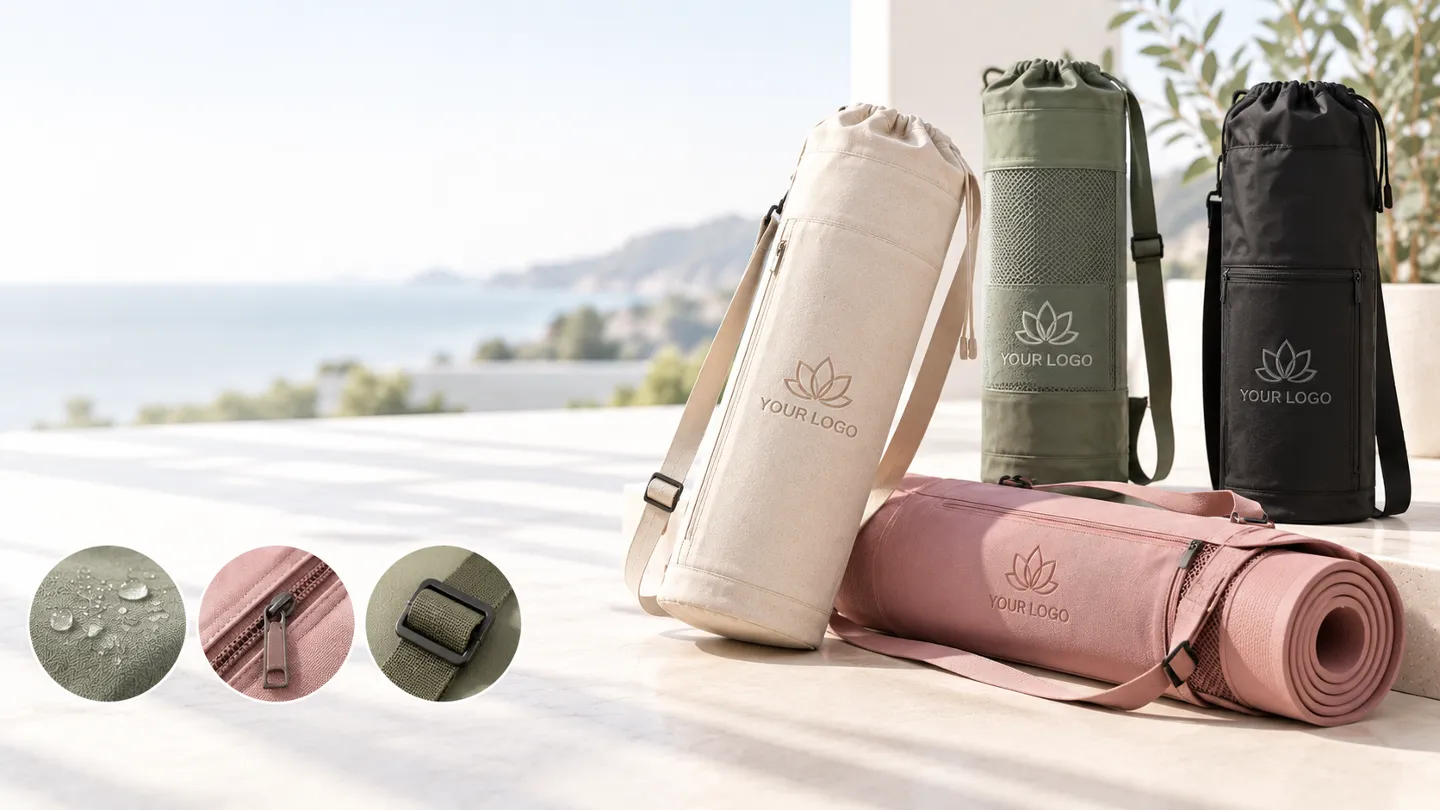
Bag Styles Compared: Sling, Tote, Backpack, Drawstring
Pick the wrong style and the bag sits in a warehouse — each style serves a different customer and a different price point. Here are the four worth ordering.
Sling (the studio staple)
- Construction: single shoulder strap, open-ended tube that a rolled mat slides into. Often includes a small zip pocket for phone and keys.
- Best for: studio retail and class bundles. Cheapest to make, fastest to customize.
- Trade-off: open ends mean the mat is exposed. Not a full-protection product.
Tote (the lifestyle pick)
- Construction: two handles, enclosed body, fits mat plus towel, bottle, and change of clothes. Zippered top on better models.
- Best for: DTC brands and premium studio lines. Doubles as a daily carry bag, which justifies a higher retail price.
- Trade-off: more fabric and hardware — higher unit cost than a sling.
Backpack (the commuter pick)
- Construction: dual straps, padded back panel, dedicated mat sleeve plus main compartment. The most complex build of the four.
- Best for: urban studios and cycling commuters. Commands the highest retail price.
- Trade-off: most expensive to manufacture; more components means more QC points to get wrong.
Drawstring (the event giveaway)
- Construction: simple cinch-top pouch sized for a rolled mat. Minimal hardware, minimal sewing.
- Best for: corporate events, retreats, and promo distributors. Lowest unit cost by far.
- Trade-off: thin margins and a disposable feel — right for giveaways, wrong for a premium brand.
Key Takeaway: Studios should start with a sling — it is the cheapest path to a branded product. DTC brands should lead with a tote or backpack, where the perceived value supports real margin. Drawstrings are for volume giveaways, not brand building.
Materials: Canvas vs. Nylon vs. Recycled PET
The fabric decides the price, the feel, and the story you tell at retail. Three materials cover nearly every bulk yoga bag order.
Cotton Canvas (the classic)
- Construction: heavyweight woven cotton, usually 12–16 oz. Natural hand feel, takes screen printing beautifully.
- Best for: eco-positioned studios and boutique brands. The organic look sells itself.
- Trade-off: heavier than synthetics, absorbs water, and costs more than basic nylon.
Nylon / Polyester (the workhorse)
- Construction: synthetic woven fabric, often with a water-resistant coating. Lightweight and colorfast.
- Best for: high-volume and price-sensitive orders. The default for promo distributors.
- Trade-off: no eco story, and cheap nylon looks cheap — specify denier and coating to avoid a plasticky finish.
Recycled PET / RPET (the story)
- Construction: fabric woven from recycled plastic bottles, usually with a GRS (Global Recycled Standard) certificate.
- Best for: brands with a sustainability message. Pairs naturally with eco-positioned mat lines.
- Trade-off: costs 15–25% more than virgin polyester. Verify the GRS certificate number — “recycled-look” fabric without certification is greenwashing.
Key Takeaway: If your brand has any eco positioning, go RPET with a real GRS certificate. Otherwise, canvas wins on perceived quality for boutique orders and nylon wins on price for volume.
Custom Logo Methods: Screen Print vs. Embroidery vs. Woven Label
The logo method matters more than most buyers realize — it decides whether your branding looks premium in year two or embarrassing by month six. Here is how the three main methods compare.
| Screen Printing | Embroidery | Woven Label | |
|---|---|---|---|
| How it works | Ink pressed through a mesh screen onto the fabric | Thread stitched directly into the fabric | Logo woven into a small fabric patch, sewn on |
| Durability | Good (2–3 years with proper curing) | Excellent — outlasts the bag itself | Excellent — as durable as the stitching |
| Detail level | Fine lines and multi-color artwork | Best for bold logos and text; minimum ~5 mm lettering | Very fine detail; photographic artwork impossible |
| Best for | Large logos on canvas and cotton | Premium feel on straps and front panels | Brand labels, size tags, “designed by” marks |
| Relative cost | $ | $$$ | $$ |
Embroidery deserves special attention. It is the most expensive option per unit, but the only one that reads as premium on sight — a small embroidered logo can justify a $10+ retail premium over print, which is exactly why DTC brands pay for it.
MOQs and Pricing: What to Expect in 2026
Minimum order quantities for custom yoga mat bags are lower than most buyers expect — you do not need a container to launch a branded bag. Current market reality:
- Starter tier: 100 units per design and color. Available from flexible factories for screen-printed slings and drawstrings. Unit cost is highest here, but inventory risk is near zero.
- Mid tier: 500 units. The sweet spot for studios and small DTC brands — meaningful per-unit savings kick in, embroidery becomes economical, and custom packaging is viable.
- Scale tier: 3,000+ units. Container-level pricing for promo distributors and retail lines buying bulk yoga bags. At this volume, negotiate tooling amortization, custom colorways, and dedicated production slots.
What drives the unit price (in order of impact):
- Style complexity — a drawstring costs a fraction of a backpack. This is the single biggest cost lever.
- Material — RPET and heavy canvas cost more than basic nylon or polyester.
- Logo method — embroidery costs 3–5x screen printing per unit; woven labels sit in between.
- Hardware — zippers, buckles, and padded straps add up fast on totes and backpacks.
- Order volume — the usual curve; the jump from 100 to 1,000 units typically cuts unit cost 25–35%.
Key Takeaway: Get quotes at two quantities (e.g., 200 and 1,000 units) for the exact same spec. The price break between them tells you how fast you should plan to scale.
Private-Label Packaging: The Detail DTC Brands Miss
Retail buyers judge your product by the packaging before they ever touch the bag. For DTC and wholesale-to-retail orders, packaging is not an afterthought.
- Polybag with branded sticker — the minimum. Fine for studio retail, not for Amazon or boutique shelves.
- Custom hang tag — care instructions, barcode, and brand story. Cheap per unit, big perceived-value lift.
- Printed box or mailer — required by most retail buyers and expected in DTC unboxing. Adds 10–20% to landed cost.
- Barcode/UPC — register your own GS1 prefix; never use the factory’s.
Key Takeaway: If you sell anywhere beyond your own studio, budget for a hang tag and a printed mailer from day one. The packaging is what photographs for social media — the bag inside just has to deliver.
How to Vet a Yoga Bag Manufacturer: Checklist & Red Flags
When sourcing yoga mat bags wholesale, most “manufacturers” you find on B2B marketplaces are trading companies marking up someone else’s factory. Use this checklist before sending a deposit.
Green flags (ask for all five):
- Factory video or live video call — see the cutting tables, sewing lines, and embroidery machines yourself.
- Fabric certifications — GRS for recycled PET, OEKO-TEX for dyed fabrics. Ask for the certificate number, not just a logo on a PDF.
- Physical samples — never approve a bulk run from photos. Check stitching density, zipper smoothness, strap strength, and print or embroidery quality up close.
- Clear MOQ and lead-time in writing — including what happens if you need a rush reorder.
- Reference customers — at least two brands in your market segment you can contact.
Red flags (any one is a walk-away):
- No factory address or refuses video verification.
- Quotes 50% below everyone else (wrong fabric weight or no QC — there is no magic).
- Demands 100% payment upfront. Standard is 30% deposit, 70% against bill of lading or pre-shipment inspection.
- Cannot tell you the fabric weight (GSM/oz) or denier of their own product.
- No sample program, or samples “take 6 weeks” (means no stock, likely a trader).
Lead Times & Freight: Planning Your Order
Bags are sewn, not molded — lead times run shorter than hard goods, but freight still sets the real deadline. Plan around these numbers:
- Samples: 7–10 days for printed samples; 10–15 days if embroidery or woven labels are involved.
- Bulk production: 20–30 days after sample approval for most styles. Backpacks with complex construction can run 30–40 days.
- Ocean freight: 25–40 days depending on your port, plus 1–2 weeks for customs clearance and inland delivery.
- Air freight: 5–7 days door to door, but costs 5–8x ocean — only makes sense for rush reorders under ~200 kg.
Key Takeaway: Work backward from your hard deadline (event date, launch day) and add a two-week buffer. The most common failure in wholesale bag orders is not quality — it is a shipment that arrives the week after the retreat.
Frequently Asked Questions
What is the minimum order quantity for custom yoga bags?
Most flexible factories accept 100 units per design and color for screen-printed slings and drawstrings. Embroidered styles and backpacks typically start at 300–500 units because of setup costs. Be wary of anyone demanding container quantities for a first order.
How much does a custom yoga mat bag cost per unit?
It depends on style, material, and volume. A screen-printed nylon sling at 500 units runs a few dollars per unit; a canvas tote with embroidery costs several times more. At 3,000+ units, per-unit cost typically drops 25–35% versus the 100-unit tier. Always compare quotes at two quantities with identical specs.
Screen printing vs. embroidery — which should I choose for my logo?
Choose screen printing for large, multi-color logos on canvas and cotton — it is the most economical at volume. Choose embroidery for a premium look on straps and front panels; it costs 3–5x more per unit but outlasts the bag and supports higher retail pricing.
Can I get my logo in my exact brand colors?
Yes. Screen printers match Pantone references with mixed inks, and embroidery thread comes in standard Madeira color charts that cover most brand palettes. For woven labels, confirm a physical strike-off before bulk production — screen colors can shift slightly between the proof and the weave.
How long does production and shipping take?
Samples take 7–15 days depending on the logo method. Bulk production runs 20–40 days after sample approval. Ocean freight adds 25–40 days plus customs clearance. Plan 3–4 months from first contact to warehouse for an initial order; reorders run 6–8 weeks.
Can I order matching custom yoga mats and bags as a bundle?
Yes — and you should if you sell both. Ordering mats and bags from the same manufacturer keeps branding consistent (same Pantone references, same logo files) and often unlocks combined-volume pricing. Ask for a bundle quote alongside individual quotes so you can compare.
Ready to put your logo on a bag? Request a quote with your style, quantity, and logo files — we will come back with specs, a samples timeline, and unit pricing at two volumes.