Bulk Foam Rollers: Wholesale Buying Guide for Gyms, Studios & Brands (2026)
- Damao Tech
- Yoga
- 04 Oct, 2026
Nobody searching for “bulk foam rollers” wants a single roller in a retail box. They are gym chain buyers outfitting 40 locations, studio owners building a branded recovery corner, physio clinics ordering for patient resale, or DTC brands launching a recovery line — and they need to know which foam holds up under daily commercial use, what custom branding actually costs, and how to tell a real factory from a middleman.
This guide covers the full picture: EPP vs. EVA vs. PU foam, smooth vs. textured surfaces, sizing, logo printing methods, MOQs and pricing for 2026, private-label packaging, and a vetting checklist for foam roller manufacturers. Whether you need 100 rollers for a studio chain or 5,000 for a distributor launch, the sections below will keep you from paying for the wrong product. Ready to talk numbers? Request a quote and we will spec it with you.
Why Buyers Order Foam Rollers in Bulk: The Business Case
Foam rollers are one of the highest-margin add-ons in fitness retail. They cost little to ship in bulk, never expire, and sell themselves — every member who uses one in class is a potential buyer. Gyms and studios typically retail them at 2.5–3x landed cost, and recovery brands bundle them into kits that lift average order value.
Five buyer profiles dominate the wholesale foam roller market:
- Gym chains and franchises — outfitting recovery zones across locations. Typical orders: 500–5,000 units, standardized SKU per location.
- Yoga and pilates studios — branded rollers for retail shelves and class use. Typical orders: 100–500 units per design. Many pair them with branded mats — see our custom yoga mat guide for the full playbook.
- Physio and rehab clinics — rollers for patient home programs and resale. Typical orders: 100–300 units, firm density preferred.
- DTC recovery brands — private-label rollers sold on Shopify or Amazon. Typical orders: 500–2,000 units, often with custom packaging.
- Distributors and wholesalers — stocking for resale to smaller studios. Typical orders: 2,000–10,000 units, price-driven.
Key Takeaway: Know which buyer you are before requesting quotes. Gym chains care about durability and unit cost at scale; studios care about branding and small-batch flexibility; distributors care about landed cost above all.
EPP vs. EVA vs. PU: Foam Density Explained
The foam is the product — everything else is packaging. Get the foam wrong and the roller goes soft in six months, your logo peels with it, and the reorder never comes. The three foams you will encounter are EPP, EVA, and PU, and they behave very differently under a 200-pound athlete.
EPP — Expanded Polypropylene (Firm Tier)
- Construction: bead-molded polypropylene, the same family of foam used in car bumpers. High density, closed cell.
- Feel: firm and unyielding — the choice for deep-tissue work and clinical use.
- Durability: the best of the three. Holds its shape under daily commercial use for years; resists sweat and wipes clean.
- Customization: takes debossing and laser engraving cleanly. Surface accepts silk-screen printing.
- Best for: gym chains, physio clinics, any setting where the roller gets punished daily.
- Trade-off: the firmest ride — beginners sometimes find it aggressive, and unit cost runs highest.
EVA — Ethylene-Vinyl Acetate (Mid Tier)
- Construction: molded EVA foam, often over a hollow plastic core. Medium density.
- Feel: moderate firmness with a bit of give — the all-rounder most retail rollers are made from.
- Durability: good for studio and home use; in high-traffic commercial gyms it compresses faster than EPP.
- Customization: prints well, takes debossing, and color options are the widest of the three.
- Best for: studios, DTC brands, and price-sensitive bulk orders where comfort matters more than maximum lifespan.
- Trade-off: not the longest-lived under heavy daily load.
PU — Polyurethane (Soft Tier)
- Construction: molded polyurethane foam, usually the softest and lightest of the three.
- Feel: gentle pressure — suited to beginners, seniors, and gentle rehab protocols.
- Durability: adequate for light use; dents and compresses under heavy or frequent loading.
- Customization: smooth surface takes printing well, but fine debossed detail can look soft.
- Best for: beginner-oriented studio lines, corporate wellness kits, promotional bundles.
- Trade-off: the shortest commercial lifespan — do not spec it for a busy gym floor.
Key Takeaway: If the roller will live in a commercial gym, spec EPP. If it is a branded studio retail product, EVA is the sweet spot. Reserve PU for beginner and promotional lines where price beats longevity.
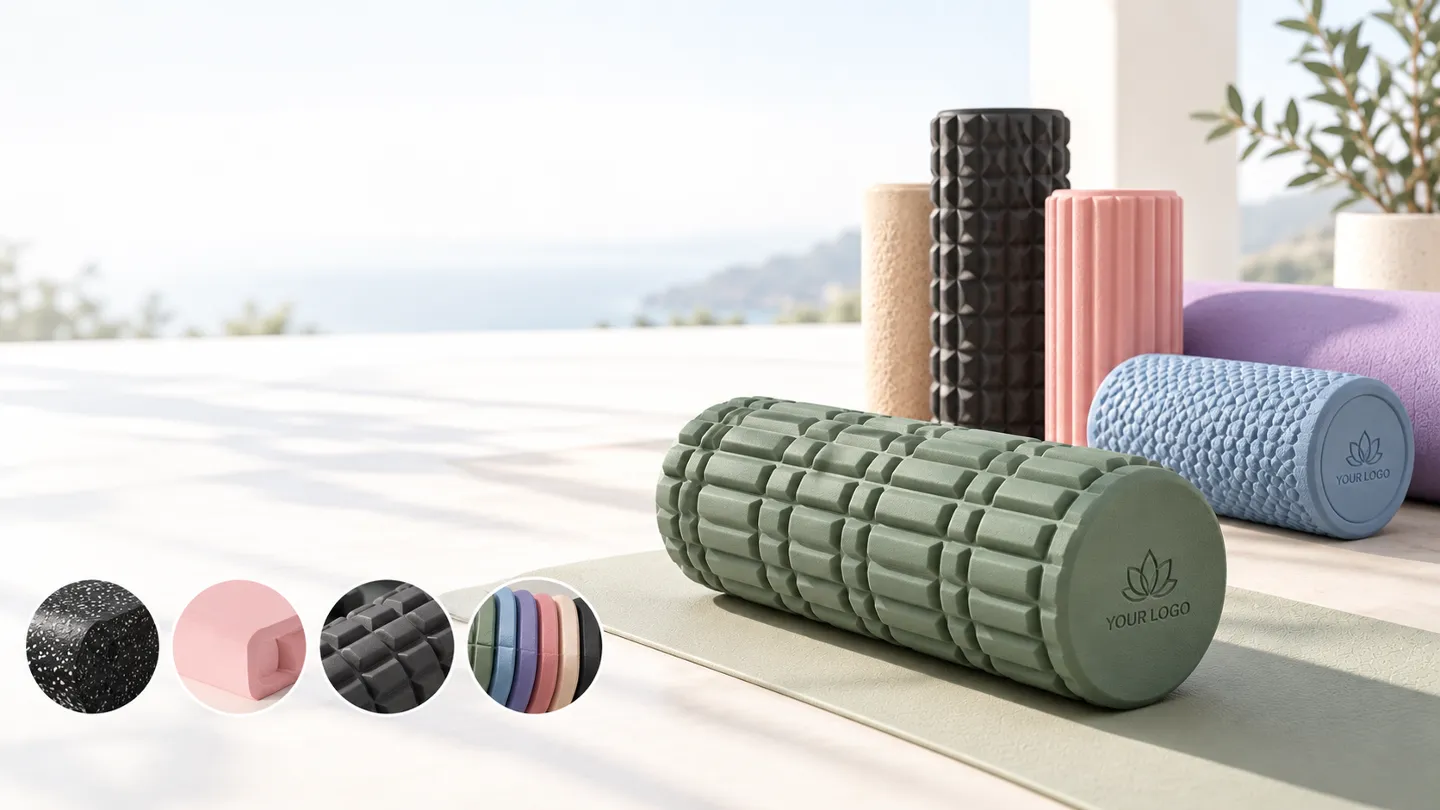
Smooth vs. Textured: Choosing the Right Surface
Surface texture changes both the feel and the use case — and it is one of the first things a buyer notices when picking the roller up. The two options:
| Smooth | Textured (Grid / Trigger-Point) | |
|---|---|---|
| How it feels | Even, consistent pressure across the muscle | Targeted pressure — ridges and nubs dig into knots |
| Best for | Beginners, general mobility, studio class use | Athletes, deep-tissue work, physio protocols |
| Cleaning | Wipes clean easily | Texture traps sweat — needs more attention in shared use |
| Branding | Largest clean area for logos | Logo must sit in a flat zone between textures |
| Cost | $ | $$ (extra molding detail) |
The grid pattern deserves a note. The multi-density grid — flat zones alternating with raised nubs — is the best-selling texture in commercial gyms because it mimics a therapist’s thumbs and fingers. If you are stocking one textured SKU, make it the grid.
Sizing: 12”, 18”, and 36” — Specifying Your Roller
Size determines what the roller can actually be used for — and freight cost, since rollers are bulky. The three standard lengths:
- 12” (30 cm): targeted work — calves, arms, IT bands. Travel-friendly. Lowest freight cost per unit.
- 18” (45 cm): the standard. Covers most full-body routines for average users. This is the default you should quote against.
- 36” (90 cm): full-back rolling and spinal alignment work. Popular with pilates studios and physio clinics. Bulkiest to ship.
Hollow vs. solid core matters too. Hollow-core rollers (rigid plastic tube inside) support heavier users without flexing and survive commercial abuse — spec these for gyms. Solid-foam rollers are lighter and cheaper, fine for studio retail and DTC.
Key Takeaway: Stock the 18” as your hero SKU and add the 36” for back-work buyers. Always spec hollow core for commercial gym orders — the freight difference is minor compared to the warranty headache of a collapsed roller.
Custom Logo Printing Methods Compared
Your logo is what turns a commodity roller into your roller — but not every printing method survives a sweaty gym floor. Here is how the options compare:
| | Debossing | Laser Engraving | Silk-Screen Print | Shrink-Wrap Sleeve | |---|---|---|---| | How it works | Logo pressed into the foam during molding | Laser etches the design into the surface | Ink printed onto the foam surface | Branded film sleeve shrunk over the roller | | Durability | Permanent — part of the mold | Permanent — cannot peel or fade | Good (1–2 years of heavy use) | Lasts until the customer removes it | | Detail level | Bold logos and text; fine lines can fill in | Extremely fine detail | Full color, photographic detail | Full color, full wrap | | Best for | EPP rollers, premium brand feel | EPP/EVA, precise logos | Colorful logos on EVA | Fast branding, any foam | | Relative cost | $$ (mold charge, then cheap per unit) | $$ | $ | $ |
Watch the setup economics. Debossing needs a mold insert (a one-time charge), which makes it expensive at 100 units but the cheapest per-unit method at 2,000+. Silk-screen has minimal setup, so it wins on small runs. Ask every supplier to quote the setup charge separately from the unit price.
MOQs and Pricing: What to Expect in 2026
Foam roller MOQs are low enough that a single studio can launch a branded line — but the price curve rewards scale aggressively. Current market reality:
- Starter tier: 100–200 units per design. Available from flexible factories. Unit cost is highest here, but you can test a design with near-zero inventory risk.
- Mid tier: 500–1,000 units. The sweet spot for studios and DTC brands — per-unit cost drops meaningfully and custom packaging becomes economical.
- Scale tier: 2,000+ units. Distributor and gym-chain pricing. At this volume, negotiate mold amortization, custom colorways, and dedicated production slots.
What drives the unit price (in order of impact):
- Foam type — EPP costs the most, PU the least. This is the single biggest cost lever.
- Size — a 36” roller uses roughly 2x the material of an 18”.
- Core — hollow plastic core adds cost but is non-negotiable for commercial use.
- Branding complexity — deboss mold charges vs. simple silk-screen; full-color art costs more in setup.
- Packaging — a printed color box can add 15–25% to landed cost. Worth it for retail.
- Order volume — the usual curve; the jump from 200 to 1,000 units typically cuts unit cost 20–30%.
Key Takeaway: Get quotes at two quantities (e.g., 300 and 1,000 units). The price break between them tells you how fast you should plan to scale — and exposes which suppliers are padding small-order margins.
Private-Label Packaging: What to Specify
Packaging is where a wholesale roller becomes a retail product. Specify it in the quote request, not as an afterthought:
- Shrink wrap: the minimum. Protects the roller in transit; add a printed belly band for branding on a budget.
- Color box: the DTC standard. Full-color printed box with your branding, barcode, and usage instructions. Adds the most perceived value.
- Hangtag: for gym and studio retail walls. Include care instructions and a QR code linking to your exercise videos.
- Master carton: specify the carton quantity (usually 10–20 rollers) and require drop-test certification — rollers are light but bulky, and crushed cartons are the number one freight complaint.
How to Vet a Foam Roller Manufacturer: Checklist & Red Flags
Most “manufacturers” on B2B marketplaces are trading companies marking up someone else’s molding line. Use this checklist before sending a deposit.
Green flags (ask for all five):
- Factory video or live video call — see the molding machines and printing lines yourself.
- Foam density specs in writing — EPP/EVA/PU grade and density (kg/m³), not just “high quality foam.”
- Physical samples — never approve a bulk run from photos. Stand on the sample, check it rebounds, try to peel the logo off.
- Clear MOQ and lead-time in writing — including what happens if you need a rush reorder.
- Reference customers — at least two buyers in your segment (gym, studio, or brand) you can contact.
Red flags (any one is a walk-away):
- No factory address or refuses video verification.
- Quotes 50% below everyone else (wrong foam density or no QC — there is no magic).
- Demands 100% payment upfront. Standard is 30% deposit, 70% against bill of lading or pre-shipment inspection.
- Cannot state the foam density in kg/m³ or explain the difference between their EPP and EVA lines.
- No sample program, or samples “take 6 weeks” (means no stock, likely a trader).
Lead Times & Freight: Planning Your Order
Rollers are bulky — freight planning matters more here than for most fitness products. Realistic timelines:
- Samples: 7–10 days, usually by express courier.
- Bulk production: 20–30 days after sample approval for standard designs; add 10–15 days if a new deboss mold is required.
- Ocean freight: 25–40 days depending on your port. A 40’ container fits roughly 8,000–12,000 rollers depending on size and packaging — confirm the carton CBM with your supplier before booking.
- Plan 3–4 months from first contact to warehouse for an initial order; reorders run 6–8 weeks.
Key Takeaway: If you have a hard deadline (new location opening, product launch), work backward from it and add two weeks of buffer. Rush production exists but you will pay for it — and air freight on bulky rollers will erase your margin.
Frequently Asked Questions
How much do bulk foam rollers cost per unit?
It depends on foam type and volume. An EPP roller with debossed logo runs roughly 2x the cost of a printed PU roller. At 100-200 units expect starter pricing; at 1,000+ units the per-unit cost typically drops 20-30%. Always compare quotes at two quantities and confirm whether packaging is included.
What is the minimum order quantity for wholesale foam rollers?
Flexible manufacturers accept 100-200 units per design, which makes small-batch brand launches viable. Standard mid-tier MOQs are 500-1,000 units. Be wary of anyone demanding container quantities for a first order.
EPP vs. EVA — which foam should I choose?
Choose EPP for commercial gyms and physio clinics - it is the firmest and longest-lasting under daily heavy use. Choose EVA for studio retail and DTC brands where moderate firmness, comfort, and color options matter more. PU is for beginner and promotional lines only.
Can I put my logo on foam rollers?
Yes. The main methods are debossing (logo molded into the foam, permanent), laser engraving (fine detail, permanent), silk-screen printing (full color, good durability), and branded shrink-wrap sleeves (fastest, lowest setup). Debossing has a one-time mold charge but the lowest per-unit cost at scale.
What sizes should I stock?
The 18-inch roller is the standard hero SKU covering most full-body routines. Add the 36-inch for back-work buyers (pilates studios, physio clinics) and the 12-inch as a travel or targeted-work option. For commercial gyms, always spec a hollow core.
How long does production and shipping take?
Samples take 7-10 days. Bulk production is 20-30 days after sample approval (add 10-15 days for a new deboss mold), plus 25-40 days ocean freight. Plan 3-4 months from first contact to warehouse for an initial order; reorders run 6-8 weeks.
Ready to build your recovery line? Request a quote — tell us your foam, size, quantity, and logo, and we will come back with samples, specs, and honest lead times.