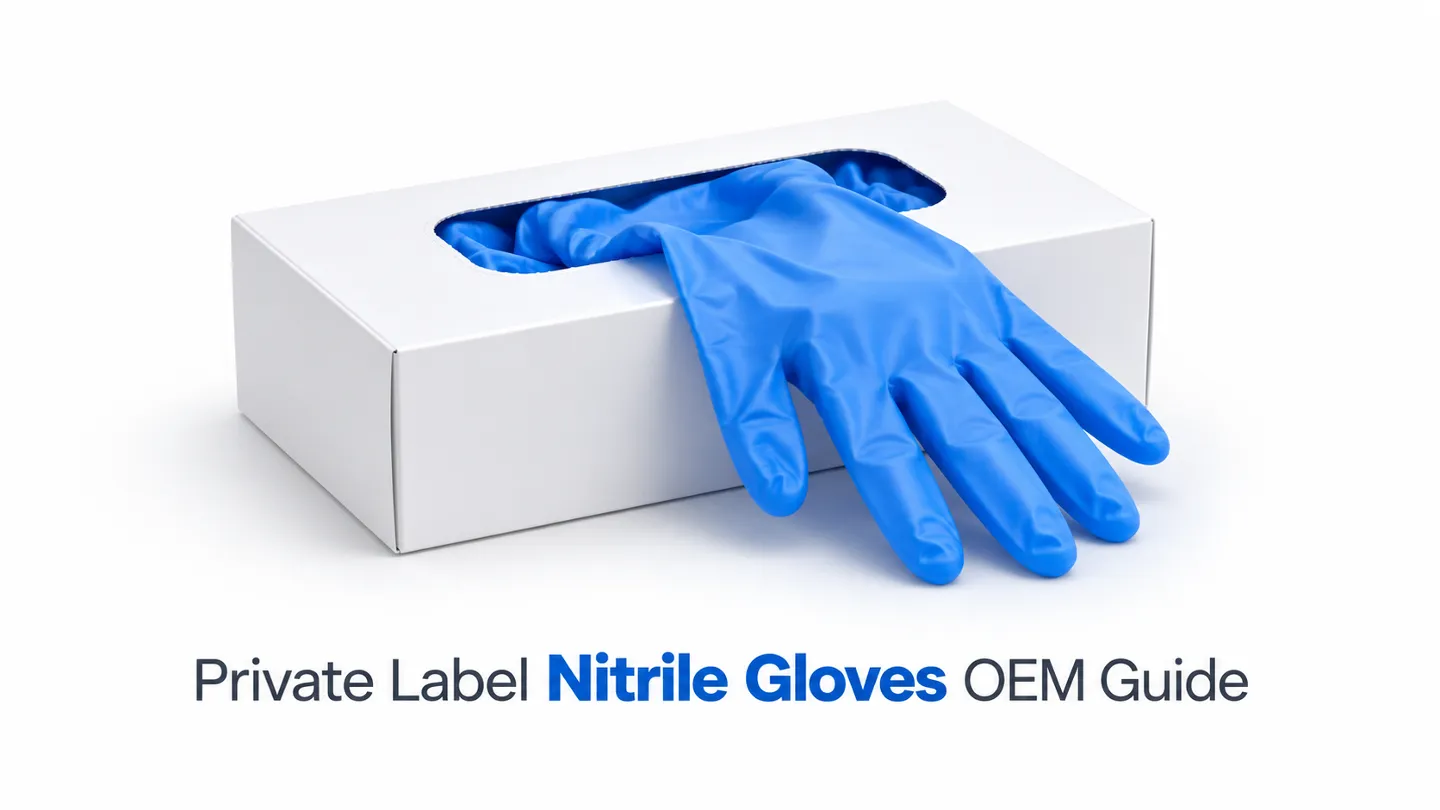
Private Label Nitrile Gloves: The OEM Buying Guide (2026)
- Damao Tech
- Gloves
- 06 Oct, 2026
The margin in disposable gloves is not in the glove — it is in the box. Anyone can buy bulk nitrile gloves. The brands that win retail shelf space and repeat B2B contracts are the ones whose dispenser box a buyer recognizes, whose sizing runs consistent, and whose certifications survive an audit. That is what a private label program buys you, and it is a manufacturing project, not a purchasing one.
This guide walks through that project the way we run it with OEM buyers: glove specification, box and packaging design, the certifications each market actually requires, realistic MOQs, QC that catches problems before the container ships, and how to tell a real manufacturer from a trading company. If you already have artwork and a spec sheet, request a quote and we will return a landed-cost breakdown with samples.
What “Private Label” Actually Covers
Buyers hear “private label” and think “my logo on the box.” The box is maybe a third of the work. A complete private label nitrile glove program has four layers, and weakness in any one of them shows up as a chargeback, a failed inspection, or a customer who does not reorder.
Layer 1 — the glove itself. Thickness, color, texture, powder-free status, sizing, cuff. This is the product your customer’s hands touch, and it is where most private label failures start: a buyer approves a box design around a 5-mil glove and receives a 3-mil glove that tears on the job.
Layer 2 — the dispenser box. Structural design, board grade, print quality, opening mechanism, glove count per box. A retail box that crushes in transit or a dispenser slot that jams will kill a SKU faster than any glove defect.
Layer 3 — compliance. The certifications, test reports, and labeling claims that let the product legally sell in your market — FDA, EU, food-contact declarations. These must be real, current, and in the brand owner’s name where required.
Layer 4 — logistics. Master carton configuration, palletization, barcodes (UPC/EAN), and case markings that survive your distributor’s receiving dock.
A proper OEM partner manages all four as one project. If a supplier only wants to talk about the box artwork, you are talking to a printer, not a glove manufacturer.
Spec the Glove Before the Box
Artwork is exciting; specifications are what get you a consistent product. Lock these before any designer opens a file:
- Thickness (mil). 3–4 mil for food service and light duty, 5–6 mil for industrial and automotive, 7–8+ mil for heavy duty. State whether you mean fingertip or palm — they differ, and ambiguous specs are how you receive thinner gloves than you approved.
- Color. Black hides stains and reads “professional” in food service, tattoo, and automotive. Blue is the medical default. White and purple serve cleanroom and lab. Note that darker pigments can slightly change tensile behavior — confirm test data for the actual color you order.
- Texture. Fully textured (fingertip or full-hand) for wet grip; smooth for lab and clean applications. Diamond texture for maximum grip in heavy-duty lines.
- Powder-free, always. Powdered gloves are effectively dead in most regulated markets. Specify powder-free and chlorinated or polymer-coated for easy donning.
- Sizing and cuff. XS–XL minimum, with 2XL for industrial programs. Beaded cuff for tear resistance during donning. Ask for the manufacturer’s sizing chart in millimeters — “large” varies by factory.
- Single-use, ambidextrous. Standard for disposable programs; say so explicitly so there is no confusion with reusable flocklined lines.
Our premium nitrile gloves line covers 3–8 mil across these colors and textures, which is the usual starting point buyers customize from.
Key Takeaway: Write the glove spec in numbers — mil, millimeters, AQL — not adjectives. “Heavy duty” means nothing on a purchase order; “6.0 mil fingertip, fully textured, beaded cuff” does.
Packaging: The Part Buyers Underestimate
The dispenser box is your brand’s physical presence, and it is also an engineering problem. Here is what the spec needs to cover:
- Box structure. Standard 100-count dispenser boxes are roughly 240 × 120 × 70 mm, but confirm against your actual glove bulk — thicker gloves need a deeper box or a lower count. The dispenser slot must feed one glove at a time without tearing the next.
- Board and print. 300–350 gsm CCNB or kraft for retail; offset print for photographic quality, flexo for cost at volume. If the box lives in a humid warehouse, specify a varnish or lamination.
- Count per box. 100 is the retail standard; 200-count “value” boxes exist for food service. Higher counts in the same box size mean tighter packing and harder dispensing — test it.
- Master carton. Typically 10 boxes per case for 100-count. Specify case dimensions, gross weight, and stacking strength — a case that collapses at the bottom of a pallet is a total loss.
- Barcodes and markings. UPC/EAN per SKU, plus case-level SSCC if your distributor requires it. Country of origin, lot number, and expiry (where applicable) must print on the case, not just the box.
- Retail-ready details. Hang tabs, shelf-ready perforations, and bilingual labeling for markets like Canada — decide these before the dieline is drawn, not after.
Certifications by Market: What You Actually Need
Certification is where private label programs most often stall, because requirements differ by where the glove is sold and what it claims. Get this straight in week one:
- United States. Medical/exam claims require FDA 510(k) clearance — the clearance holder matters, so clarify whether you sell under the manufacturer’s clearance or need your own. Food-contact use falls under FDA 21 CFR. Industrial-only gloves need neither, but cannot make medical claims on the box.
- European Union. Medical gloves need CE marking under the EU Medical Device Regulation with a notified body; a self-declared CE is not enough for exam gloves. PPE claims (chemical resistance) fall under the PPE Regulation with EN standards testing.
- Food service. Look for declarations of compliance with FDA 21 CFR and EU 10/2011 for food-contact materials, plus migration test reports. “Food safe” on a box without test data is a liability.
- What the OEM must provide. Current test reports (not expired), the actual certificates (not thumbnails), and a written statement of which certifications transfer to your private label and which require your own filing. If a supplier cannot produce these before you pay a deposit, walk away.
MOQs and What Drives Cost
Private label MOQs are set by the packaging line as much as the glove line. Typical ranges from an actual manufacturer:
- Glove production. 100,000–500,000 gloves per SKU is a common starting band; the constraint is usually the packaging run, not the dipping line.
- Custom printed boxes. 5,000–10,000 boxes minimum for offset print; digital or flexo can go lower at higher unit cost.
- What moves the price. Thickness (more nitrile per glove), color (black and specialty colors cost more than blue), texture, box board grade and print colors, and count per box. Freight is a major line item — gloves are light but bulky, so quote FOB and CIF separately and compare.
- The sample trap. Free samples are standard, but samples are hand-picked. Always approve a production-run sample — gloves pulled from the actual line run, in your box — before authorizing the full quantity.
Vetting the Manufacturer: The Short Checklist
Most “glove factories” on B2B marketplaces are trading companies. Before you send a deposit:
Green flags:
- Owns dipping lines and will show them on a live video call — not a showroom, the production floor.
- Quotes AQL in writing. 1.5 for medical exam, 2.5–4.0 for industrial are the standard reference points (ISO 2859). A supplier who cannot name their AQL does not run QC.
- Runs pre-shipment inspection and accepts your third-party inspector (SGS, TÜV, Bureau Veritas) without drama.
- Shows current certifications with expiry dates, and explains which transfer to your label.
- Sends a production-run sample in your actual box before full production.
Red flags (any one is a walk-away):
- Cannot explain the difference between their own production and outsourced overflow.
- Quotes without asking thickness, color, or target market.
- “FDA approved” claims without a 510(k) number you can verify.
- Demands 100% upfront. Standard is 30% deposit, balance against inspection or before shipment.
- Box artwork approved but no dieline or physical box proof before the run.
From Artwork to Delivery: A Realistic Timeline
- Week 1–2: Spec lock and quotation. You provide glove spec, box dieline inputs, and target certifications; the factory returns pricing and MOQs.
- Week 3–4: Box design and proofing. Physical box proof (not just a PDF) — check the dispenser slot with real gloves.
- Week 5–6: Pre-production sample. Gloves from the line, in your box, with your lot coding. Approve in writing.
- Week 7–10: Production and inspection. Third-party inspection at the factory before the container is sealed.
- Week 11–14: Ocean freight and customs, depending on your port.
Rush programs compress this to 8 weeks, but only by overlapping proofing and production — which means approving risk, not removing it. Plan a 14-week first order; reorders run 6–8 weeks once tooling and artwork are locked.
Frequently Asked Questions
What is the minimum order for private label nitrile gloves?
For custom printed dispenser boxes, expect 5,000–10,000 boxes minimum for offset printing; the glove quantity behind that is typically 500,000–1,000,000 gloves. Plain boxes with a sticker label can start lower, but that is not really a private label program — it is bulk gloves with your sticker.
Do I need my own FDA 510(k) to sell private label exam gloves in the US?
Not necessarily. Many OEM programs let you sell under the manufacturer’s existing 510(k) clearance as a private label distributor, with your brand on the box. What you cannot do is make medical claims without any clearance behind the product. Confirm the arrangement in writing before you order.
How much does custom box packaging add to the unit cost?
At volume, a custom printed dispenser box typically adds a few cents per box over a plain box — the bigger cost is the MOQ commitment, not the unit price. The real cost driver in the program is glove thickness and order volume, not the artwork.
Can I get black nitrile gloves in food-service grades?
Yes. Black nitrile is standard in food service, BBQ, and tattoo — the color hides stains and reads professional. Make sure the specific black formulation carries food-contact declarations (FDA 21 CFR / EU 10/2011); color pigments vary, so ask for test data on the actual color you are buying.
What is AQL and what should I require?
AQL (Acceptable Quality Limit) is the defect sampling standard from ISO 2859. For disposable gloves, AQL 1.5 is the medical exam standard and 2.5–4.0 covers industrial grades. Require it in writing on the purchase order and have the pre-shipment inspection test to it.
How do I protect my box design from being reused for other buyers?
Put it in the manufacturing agreement: your dielines, artwork, and UPCs are your property, and the factory may not reuse them. Reputable OEMs agree to this routinely. Also register your trademarks in the markets where you sell — a contract clause without a registered mark is hard to enforce.
Ready to build your private label glove line? Browse our premium nitrile gloves, then request a quote — send your spec, your artwork (or just an idea), and your target market, and we will return pricing, MOQs, and a production timeline with physical samples before you commit.